Yes, different solids melt at different rates. While liquids themselves don't melt (they freeze), the solids they form from absolutely melt at varying speeds. This rate is determined by a combination of the material's intrinsic properties and its surrounding environment, not just its melting temperature.
The core reason different substances melt at different rates is not their melting point, but rather the total energy required to first heat the solid to that point and then break apart its molecular structure. This process is governed by properties like latent heat, heat capacity, and thermal conductivity.
The Core Principles of Melting
To understand why a block of ice and a block of lead (of the same size) will melt at different speeds, we need to look beyond the temperature on the thermometer. The process involves several distinct physical properties working together.
Melting Point vs. Melting Rate
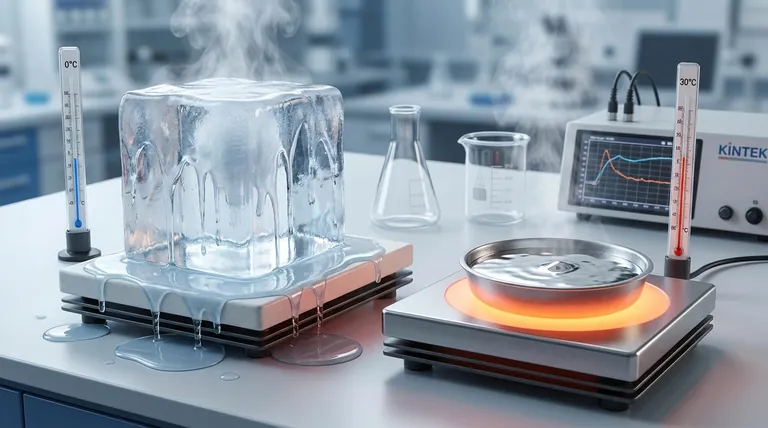
A melting point is the specific temperature at which a solid turns into a liquid. For water, this is 0°C (32°F).
A melting rate is the speed at which this change happens. It describes how much solid turns to liquid over a period of time. Two materials can be at their melting points, but one will melt much faster than the other.
Latent Heat of Fusion: The Hidden Energy Cost
The most critical factor is the latent heat of fusion. This is the amount of "hidden" energy a substance must absorb at its melting point to break the bonds holding its solid structure together.
Think of it as the energy required to tear down a building after you've already gathered all the workers. Some structures are much harder to demolish than others.
A substance with a high latent heat of fusion, like water, requires a tremendous amount of energy to melt. This is why ice is so effective at cooling things—it absorbs a lot of heat from its surroundings as it slowly melts.
Specific Heat Capacity: The Warm-Up Phase
Before a solid can even begin to melt, its temperature must be raised to its melting point. Specific heat capacity is the measure of energy needed to raise the temperature of a substance.
A material with a high specific heat capacity requires more energy (and therefore more time) just to warm up to the point where melting can start.
Thermal Conductivity: How Heat Travels
Thermal conductivity measures how efficiently heat is transferred through a material. For a solid to melt, heat must travel from its outer surface to its interior.
Metals are generally good thermal conductors. Heat quickly spreads throughout a piece of metal, causing it to melt more uniformly and often faster. Ice, on the other hand, is a poor thermal conductor, which is why it tends to melt slowly from the outside in.
External Factors That Control the Rate
A substance's properties are only half the story. The environment plays an equally important role in determining the melting rate.
The Role of Temperature Difference
The greater the temperature difference between the solid and its surroundings, the faster heat will transfer into it. This is why an ice cube melts much faster on a hot summer day than in a cool room.
Surface Area to Volume Ratio
This is a crucial factor. A large, solid block of a substance will melt much more slowly than the same amount of that substance crushed into small pieces.
The crushed pieces have a much higher surface-area-to-volume ratio. This exposes more of the material to the warmer environment, dramatically increasing the rate of heat absorption and melting.
The Influence of Mass
This is straightforward: a larger mass of a substance will take longer to melt than a smaller mass, assuming all other conditions are identical. There is simply more material that needs to absorb the necessary energy for the phase change.
Common Pitfalls and Misconceptions
Understanding these principles helps us avoid common errors in thinking about the melting process.
Misconception: "Melting Point Determines Melting Speed"
This is the most common mistake. A substance with a low melting point does not automatically melt quickly. Gallium, for example, melts in your hand (melting point of 29.8°C / 85.6°F) but can take a while because of its specific heat and latent heat properties.
The "Liquid" vs. "Solid" Clarification
It's a technical but important point: solids melt to become liquids, and liquids freeze (or solidify) to become solids. The original question is best understood as "Why do different solids melt at different rates?"
How to Apply This to Your Goal
Your approach to controlling melting depends entirely on what you want to achieve.
- If your primary focus is to melt something as quickly as possible: Maximize its surface area (crush it or break it up) and increase the temperature of the surrounding environment.
- If your primary focus is to keep something frozen for as long as possible: Use a large, single block to minimize the surface-area-to-volume ratio and insulate it from the warmer environment.
- If you are comparing two different materials: Look beyond the melting point and consider their latent heat of fusion and thermal conductivity to predict their melting behavior.
Ultimately, the rate of melting is a dynamic interplay between a material's inherent resistance to change and the environmental forces acting upon it.
Summary Table:
| Key Factor | What It Measures | Impact on Melting Rate |
|---|---|---|
| Latent Heat of Fusion | Energy to break solid bonds at melting point | Higher latent heat = Slower melting |
| Specific Heat Capacity | Energy to raise temperature to melting point | Higher heat capacity = Slower warm-up |
| Thermal Conductivity | Efficiency of heat transfer through material | Higher conductivity = Faster, more uniform melting |
| Surface Area to Volume Ratio | Amount of material exposed to heat source | Higher ratio = Faster melting |
| Temperature Difference | Gap between solid and surroundings | Larger difference = Faster melting |
Need precise control over melting processes in your lab? KINTEK specializes in lab equipment and consumables designed for accurate thermal management. Whether you're working with high-latent-heat materials or require uniform heating, our solutions ensure reliable results. Contact us today to optimize your lab's efficiency and achieve consistent outcomes!
Visual Guide

Related Products
- Laboratory Muffle Oven Furnace Bottom Lifting Muffle Furnace
- 1800℃ Muffle Oven Furnace for Laboratory
- 1400℃ Muffle Oven Furnace for Laboratory
- 1700℃ Muffle Oven Furnace for Laboratory
- 1400℃ Laboratory Quartz Tube Furnace with Alumina Tube Tubular Furnace
People Also Ask
- What hazard is involved when using a furnace? Protect Your Home from the Silent Killer
- What is the temperature limit on a muffle furnace? A Guide to Selecting the Right Model
- At what temperature is it safe to open a muffle furnace? A Guide to Preventing Injury and Equipment Damage
- What affects the melting point of a substance? Uncover the Key Factors & Forces
- What is the burnout cycle on a furnace? Stop This Destructive Overheating Pattern Now