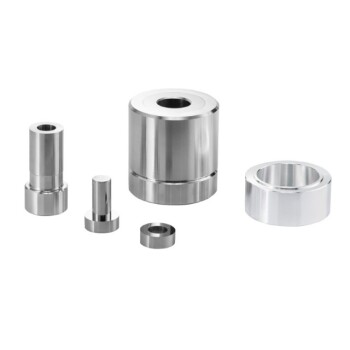
Measuring the electrical conductivity of Cobalt Phosphide (CoP) powder requires a two-step process involving mechanical compaction and precision electronic probing. The hydraulic pellet press compresses the loose powder into a dense, uniform disk to minimize inter-particle voids and inter-particle contact resistance. Subsequently, a four-probe tester applies a controlled current and measures the voltage drop across the sample, utilizing an independent probe configuration to isolate and calculate the material's true bulk resistivity.
To accurately measure the intrinsic conductivity of a powder like CoP, you must transform the loose material into a solid-state equivalent. The pellet press ensures physical continuity between particles, while the four-probe method removes the electrical "noise" caused by probe-to-sample contact.
The Role of the Hydraulic Pellet Press
Eliminating Inter-Particle Voids
Loose CoP powder is filled with air gaps that act as insulators, making direct measurement impossible. The hydraulic press applies high mechanical pressure—often ranging from 15 MPa to 20 MPa—to force these particles into a dense, cohesive unit.
Standardizing Sample Geometry
For conductivity calculations to be accurate, the sample must have a defined geometric volume. The press creates a uniform disk with specific diameter and thickness (often around 0.4 mm), which allows the tester to convert resistance measurements into standardized resistivity units.
Minimizing Contact Resistance
By compressing the powder, the press reduces the grain boundary resistance between individual CoP nanoparticles. This ensures that the electrical current flows through the material itself rather than jumping across gaps between loose grains.
The Mechanism of the Four-Probe Tester
Independent Current and Voltage Circuits
Traditional two-probe setups suffer from "contact resistance" where the probe meets the sample, which can skew results. The four-probe tester uses two outer probes to provide a constant current and two inner probes to measure the voltage drop.
Isolating Bulk Resistivity
Because the voltage probes draw almost no current, the resistance at the probe-to-pellet interface does not affect the voltage reading. This configuration allows the technician to measure the true bulk resistivity of the CoP, reflecting its intrinsic electronic transmission capability.
Evaluating Material Enhancements
This measurement is frequently used to determine how phosphidation treatments improve the performance of a catalyst. By comparing conductivity before and after treatment, researchers can quantify the enhancement in electronic conduction.
Understanding the Trade-offs and Pitfalls
Pressure-Dependent Conductivity
The conductivity of a powder pellet is highly sensitive to the pressure applied during the pressing stage. If the pressure is too low, the pellet remains porous; if it is too high, you may induce structural changes in the CoP crystals.
The Influence of Binders
In some cases, a small amount of PTFE binder is added to help the powder hold its shape. While this creates a more stable pellet, the binder is non-conductive and can slightly lower the recorded conductivity compared to a pure powder sample.
Surface Uniformity Issues
The four-probe method assumes a perfectly flat surface for all four contact points. Any surface irregularities or cracks in the pellet caused by improper pressing will lead to inconsistent readings and poor data reproducibility.
How to Apply This to Your Project
Making the Right Choice for Your Goal
- If your primary focus is material benchmarking: Use a consistent pressure (e.g., 20 MPa) for all samples to ensure that variations in conductivity are due to the material chemistry rather than the compaction state.
- If your primary focus is electrode performance: Simulate the actual compaction density of your battery or catalyst layer by adjusting the hydraulic press to match the mechanical conditions of your final device.
- If your primary focus is identifying intrinsic limits: Perform a series of measurements at increasing pressures to find the "saturation point" where the conductivity no longer increases, indicating the voids have been fully eliminated.
By integrating precise mechanical preparation with isolated electrical probing, you can transform a volatile powder into a quantifiable data point for high-performance material development.
Summary Table:
| Tool | Primary Function | Benefit for CoP Analysis |
|---|---|---|
| Hydraulic Pellet Press | Compresses loose powder into a dense, uniform disk | Eliminates air voids and minimizes inter-particle contact resistance. |
| Four-Probe Tester | Uses independent current and voltage circuits | Isolate and calculates true bulk resistivity by removing probe contact noise. |
| Geometric Standards | Ensures consistent sample thickness (~0.4 mm) | Allows for accurate conversion of resistance to standardized resistivity units. |
Elevate Your Material Research with KINTEK’s Precision Equipment
Achieving accurate conductivity data for materials like Cobalt Phosphide (CoP) requires high-performance sample preparation and testing tools. KINTEK specializes in providing laboratory solutions that ensure consistency and reliability in every measurement.
Our extensive portfolio includes:
- Hydraulic Presses: Advanced manual, pellet, and isostatic presses for perfect sample compaction.
- Material Processing: High-efficiency crushing, milling, and sieving systems for uniform powder preparation.
- Thermal & Chemical Synthesis: High-temperature furnaces (CVD, vacuum, muffle) and high-pressure reactors for CoP synthesis.
- Essential Consumables: Premium PTFE products, high-purity ceramics, and crucibles.
Whether you are optimizing catalyst performance or developing next-generation battery tools, KINTEK offers the technical expertise and reliable supply chain you need to succeed.
Ready to upgrade your lab? Contact KINTEK Experts Today to find the ideal equipment for your specific application!
References
- Xinwu Xu, Yibo He. Corrosion-resistant cobalt phosphide electrocatalysts for salinity tolerance hydrogen evolution. DOI: 10.1038/s41467-023-43459-w
This article is also based on technical information from Kintek Solution Knowledge Base .
Related Products
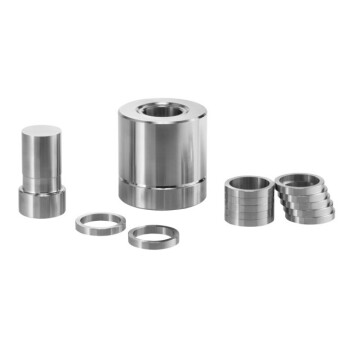
- XRF & KBR steel ring lab Powder Pellet Pressing Mold for FTIR
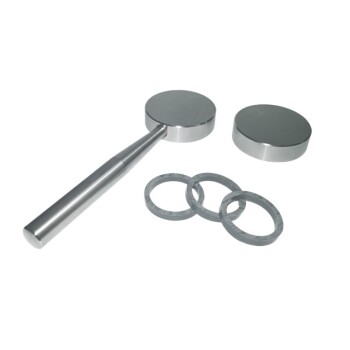
- XRF & KBR plastic ring lab Powder Pellet Pressing Mold for FTIR
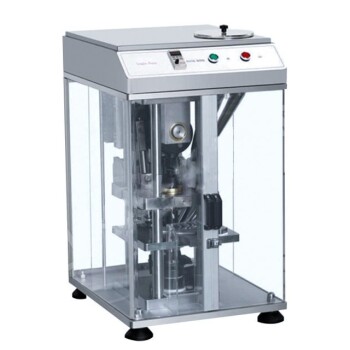
- Automatic Laboratory Hydraulic Pellet Press Machine for Lab Use
- Laboratory Hydraulic Pellet Press for XRF KBR FTIR Lab Applications
- Laboratory Manual Hydraulic Pellet Press for Lab Use
People Also Ask
- What is the purpose of using a mold for pellet pressing when preparing catalyst test samples? Ensure Data Consistency
- What are the advantages of using the pressed pellet method for XRF sample preparation? Optimize Your XRF Analysis
- What is the pressed powder pellet method? A Guide to Accurate FTIR Sample Preparation
- How does the selection of a pressure mold affect the performance of all-solid-state batteries? Expert Pelletizing Guide
- What are the different types of XRF samples? A Guide to Solid, Powder, and Liquid Prep