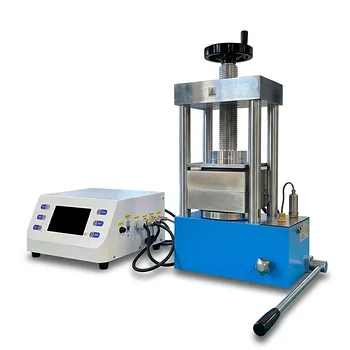
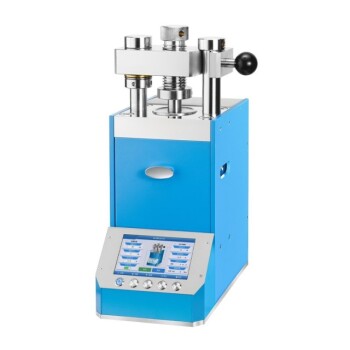
A laboratory hydraulic press facilitates the cold welding of silver nanowires by applying precise mechanical pressure, typically around 25 MPa, to the nanowire network. This room-temperature process forces the nanowire junctions to fuse through atomic rearrangement, significantly lowering electrical resistance without the need for thermal annealing.
By replacing thermal energy with mechanical force, you can fuse silver nanowire junctions at room temperature. This method protects heat-sensitive substrates while simultaneously flattening the film surface, making it ideal for the integration of multi-layer electronic devices.
The Mechanism of Mechanical Cold Welding
Replacing Heat with Pressure
Standard annealing requires heat to fuse nanowire junctions, which can degrade delicate substrates.
A hydraulic press circumvents this by using physical compression to drive the "cold welding" process. The pressure forces the nanowires into intimate contact, overcoming the energy barrier required for fusion.
Atomic Rearrangement
At the junction points where nanowires intersect, the applied pressure induces atomic rearrangement.
This process exploits nanoscale capillary forces and the material's plasticity. The silver atoms at the interface migrate and bond, effectively merging two distinct wires into a single conductive pathway.
Critical Performance Benefits
Reducing Contact Resistance
The primary goal of this process is to minimize the electrical resistance found at the junctions of the nanowire network.
Loose junctions impede electron flow. By physically welding these junctions, the hydraulic press ensures a continuous electrical path, drastically improving the overall conductivity of the film.
Enhancing Surface Planarity
Silver nanowire networks often have a rough surface profile due to the stacking of wires.
The vertical pressure from the hydraulic press compresses the network, resulting in a significantly flatter film surface. This smoothness is essential for preventing electrical shorts when stacking subsequent layers in multi-layer device integration.
Compatibility with Sensitive Substrates
Many modern electronics utilize flexible plastic or polymer substrates that cannot withstand high temperatures.
Because the hydraulic press operates at room temperature, it allows for the fabrication of high-performance conductive films on heat-sensitive materials without risk of warping or melting.
Understanding the Trade-offs
Precision is Paramount
While the reference suggests 25 MPa, the pressure must be calibrated carefully.
Insufficient pressure will fail to induce cold welding, leaving high contact resistance. Conversely, excessive pressure risks crushing the nanowires or damaging the underlying substrate structure.
Batch Processing Limitations
A laboratory hydraulic press is inherently a batch-processing tool.
While excellent for research, prototyping, and small-scale fabrication, this method may require adaptation for high-volume, continuous roll-to-roll manufacturing environments.
Optimizing Your Fabrication Process
To maximize the utility of a hydraulic press for silver nanowire applications, align your approach with your specific device requirements:
- If your primary focus is flexible electronics on polymers: Utilize this cold welding technique to achieve high conductivity without exposing your substrate to damaging thermal cycles.
- If your primary focus is complex, multi-layer devices: Leverage the flattening effect of the press to create a smooth base layer that prevents shorts in subsequent component stacks.
By controlling mechanical pressure, you transform a loose network of wires into a cohesive, high-performance conductive film.
Summary Table:
| Feature | Thermal Annealing | Mechanical Cold Welding (Hydraulic Press) |
|---|---|---|
| Operating Temperature | High Heat (Risk to Substrates) | Room Temperature (Substrate Safe) |
| Bonding Mechanism | Thermal Diffusion | Atomic Rearrangement via Pressure |
| Surface Finish | Remains Rough | Flattened & Planarized |
| Pressure Required | N/A | Typically ~25 MPa |
| Electrical Resistance | Reduced | Significantly Minimized |
Elevate Your Material Research with KINTEK Precision
Unlock the full potential of your silver nanowire applications with KINTEK’s high-performance laboratory hydraulic presses (pellet, hot, and isostatic). Designed for precision and reliability, our equipment ensures the exact pressure control necessary for successful cold welding and material synthesis.
From high-temperature furnaces and crushing systems to high-pressure reactors and advanced battery research tools, KINTEK provides a comprehensive range of laboratory solutions tailored for researchers and manufacturers. Don't compromise on your thin-film conductivity—contact us today to find the perfect press for your lab's specific needs!
References
- Longxia Yang, Haicheng Wang. Silver Nanowires: From Synthesis, Growth Mechanism, Device Fabrications to Prospective Engineered Applications. DOI: 10.30919/es8d808
This article is also based on technical information from Kintek Solution Knowledge Base .
Related Products
- Automatic Laboratory Hydraulic Press for XRF & KBR Pellet Press
- Ball Press Mold for Lab
- Automatic Laboratory Hydraulic Pellet Press Machine for Lab Use
- Laboratory Manual Hydraulic Pellet Press for Lab Use
- Laboratory Hydraulic Press Split Electric Lab Pellet Press
People Also Ask
- What is the significance of applying 200 MPa of pressure with a laboratory hydraulic pellet press for composite ceramics?
- What is the role of a laboratory hydraulic pellet press and stainless steel molds in the fabrication of RuO2/NbC anodes?
- What is the necessity of using a laboratory hydraulic pellet press in the preparation of biomass fuel pellets? Guide
- How does a laboratory hydraulic pellet press contribute to SiCw/2024 aluminum composite preforms? Optimize Densification
- What role does a laboratory hydraulic pellet press play in fly ash utilization? Enhancing Adsorption and Flow Control