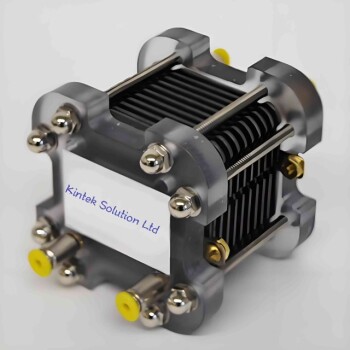
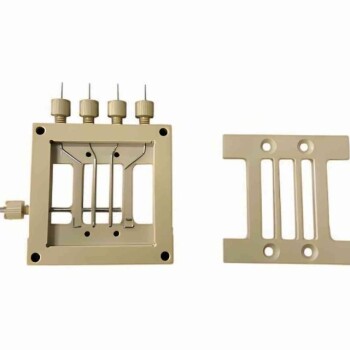
The DC power supply and electrolytic cell form the fundamental engine of the Electrophoretic Deposition (EPD) process. They function together to establish a constant electric field that drives charged particles—specifically graphene oxide—onto carbon fibers. By manipulating the energy input within this system, you gain direct control over the physical architecture and mechanical performance of the resulting nanocoating.
Core Takeaway Success in EPD relies on the precise calibration of the electric field generated by these components. By regulating the voltage and duration of the current, you dictate the thickness and uniformity of the coating, which is the primary determinant of the composite's Interfacial Shear Strength (IFSS).
Establishing the Driving Force
To understand how these components affect your results, you must first understand the mechanism they create. The hardware does not just supply power; it creates the specific environment required for migration.
The Role of the Electrolytic Cell
The cell serves as the vessel for the reaction, where the carbon fibers are positioned to act as electrodes.
This setup allows charged graphene oxide particles to be suspended in a solution, ready for mobilization.
The Role of the DC Power Supply
The power supply is responsible for generating a constant electric field across the cell.
This field acts as the invisible force that physically pulls the charged particles out of suspension and deposits them onto the fiber surface.
Regulating Coating Properties
The primary value of using a DC power supply in an electrolytic system is the ability to exert quantitative control over the deposition. You are not guessing; you are engineering the surface.
Controlling Thickness and Coverage
By adjusting the power-on time, you control exactly how long the deposition process lasts.
This allows you to determine the total accumulation of material, defining the specific thickness of the nanocoating.
Ensuring Uniformity
The stability of the DC voltage ensures that the driving force remains consistent throughout the process.
This consistency leads to a uniform coating layer, avoiding the irregularities that occur with unstable power sources.
Translating Process to Performance
The physical changes to the fiber surface (thickness and uniformity) directly alter the mechanical properties of the final composite material.
The Impact on Interfacial Shear Strength (IFSS)
The ultimate measure of EPD success is the bond strength between the carbon fiber and the resin matrix.
By using the power supply to create an optimal coating, you significantly improve the Interfacial Shear Strength (IFSS).
Optimizing the Interface
A uniform nanocoating acts as a bridge, facilitating better stress transfer between the fiber and the resin.
Precise regulation of the system parameters ensures this bridge is robust rather than weak or brittle.
Understanding the Trade-offs
While the EPD system offers high control, it requires strict adherence to parameters. The relationship between input and output is direct, meaning errors are amplified.
The Balance of Thickness
While you can increase coating thickness by extending power-on time, a thicker coating is not automatically better.
You must find the specific window where the coating is thick enough to provide coverage but thin enough to maintain structural integrity.
Sensitivity to Voltage Regulation
The system relies on precise regulation.
Fluctuations in DC voltage can lead to uneven electric fields, resulting in patchy coverage that compromises the IFSS.
Making the Right Choice for Your Goal
To maximize the effectiveness of your EPD system for carbon fiber modification, tailor your settings to your specific requirements.
- If your primary focus is mechanical performance: Prioritize voltage and time settings that have been tested to yield the highest Interfacial Shear Strength (IFSS).
- If your primary focus is geometric precision: Focus on the strict regulation of power-on time to achieve specific, reproducible nanocoating thickness specifications.
Ultimately, the DC power supply and electrolytic cell are not just delivery mechanisms; they are the tuning knobs that define the quality of your material's interface.
Summary Table:
| System Component | Primary Function | Impact on Result |
|---|---|---|
| Electrolytic Cell | Reaction Vessel & Electrode Holder | Establishes the environment for particle suspension and mobilization. |
| DC Power Supply | Electric Field Generation | Controls the driving force, ensuring consistent particle migration. |
| Voltage Regulation | Intensity Control | Determines the uniformity and density of the deposited nanocoating. |
| Power-on Time | Duration Control | Directly dictates the total accumulation and thickness of the coating layer. |
Elevate Your Material Research with KINTEK Precision
Unlock the full potential of your Electrophoretic Deposition (EPD) processes. At KINTEK, we specialize in providing high-performance laboratory equipment tailored for advanced material science. Whether you are optimizing electrolytic cells and electrodes for carbon fiber modification or require precise thermal control with our muffle, vacuum, or CVD furnaces, we deliver the reliability your research demands.
From high-pressure reactors to specialized battery research tools and PTFE consumables, KINTEK is your partner in engineering superior material interfaces and achieving peak Interfacial Shear Strength (IFSS).
Ready to refine your laboratory setup? Contact our technical experts today to find the perfect solution for your specific application.
References
- John Keyte, James Njuguna. Recent Developments in Graphene Oxide/Epoxy Carbon Fiber-Reinforced Composites. DOI: 10.3389/fmats.2019.00224
This article is also based on technical information from Kintek Solution Knowledge Base .
Related Products
- Quartz Electrolytic Electrochemical Cell for Electrochemical Experiments
- PTFE Electrolytic Cell Electrochemical Cell Corrosion-Resistant Sealed and Non-Sealed
- Electrolytic Electrochemical Cell for Coating Evaluation
- Electrolytic Electrochemical Cell with Five-Port
- Customizable PEM Electrolysis Cells for Diverse Research Applications
People Also Ask
- Why is a quartz electrolytic cell used for acrylic acid wastewater? Ensure Chemical Stability & Data Integrity
- How does the design of an electrochemical electrolytic cell influence the coating uniformity? Optimize Your Catalysts
- What are the key features of quartz that make it suitable for electrolytic cells? Discover the 4 Pillars of Superior Performance
- What is the correct shutdown and disassembly procedure after an experiment? Ensure Safety and Protect Your Equipment
- How do the electrochemical cell and three-electrode testing system collaborate? Optimize Zinc Anode Deposition Control