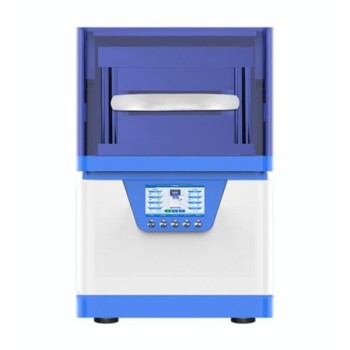
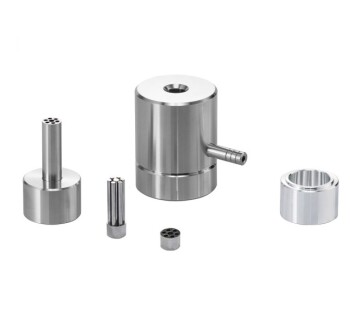
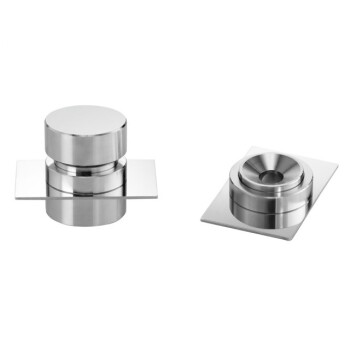
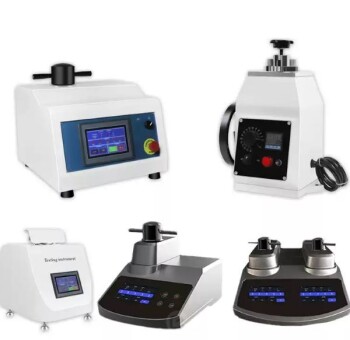
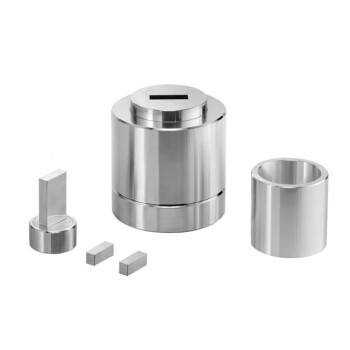
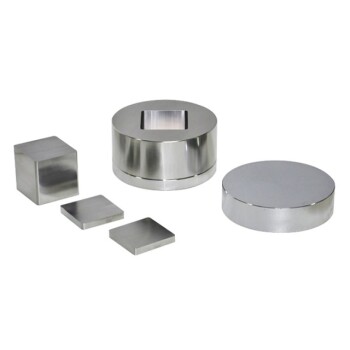
High-precision laboratory presses are the critical catalyst for unlocking ductility in tungsten alloys. By applying strictly controlled compression to pre-consolidated materials at elevated temperatures, these systems induce superplastic deformation, effectively eliminating residual porosity and optimizing the microstructure to achieve performance levels that standard powder metallurgy cannot reach alone.
The laboratory press serves as a precise instrument for Grain Boundary Sliding Microstructural Modification (GSMM), transforming tungsten from a notoriously brittle metal into one capable of room-temperature ductility.
The Mechanics of Microstructural Modification
To understand how a laboratory press improves tungsten, one must look beyond simple compaction. The process targets the fundamental limitations of the material's grain structure.
Inducing Superplastic Deformation
The primary role of the press is to subject the alloy to controlled compression at specific temperatures.
This mechanical stress forces the material into a state of superplasticity.
In this state, the grains can slide past one another—a phenomenon known as Grain Boundary Sliding—rather than fracturing under stress.
Eliminating Residual Defects
Standard tungsten manufacturing, often involving powder metallurgy, frequently leaves behind microscopic voids.
The high-precision press applies force that physically closes these residual pores.
By densifying the material further than sintering alone, the press removes the stress concentrators that typically lead to early material failure.
Optimizing Grain Boundary Chemistry
The performance of tungsten alloys is largely dictated by what happens at the edges of the grains. The press uses thermal and mechanical energy to manipulate these boundaries.
Controlling Precipitate Distribution
The GSMM process encourages the precipitation and specific segregation of secondary phases, particularly titanium carbide (TiC).
The press ensures these precipitates settle at the grain boundaries rather than randomly throughout the matrix.
Enhancing Adhesion and Ductility
By optimizing the location of TiC and other phases, the process significantly enhances grain boundary adhesion.
This stronger bonding lowers the yield stress required to deform the material.
The ultimate result is a dramatic reduction in the ductile-to-brittle transition temperature (DBTT), allowing the alloy to remain ductile even at room temperature.
Understanding the Trade-offs
While high-precision pressing offers superior material properties, it is essential to recognize the constraints of this method.
Processing Complexity
GSMM is a secondary processing step that requires pre-consolidated material.
It adds time and complexity compared to single-step sintering, requiring precise synchronization of temperature and pressure.
Volume Limitations
Laboratory presses are generally designed for sample-scale or small-batch processing.
While they are ideal for achieving peak material performance and research validation, scaling this precise mechanic-thermal control to industrial mass production presents significant engineering challenges.
Making the Right Choice for Your Goal
The decision to utilize a high-precision press for GSMM depends on the specific mechanical demands of your application.
- If your primary focus is Room-Temperature Ductility: Implement the GSMM process to lower the ductile-to-brittle transition temperature and prevent catastrophic fracture during handling.
- If your primary focus is Defect Elimination: Use the press to apply controlled compression for the removal of residual pores left by powder metallurgy.
Success in modifying tungsten alloys lies not just in applying pressure, but in the precise orchestration of heat and force to rewrite the material's microstructural rules.
Summary Table:
| Feature | Impact on Tungsten Alloy (GSMM) | Benefit to Material Performance |
|---|---|---|
| Controlled Compression | Induces Grain Boundary Sliding | Enables superplasticity and high ductility |
| Porosity Removal | Closes microscopic residual voids | Increases density and reduces stress failure |
| Precipitate Control | Segregates TiC to grain boundaries | Lowers DBTT for room-temperature flexibility |
| Thermal Precision | Synchronized heat and mechanical force | Optimizes microstructure beyond standard sintering |
Elevate Your Material Research with KINTEK Precision
Unlock the full potential of your tungsten alloys and advanced materials with KINTEK’s high-precision laboratory presses. Our specialized pellet, hot, and isostatic presses provide the exact mechanical-thermal control required for Grain Boundary Sliding Microstructural Modification (GSMM), transforming brittle samples into ductile, high-performance materials.
From high-temperature furnaces and crushing systems to high-pressure reactors and autoclaves, KINTEK provides researchers and manufacturers with the comprehensive toolset needed for breakthrough results.
Ready to eliminate defects and enhance grain boundary adhesion in your lab? Contact our technical experts today to find the perfect pressing solution for your application.
References
- Ch. Linsmeier, Zhangjian Zhou. Development of advanced high heat flux and plasma-facing materials. DOI: 10.1088/1741-4326/aa6f71
This article is also based on technical information from Kintek Solution Knowledge Base .
Related Products
- Automatic Laboratory Heat Press Machine
- Special Shape Press Mold for Lab
- Laboratory High Pressure Steam Sterilizer Vertical Autoclave for Lab Department
- Mini SS High Pressure Autoclave Reactor for Laboratory Use
- Automatic Heated Hydraulic Press Machine with Heated Plates for Laboratory Hot Press
People Also Ask
- What are the core advantages of using a laboratory hot press to produce Bi2Se3? Achieve 93% Density & High Conductivity
- Why is a laboratory hot press necessary for all-solid-state battery assembly? Reduce Impedance and Enhance Performance
- How does a three-stage pressure program affect rice husk particleboards? Optimize Bond Strength & Stability
- What is the primary function of a laboratory hot press in MEA assembly? Optimize Fuel Cell Bonding & Performance
- How does a laboratory hot press improve alloy performance? Optimize Liquid Phase Sintering for High-Strength Materials