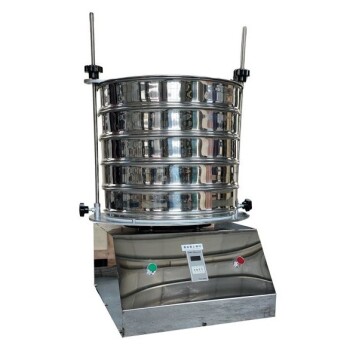
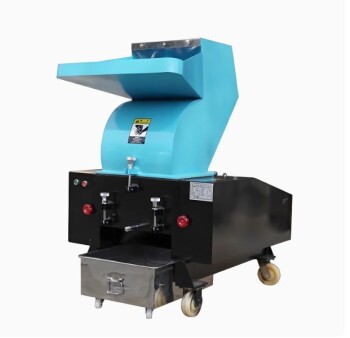
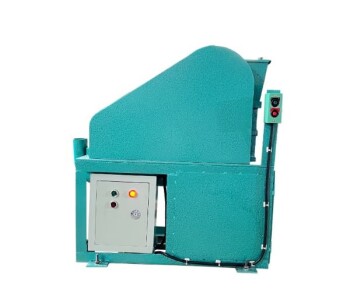
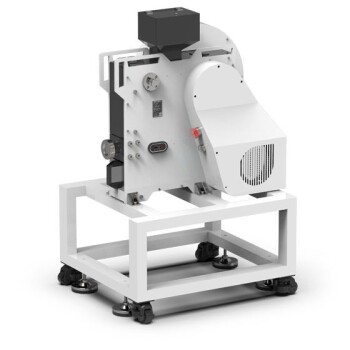
Mechanical crushing and sieving function as a synchronized reduction and classification system. The crushing equipment employs grinding and impact forces to fracture large high-entropy alloy ingots into coarse particulates. Immediately following this, the sieving system acts as a quality control gate, filtering the output through specific mesh sizes to ensure all particles meet a strict size threshold—typically below 300 μm—before further processing.
While crushing provides the brute force necessary to break down bulk ingots, the sieving system provides the precision required for downstream success. This combination is not just about reducing size; it is about creating a consistent particle baseline that ensures uniform mixing, high density, and a homogeneous microstructure in the final material.
The Mechanics of the Two-Stage Process
The transformation of a solid ingot into a usable powder relies on a sequential relationship between destruction and selection.
Stage 1: Mechanical Reduction
The process begins with mechanical crushing equipment. This machinery utilizes grinding and impact forces to attack the structural integrity of the high-entropy alloy ingot.
The objective here is strictly volume reduction. The equipment breaks the large, solid ingot down into smaller, manageable fragments that can be processed further.
Stage 2: Precision Classification
Once the material is fractured, the sieving system takes over. This step involves passing the crushed material through screens with specific mesh sizes.
This classifies the powder by strictly controlling the particle size. As noted in standard high-entropy alloy processing, the goal is often to filter the material to below 300 μm.
The Feedback Loop
Any material that does not pass through the sieve is typically identified as too large. In many systems, this oversize material would be rejected or returned to the crushing stage for further refinement, ensuring no material is wasted.
Why This Synergy is Critical
The collaboration between crushing and sieving solves the "Deep Need" of material consistency. Without this strict control, the subsequent stages of manufacturing would likely fail.
Enabling Mechanical Alloying
The output of this system is the input for the mechanical alloying stage.
If the starting particles are too large or irregular, the alloying process becomes inefficient. A pre-refined particle size (<300 μm) ensures the mechanical alloying equipment can operate effectively from the start.
Ensuring Uniform Distribution
Consistency in particle size is essential for the mixing stages that follow.
Specifically, if you are introducing nano-oxide particles into the alloy, the base powder must be uniform. Large, irregular chunks of alloy would prevent these nano-particles from distributing evenly, leading to weak points in the material.
Eliminating Agglomeration
The sieving process also serves to break up or remove agglomerations (clumps of particles).
By filtering the crushed product, the system ensures that the powder remains loose and free-flowing. This is a prerequisite for achieving a homogeneous mix.
Understanding the Trade-offs
While this process is effective, it is important to understand the implications of the size targets you select.
The Density Correlation
The uniformity achieved by sieving has a direct impact on the final bulk material.
In subsequent stages, such as hot pressing sintering, a uniform particle size distribution is critical. It allows for tighter packing of particles, resulting in high density and a homogeneous microstructure.
The Risk of Poor Classification
If the sieving process is skipped or mesh sizes are inconsistent, the final product suffers.
Inconsistent particle sizes lead to segregation during mixing. This results in a final material with uneven properties, potential voids, and unpredictable mechanical strength.
Making the Right Choice for Your Goal
When configuring your crushing and sieving line, your specific end-goal should dictate your parameters.
- If your primary focus is Uniform Mixing: Ensure your sieving system is strictly calibrated (e.g., <300 μm) to facilitate the even distribution of secondary phases like nano-oxide particles.
- If your primary focus is Final Density: Prioritize the elimination of agglomerates during sieving to ensure the homogeneous microstructure required for successful hot pressing sintering.
The precise coordination of mechanical force and mesh classification is the single most important factor in preparing high-entropy alloys for advanced manufacturing.
Summary Table:
| Process Stage | Core Mechanism | Key Objective | Targeted Outcome |
|---|---|---|---|
| Mechanical Crushing | Grinding & Impact Forces | Volume Reduction | Coarse particulates from bulk ingots |
| Sieving System | Mesh Filtration | Precision Classification | Particles <300 μm; elimination of clumps |
| Feedback Loop | Recirculation | Quality Control | Re-processing of oversize material |
| Downstream Impact | Material Synergy | Consistency | Uniform mixing & high-density microstructure |
Elevate Your Material Research with KINTEK Precision Solutions
Consistency is the foundation of high-performance alloy development. At KINTEK, we specialize in providing the high-precision crushing and milling systems and sieving equipment necessary to transform high-entropy alloy ingots into uniform, high-quality powders.
Why partner with KINTEK?
- Optimized Particle Size: Achieve the strict thresholds (e.g., <300 μm) required for successful mechanical alloying and sintering.
- Comprehensive Lab Portfolio: From hydraulic presses and high-temperature furnaces to advanced battery research tools and ceramic consumables, we provide everything needed for a seamless workflow.
- Expert Guidance: Our equipment is designed to ensure the homogeneous microstructure and high density your advanced materials demand.
Ready to refine your production process? Contact our technical experts today to find the perfect crushing and sieving solution for your laboratory.
References
- І.V. Kolodiy, V. S. Okovit. MICROSTRUCTURE AND MECHANICAL PROPERTIES OF OXIDE DISPERSION STRENGTHENED HIGH-ENTROPY ALLOYS CoCrFeMnNi AND CrFe2MnNi. DOI: 10.46813/2021-132-087
This article is also based on technical information from Kintek Solution Knowledge Base .
Related Products
- Laboratory Test Sieves and Sieving Machines
- Powerful Plastic Crusher Machine
- Sealed Jaw Crusher High Efficiency Environmental Protection Safe and Reliable
- Three-dimensional electromagnetic sieving instrument
- Laboratory Jaw Crusher
People Also Ask
- What are laboratory test sieves used for? A Guide to Particle Size Analysis
- How do you calculate the sieve test? Master Particle Size Distribution for Quality Control
- How does a lab test sieve contribute to biomass charcoal powder preparation? Achieve Uniform Particle Size
- What are the specifications for test sieves? A Guide to ASTM & ISO Standards for Accurate Particle Analysis
- What materials are required for sieving? Achieve Accurate Particle Size Analysis