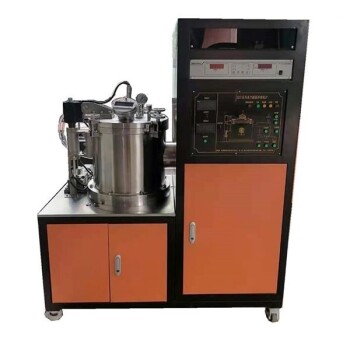
Specialized small-scale induction furnaces address the specific challenges of jewelry casting by integrating high-efficiency heating with rigorous environmental controls. Designed for difficult materials like platinum alloys, these units prevent oxidation and ensure the molten metal maintains optimal fluidity, directly improving surface finish and minimizing costly metal loss.
By mitigating high-temperature oxidation and ensuring consistent flow characteristics, industrial-grade induction furnaces transform the processing of volatile precious metals from a risky variable into a controlled, repeatable standard.
Solving the Material Science Challenges
To understand the value of these furnaces, one must look beyond simple heating. The core value lies in how they manage the physical properties of sensitive alloys during the transition from solid to liquid.
Mastering High Melting Points
Standard melting equipment often struggles with the extreme thermal requirements of high-grade jewelry materials. Specialized induction units are engineered to reach the high melting points necessary for alloys such as 95% platinum mixed with copper, cobalt, or ruthenium.
Eliminating Oxidation Risks
At high temperatures, precious metals become highly reactive to oxygen. These furnaces mitigate oxidation susceptibility by strictly controlling the atmospheric conditions within the melting chamber. This preservation of chemical integrity is critical for preventing structural weaknesses in the final piece.
Ensuring Complex Mold Filling
Jewelry designs are becoming increasingly intricate, requiring the metal to flow into microscopic details. By maintaining precise temperature control, these furnaces ensure the alloy retains optimal flow properties. This allows the melt to fill complex molds completely before solidifying.
Reducing Precious Metal Loss
Inefficiency in melting leads to waste, which is financially devastating when working with platinum. By improving surface quality and preventing defects, these specialized furnaces significantly reduce the loss rate of precious metals during the casting and finishing processes.
Understanding the Operational Considerations
While these devices solve critical problems, they introduce specific requirements that must be managed to ensure success.
Specificity vs. Flexibility
These furnaces are often optimized for specific casting alloys. A machine calibrated for the high-temperature requirements of platinum-ruthenium may require recalibration or different protocols to handle metals with significantly lower melting points.
The Necessity of Precision
The technology relies on exact settings. To achieve the reduced loss rates and improved surfaces promised, operators must exercise precise control over both melting temperatures and atmospheric variables. This is not a "set and forget" operation; it requires adherence to strict process parameters.
Making the Right Choice for Your Goal
When evaluating whether to integrate a specialized induction furnace into your workflow, consider your specific production bottlenecks.
- If your primary focus is intricate design: Prioritize the furnace's ability to maintain optimal flow to ensure complex molds are filled without defects.
- If your primary focus is cost efficiency: Focus on the reduction of the loss rate of precious metals, as this directly impacts your bottom line.
Precision in the melting process is the single most effective way to guarantee quality in the finished casting.
Summary Table:
| Feature | Jewelry Casting Challenge | Furnace Solution |
|---|---|---|
| Temperature Control | High melting points (Platinum alloys) | High-frequency induction heating |
| Atmosphere Management | Oxidation & structural weakness | Controlled atmospheric chambers |
| Fluidity Optimization | Filling intricate mold designs | Precise temperature maintenance for optimal flow |
| Resource Management | Expensive precious metal waste | Reduced loss rates via improved surface quality |
Elevate Your Jewelry Production with KINTEK Precision
Don't let oxidation and metal loss undermine your artistry. KINTEK specializes in advanced laboratory and industrial solutions, offering high-performance induction melting furnaces, crushing systems, and essential consumables like high-purity crucibles designed for the most demanding precious metal alloys.
Whether you are working with platinum-ruthenium or complex gold alloys, our equipment ensures the chemical integrity and optimal flow required for flawless casting. Our experts are ready to help you minimize waste and maximize surface quality with tools tailored to your specific material requirements.
Contact KINTEK Today for a Specialized Consultation
References
- Lesley Cornish. PGMs: A cornucopia of possible applications. DOI: 10.17159/2411-9717/2017/v117n10a7
This article is also based on technical information from Kintek Solution Knowledge Base .
Related Products
- Lab-Scale Vacuum Induction Melting Furnace
- Non Consumable Vacuum Arc Induction Melting Furnace
- Vacuum Heat Treat Furnace and Levitation Induction Melting Furnace
- Vacuum Arc Induction Melting Furnace
- 600T Vacuum Induction Hot Press Furnace for Heat Treat and Sintering
People Also Ask
- How do vacuum induction or arc melting furnaces facilitate the synthesis of U-Al-C MAX phases? Precision Heat & Purity
- What types of metals are typically processed in a vacuum induction melting furnace? High-Purity Alloys for Critical Applications
- What is the primary function of a vacuum induction melting furnace in Ni-Mo-Cr-Fe master alloy prep? Ensure High Purity
- Why use VIM for rare earth steel? Essential Precision for Melting Reactive Lanthanum and Cerium
- What are the key components inside the vacuum chamber of a vacuum induction melting furnace? A Guide to the Core Melting Assembly