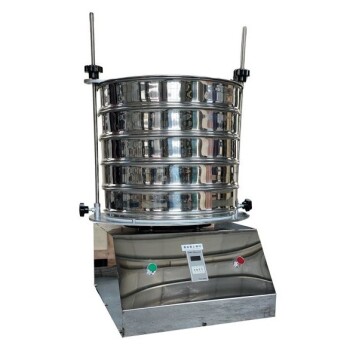
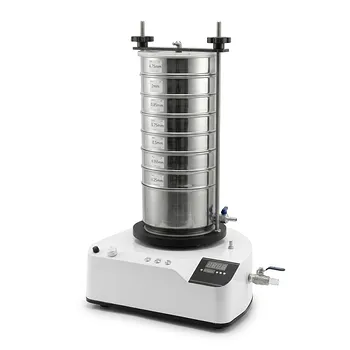
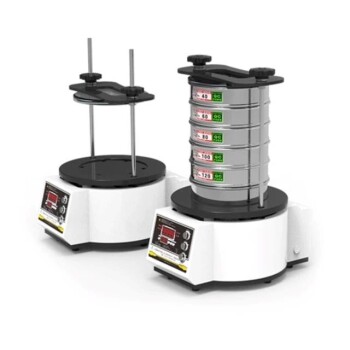
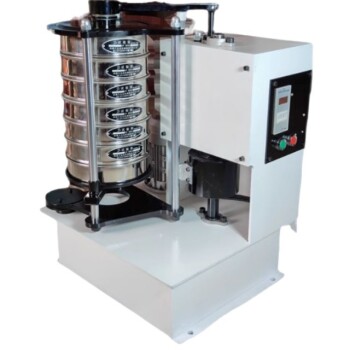
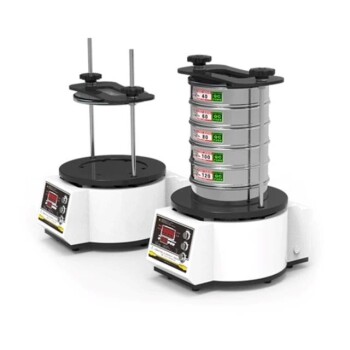
Standard industrial sieves act as the critical quality control checkpoint in the processing of slate ceramsite raw materials. Specifically, they grade and screen crushed slate powder to ensure it meets precise size specifications—commonly 0.147 mm—before it enters the pelletizing stage. This rigorous screening process is the primary mechanism for establishing the physical properties of the final product.
The strategic value of sieving extends beyond simple separation. By strictly enforcing particle size limits, manufacturers prevent physical defects during heating and eliminate the financial drain of processing unsuitable material, directly resulting in stable density and consistent pore structures.
The Impact on Structural Integrity
Regulating Expansion Behavior
The primary function of the sieve is to standardize the raw material for the kiln. Coarse particles that exceed the size specification react unpredictably during the heating process.
If these larger particles enter the pelletizing stage, they lead to uneven expansion. This inconsistency compromises the structural uniformity of the final ceramsite, leading to weak points or irregular shapes.
Ensuring Consistent Pore Structure
Quality ceramsite relies on a specific internal architecture. Sieving ensures that the powder is uniform enough to generate consistent pore structures throughout the batch.
By controlling the input size, you stabilize the density of the finished product. This uniformity is essential for applications where weight and insulation properties must be predictable.
Operational Efficiency and Cost Control
Reducing Processing Waste
Quality control is also about economic efficiency. The sieving process identifies and separates particles that are overly fine.
Processing material that is too fine incurs unnecessary costs without adding value to the final product. Removing this material early prevents wasted energy and resources during the pelletizing and firing stages.
Common Pitfalls in Size Management
The Danger of Oversized Inputs
Allowing material larger than the specified threshold (e.g., >0.147 mm) is the most common cause of product failure.
This oversight results in immediate quality degradation due to uneven expansion. The trade-off here is absolute: you cannot achieve high-quality ceramsite with inconsistent raw feed.
The Hidden Cost of Fines
Ignoring the lower limit of particle size does not necessarily ruin the product's structure, but it ruins the project's economics.
Retaining overly fine particles increases the volume of material that must be processed but often fails to contribute effectively to the pellet structure. This leads to inflated operational costs for the same yield of usable product.
Making the Right Choice for Your Goal
To optimize your slate ceramsite production, use the sieving data to drive your decision-making:
- If your primary focus is Product Performance: Strictly enforce the 0.147 mm upper limit to guarantee uniform expansion and stable density in every batch.
- If your primary focus is Operational Efficiency: Calibrate sieves to aggressively filter out overly fine particles to eliminate unnecessary processing costs.
Precise particle control is the single most effective lever for balancing high product quality with manufacturing economy.
Summary Table:
| Parameter | Influence on Quality | Operational Benefit |
|---|---|---|
| Particle Size Control | Ensures uniform expansion & pore structure | Eliminates physical product defects |
| Upper Limit (0.147mm) | Prevents structural weak points | Guarantees consistent material density |
| Fine Particle Removal | Optimizes pelletizing efficiency | Reduces energy waste & processing costs |
| Screening Consistency | Stabilizes kiln reaction behavior | Enhances predictability of final product |
Elevate Your Material Standards with KINTEK Precision
In the production of slate ceramsite, precision isn't just a goal—it's a requirement for structural integrity. KINTEK specializes in high-performance sieving equipment and crushing systems designed to meet the rigorous demands of industrial material processing.
Our comprehensive laboratory and industrial portfolio—ranging from standard sieves and milling systems to high-temperature furnaces (muffle, rotary, vacuum) and hydraulic presses—empowers researchers and manufacturers to achieve absolute consistency. Whether you are optimizing pore structures or reducing operational waste, KINTEK provides the high-quality consumables and equipment you need to succeed.
Ready to optimize your screening process? Contact our technical experts today to find the perfect solution for your lab or production line!
References
- Zhen Li, Xiao-Wei Duan. Manufacturing of Ultra-light Ceramsite from Slate Wastes in Shangri-la, China. DOI: 10.4191/kcers.2018.55.1.02
This article is also based on technical information from Kintek Solution Knowledge Base .
Related Products
- Custom PTFE Teflon Parts Manufacturer for PTFE Mesh F4 Sieve
- Laboratory Test Sieves and Sieving Machines
- Three-dimensional electromagnetic sieving instrument
- Laboratory Vibratory Sieve Shaker Machine for Dry and Wet Three-Dimensional Sieving
- Vibratory Sieve Shaker Machine Dry Three-Dimensional Vibrating Sieve
People Also Ask
- What are the primary reasons for selecting PTFE as a matrix? Enhance Composites with Carbon Nanotube Reinforcement
- How is PTFE utilized for insulation in Alloy 22 corrosion setups? Ensure Signal Purity & Accuracy
- Is PTFE corrosion resistant? Discover the Ultimate Chemical Resistance for Your Lab
- What are the specific applications of PTFE in micro-batch slug flow systems? Enhance Your Microfluidic Reaction Purity
- What is the mesh size of a sieve? A Guide to Particle Size and Sieve Selection