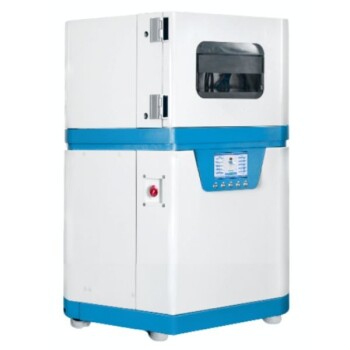
Thermal-mechanical coupling is the primary mechanism driving Ti-3Al-2.5V densification. Within a vacuum hot press furnace, the induction heating system facilitates rapid atomic diffusion, while the uniaxial hydraulic system simultaneously applies continuous mechanical pressure (typically around 30 MPa). This dual approach forces particle rearrangement and plastic deformation, achieving high relative density (>98%) significantly faster than heat alone.
Core Insight The power of this system lies in synergy: neither heat nor pressure alone is sufficient for efficient densification of high-strength alloys like Ti-3Al-2.5V. By mechanically compressing the material while it is thermally softened, the system overcomes inter-particle friction to eliminate porosity and achieve near-theoretical density without melting the alloy.
The Mechanics of Densification
Rapid Thermal Activation
The induction heating system is responsible for the rapid elevation of the alloy's temperature.
This speed is critical. By quickly reaching the target temperature, the system provides the necessary energy to promote atomic diffusion. This thermal energy softens the Ti-3Al-2.5V particles, reducing their yield strength and making them susceptible to deformation.
Mechanical Pore Closure
Simultaneously, the uniaxial hydraulic system applies a continuous load, such as 30 MPa.
This mechanical force acts as the physical driver for densification. It forces the powder particles to undergo plastic flow, pushing material into interstitial voids (pores) that would otherwise remain open during pressureless sintering.
Overcoming Internal Friction
One of the primary barriers to densification is the friction between individual powder particles.
The combination of thermal softening and mechanical pressure effectively overcomes this friction. The hydraulic pressure forces particles to slide past one another and rearrange, creating a tighter packing order before diffusion bonding cements them in place.
The Result: Synergy and Microstructure
Promoting Creep and Plastic Deformation
The interaction between the thermal field and the stress field is known as thermal-mechanical coupling.
This coupling promotes mechanisms like creep (deformation under constant stress at high heat) and plastic deformation. These mechanisms allow the material to fill microscopic voids efficiently, resulting in a dense, cohesive bulk material.
Preserving Fine-Grained Microstructure
Because the induction system heats rapidly and the pressure drives densification quickly, the total processing time is relatively short.
This short cycle time is advantageous for Ti-3Al-2.5V. It minimizes the window for grain growth, allowing for the production of a fine-grained microstructure. A finer grain structure typically correlates to superior mechanical properties in the final component.
The Critical Role of Vacuum Environment
While not part of the pressure-heat mechanic, the vacuum environment is the essential third pillar for Titanium alloys.
Preventing Embrittlement
Titanium has a high affinity for oxygen and nitrogen at elevated temperatures.
The vacuum environment (e.g., 10^-1 mbar) isolates the Ti-3Al-2.5V from air. This prevents the formation of oxides and nitrides, which would otherwise lead to material embrittlement. Without the vacuum, the densification would succeed, but the material's ductility and fatigue performance would be compromised.
Understanding the Trade-offs
Geometric Limitations
The pressure system is uniaxial, meaning force is applied in only one direction (usually top-down).
This limits the complexity of the shapes you can produce. While excellent for simple geometries like pucks, plates, or cylinders, it cannot easily produce complex, net-shape components with undercuts or intricate features.
Equipment Complexity
Vacuum hot press furnaces are complex systems requiring precise synchronization.
Balancing the induction frequency, hydraulic pressure ramp rates, and vacuum levels requires sophisticated control systems. Misalignment in these variables can lead to density gradients (uneven density) within the part.
Making the Right Choice for Your Goal
To maximize the effectiveness of a vacuum hot press for Ti-3Al-2.5V, align your process parameters with your specific outcome:
- If your primary focus is maximum density (>99%): Prioritize higher hydraulic pressure (up to 35 MPa) to physically force pore closure during the peak thermal window.
- If your primary focus is mechanical strength: Focus on minimizing total time at peak temperature to preserve a fine-grained microstructure, utilizing the rapid heating of the induction system.
- If your primary focus is ductility: Ensure the vacuum integrity is absolute to prevent interstitial contamination (oxidation) during the heating phase.
The vacuum hot press creates a unique environment where mechanical force acts as a catalyst for thermal bonding, allowing you to forge high-performance alloys below their melting points.
Summary Table:
| System Component | Primary Function | Impact on Densification |
|---|---|---|
| Induction Heating | Rapid thermal activation | Softens material & promotes atomic diffusion |
| Uniaxial Hydraulic | Constant mechanical load | Drives plastic flow & closes internal pores |
| Vacuum Environment | Atmospheric isolation | Prevents oxidation & material embrittlement |
| Combined Synergy | Thermal-mechanical coupling | Achieves >98% density & fine-grained structure |
Elevate Your Material Synthesis with KINTEK
Unlock the full potential of high-performance alloys like Ti-3Al-2.5V with KINTEK’s precision engineering. Whether you require advanced vacuum hot press furnaces, high-temperature induction systems, or specialized hydraulic presses, we provide the thermal-mechanical solutions necessary to achieve superior material density and microstructure.
From laboratory-scale battery research tools to industrial-grade crushing and milling systems, KINTEK offers a comprehensive portfolio including:
- High-Temperature Furnaces: Vacuum, CVD, PECVD, and atmosphere-controlled options.
- Pressure Systems: Isostatic and pellet presses for precise densification.
- Essential Consumables: High-purity ceramics, crucibles, and PTFE products.
Ready to optimize your densification process? Contact us today to consult with our experts and find the perfect equipment for your lab's unique requirements!
Related Products
- Vacuum Hot Press Furnace Heated Vacuum Press Machine Tube Furnace
- 600T Vacuum Induction Hot Press Furnace for Heat Treat and Sintering
- Vacuum Hot Press Furnace Machine Heated Vacuum Press
- Vacuum Hot Press Furnace Machine for Lamination and Heating
- Vacuum Heat Treat and Pressure Sintering Furnace for High Temperature Applications
People Also Ask
- What advantages does a vacuum hot press furnace provide for LSLBO ceramic electrolytes? Achieve 94% Relative Density
- What role does a Vacuum Hot Press (VHP) furnace play in the densification of austenitic stainless steel 316 composites?
- What are the advantages of using a vacuum hot pressing furnace? Superior Densification for 2024Al/Gr/SiC Composites
- What are the advantages of a vacuum hot press furnace for LTPO solid electrolytes? Boost Density and Conductivity
- What core processing conditions does a vacuum hot press furnace provide? Achieve High-Density Cu-SiC/Diamond Composites