Knowledge How do you convert biomass into energy? A Guide to Thermochemical and Biochemical Methods
Author avatar

Tech Team · Kintek Solution

Updated 1 week ago

How do you convert biomass into energy? A Guide to Thermochemical and Biochemical Methods


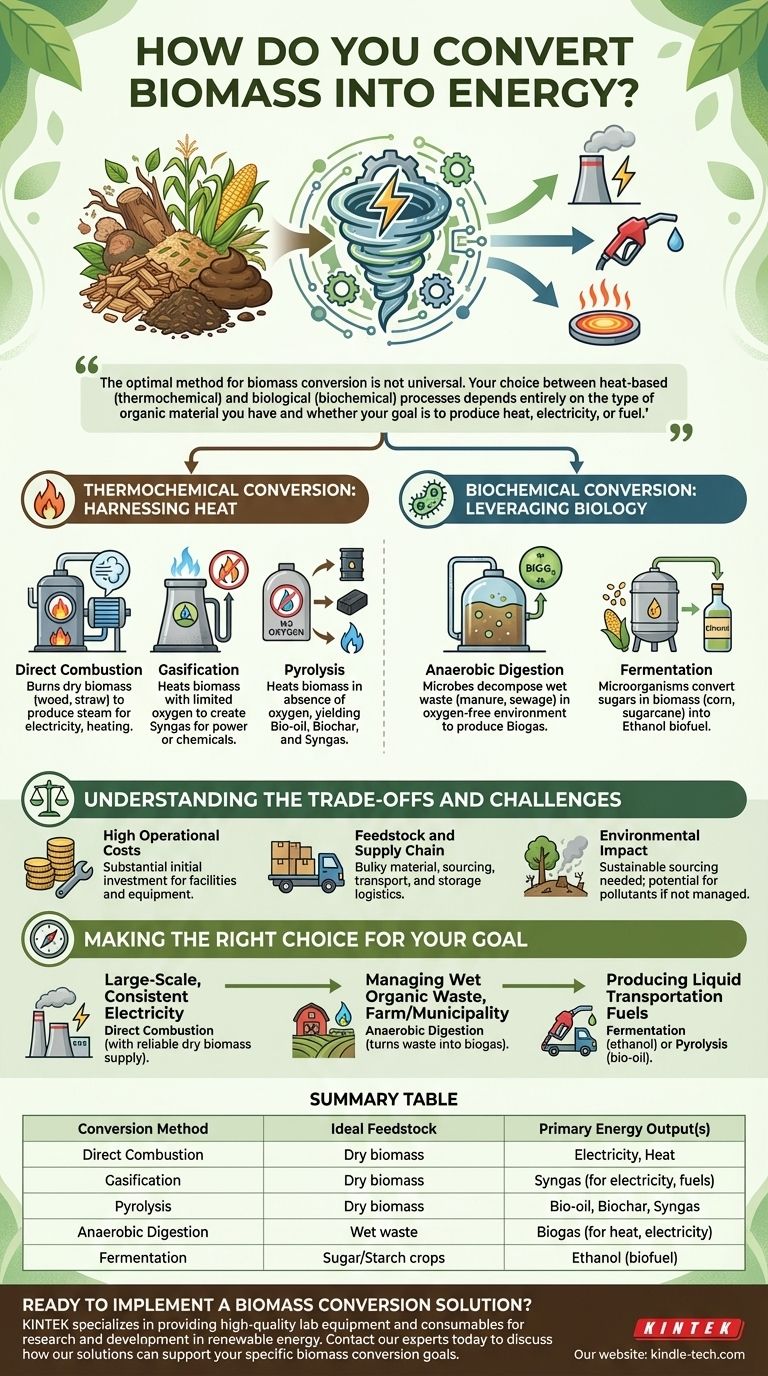
At its core, converting biomass into energy involves transforming organic matter into a usable form of power. This is primarily accomplished through two distinct categories of processes: thermochemical methods, which use heat to break down materials, and biochemical methods, which use microorganisms to decompose them.

The optimal method for biomass conversion is not universal. Your choice between heat-based (thermochemical) and biological (biochemical) processes depends entirely on the type of organic material you have and whether your goal is to produce heat, electricity, or fuel.
How do you convert biomass into energy? A Guide to Thermochemical and Biochemical Methods

Thermochemical Conversion: Harnessing Heat

Thermochemical conversion uses high temperatures to convert biomass into energy. These methods are generally best suited for dry biomass like wood, straw, or other agricultural residues.

Direct Combustion

Direct combustion is the most straightforward and common method. It involves burning biomass in a boiler to produce high-pressure steam.

This steam then drives a turbine connected to a generator to produce electricity, or it can be used directly for industrial processes or heating.

Gasification

Gasification involves heating biomass with a limited amount of oxygen. This process doesn't burn the material completely but instead converts it into a flammable gas mixture called syngas.

This syngas is a flexible fuel that can be burned to generate electricity or further processed into liquid fuels and chemicals.

Pyrolysis

Pyrolysis is the process of heating biomass in the complete absence of oxygen.

This decomposition yields three key products: a liquid called bio-oil (which can be refined into fuel), a solid residue called biochar (a valuable soil amendment), and syngas.

Biochemical Conversion: Leveraging Biology

Biochemical processes use enzymes, bacteria, and other microorganisms to break down biomass. These methods are ideal for converting wet organic materials, such as sewage, animal manure, and food processing waste.

Anaerobic Digestion

This process uses microorganisms in an oxygen-free environment to decompose wet organic matter.

The primary output is biogas, which is mostly methane. This biogas can be captured and burned to generate localized heat and electricity, making it an excellent solution for farms and wastewater treatment plants.

Fermentation

Fermentation uses microorganisms (like yeast) to convert the carbohydrates and sugars in certain biomass crops (such as corn, sugarcane, or switchgrass) into alcohol.

The most common product is ethanol, a biofuel that is blended with gasoline to power vehicles.

Understanding the Trade-offs and Challenges

While biomass is a renewable resource, its conversion to energy is not without significant challenges that require careful consideration.

High Operational Costs

The initial investment for building a biomass energy facility can be substantial. Construction, production equipment, and ongoing maintenance contribute to high costs that can be a barrier to entry.

Feedstock and Supply Chain

Biomass is often bulky, has a lower energy density than fossil fuels, and may be geographically dispersed. Sourcing, collecting, transporting, and storing the raw material efficiently is a major logistical and financial challenge.

Environmental Impact

If not managed sustainably, sourcing biomass can lead to deforestation or competition for land that would otherwise be used for food production. Furthermore, direct combustion can release air pollutants like nitrogen oxides and particulates if not properly controlled.

Making the Right Choice for Your Goal

Selecting the correct conversion technology is critical for a successful biomass project. Your decision should be guided by your available resources and ultimate energy goal.

  • If your primary focus is large-scale, consistent electricity: Direct combustion is the most established and powerful method, assuming a reliable supply of dry biomass like wood chips or agricultural pellets.
  • If your primary focus is managing wet organic waste: Anaerobic digestion is the ideal solution, as it effectively turns a waste stream from a farm, municipality, or food processor into valuable biogas.
  • If your primary focus is producing liquid transportation fuels: Fermentation (for ethanol) or pyrolysis (for bio-oil) are the designated pathways, though they require specific types of feedstocks and often complex refining processes.

By understanding these distinct conversion pathways, you can strategically align your biomass resources with your specific energy objectives.

Summary Table:

Conversion Method Ideal Feedstock Primary Energy Output(s)
Direct Combustion Dry biomass (wood chips, straw) Electricity, Heat
Gasification Dry biomass Syngas (for electricity, fuels)
Pyrolysis Dry biomass Bio-oil, Biochar, Syngas
Anaerobic Digestion Wet waste (manure, sewage) Biogas (for heat, electricity)
Fermentation Sugar/Starch crops (corn, sugarcane) Ethanol (biofuel)

Ready to implement a biomass conversion solution in your lab or facility?

KINTEK specializes in providing high-quality lab equipment and consumables for research and development in renewable energy. Whether you are optimizing pyrolysis processes, analyzing bio-oil, or testing biogas yields, we have the reliable equipment you need to advance your biomass energy projects.

Contact our experts today to discuss how our solutions can support your specific biomass conversion goals and help you achieve efficient, sustainable energy production.

Visual Guide
How do you convert biomass into energy? A Guide to Thermochemical and Biochemical Methods Visual Guide

Related Products

People Also Ask

Related Products

Electric Rotary Kiln Small Rotary Furnace Biomass Pyrolysis Plant

Electric Rotary Kiln Small Rotary Furnace Biomass Pyrolysis Plant

Learn about Rotary Biomass Pyrolysis Furnaces & how they decompose organic material at high temps without oxygen. Use for biofuels, waste processing, chemicals & more.

Vacuum Sealed Continuous Working Rotary Tube Furnace Rotating Tube Furnace

Vacuum Sealed Continuous Working Rotary Tube Furnace Rotating Tube Furnace

Experience efficient material processing with our vacuum-sealed rotary tube furnace. Perfect for experiments or industrial production, equipped with optional features for controlled feeding and optimized results. Order now.

Electric Rotary Kiln Continuous Working Small Rotary Furnace Heating Pyrolysis Plant

Electric Rotary Kiln Continuous Working Small Rotary Furnace Heating Pyrolysis Plant

Efficiently calcine and dry bulk powder and lump fluid materials with an electric heating rotary furnace. Ideal for processing lithium ion battery materials and more.

Customizable High Pressure Reactors for Advanced Scientific and Industrial Applications

Customizable High Pressure Reactors for Advanced Scientific and Industrial Applications

This laboratory-scale high-pressure reactor is a high-performance autoclave engineered for precision and safety in demanding research and development environments.

High Pressure Laboratory Autoclave Reactor for Hydrothermal Synthesis

High Pressure Laboratory Autoclave Reactor for Hydrothermal Synthesis

Discover the applications of Hydrothermal Synthesis Reactor - a small, corrosion-resistant reactor for chemical labs. Achieve rapid digestion of insoluble substances in a safe and reliable way. Learn more now.

Mini SS High Pressure Autoclave Reactor for Laboratory Use

Mini SS High Pressure Autoclave Reactor for Laboratory Use

Mini SS High Pressure Reactor - Ideal for medicine, chemical, and scientific research industries. Programmed heating temp and stirring speed, up to 22Mpa pressure.

Stainless High Pressure Autoclave Reactor Laboratory Pressure Reactor

Stainless High Pressure Autoclave Reactor Laboratory Pressure Reactor

Discover the versatility of Stainless High Pressure Reactor - a safe and reliable solution for direct and indirect heating. Built with stainless steel, it can withstand high temperatures and pressures. Learn more now.

Small Vacuum Heat Treat and Tungsten Wire Sintering Furnace

Small Vacuum Heat Treat and Tungsten Wire Sintering Furnace

The small vacuum tungsten wire sintering furnace is a compact experimental vacuum furnace specially designed for universities and scientific research institutes. The furnace features a CNC welded shell and vacuum piping to ensure leak-free operation. Quick-connect electrical connections facilitate relocation and debugging, and the standard electrical control cabinet is safe and convenient to operate.

Graphite Vacuum Continuous Graphitization Furnace

Graphite Vacuum Continuous Graphitization Furnace

High-temperature graphitization furnace is a professional equipment for graphitization treatment of carbon materials. It is a key equipment for the production of high-quality graphite products. It has high temperature, high efficiency and uniform heating. It is suitable for various high-temperature treatments and graphitization treatments. It is widely used in metallurgy, electronics, aerospace, etc. industry.

Electrolytic Electrochemical Cell Gas Diffusion Liquid Flow Reaction Cell

Electrolytic Electrochemical Cell Gas Diffusion Liquid Flow Reaction Cell

Looking for a high-quality gas diffusion electrolysis cell? Our liquid flow reaction cell boasts exceptional corrosion resistance and complete specifications, with customizable options available to suit your needs. Contact us today!

Lab-Scale Vacuum Induction Melting Furnace

Lab-Scale Vacuum Induction Melting Furnace

Get precise alloy composition with our Vacuum Induction Melting Furnace. Ideal for aerospace, nuclear energy, and electronic industries. Order now for effective smelting and casting of metals and alloys.

Quartz Electrolytic Electrochemical Cell for Electrochemical Experiments

Quartz Electrolytic Electrochemical Cell for Electrochemical Experiments

Looking for a reliable quartz electrochemical cell? Our product boasts excellent corrosion resistance and complete specifications. With high-quality materials and good sealing, it's both safe and durable. Customize to meet your needs.

Customizable PEM Electrolysis Cells for Diverse Research Applications

Customizable PEM Electrolysis Cells for Diverse Research Applications

Custom PEM test cell for electrochemical research. Durable, versatile, for fuel cells & CO2 reduction. Fully customizable. Get a quote!

Cylindrical Resonator MPCVD Machine System Reactor for Microwave Plasma Chemical Vapor Deposition and Lab Diamond Growth

Cylindrical Resonator MPCVD Machine System Reactor for Microwave Plasma Chemical Vapor Deposition and Lab Diamond Growth

Learn about Cylindrical Resonator MPCVD Machine, the microwave plasma chemical vapor deposition method used for growing diamond gemstones and films in the jewelry and semi-conductor industries. Discover its cost-effective advantages over traditional HPHT methods.

Double-Layer Water Bath Electrolytic Electrochemical Cell

Double-Layer Water Bath Electrolytic Electrochemical Cell

Discover the temperature-controllable electrolytic cell with a double-layer water bath, corrosion resistance, and customization options. Complete specifications included.

Optical Water Bath Electrolytic Electrochemical Cell

Optical Water Bath Electrolytic Electrochemical Cell

Upgrade your electrolytic experiments with our Optical Water Bath. With controllable temperature and excellent corrosion resistance, it's customizable for your specific needs. Discover our complete specifications today.

Inclined Rotary Plasma Enhanced Chemical Vapor Deposition PECVD Equipment Tube Furnace Machine

Inclined Rotary Plasma Enhanced Chemical Vapor Deposition PECVD Equipment Tube Furnace Machine

Upgrade your coating process with PECVD coating equipment. Ideal for LED, power semiconductors, MEMS and more. Deposits high-quality solid films at low temps.

Microwave Plasma Chemical Vapor Deposition MPCVD Machine System Reactor for Lab and Diamond Growth

Microwave Plasma Chemical Vapor Deposition MPCVD Machine System Reactor for Lab and Diamond Growth

Get high-quality diamond films with our Bell-jar Resonator MPCVD machine designed for lab and diamond growth. Discover how Microwave Plasma Chemical Vapor Deposition works for growing diamonds using carbon gas and plasma.

Molybdenum Disilicide (MoSi2) Thermal Elements Electric Furnace Heating Element

Molybdenum Disilicide (MoSi2) Thermal Elements Electric Furnace Heating Element

Discover the power of Molybdenum Disilicide (MoSi2) Heating Element for high-temperature resistance. Unique oxidation resistance with stable resistance value. Learn more about its benefits now!

Small Jaw Crusher for Laboratory and Small Mines Efficient Flexible Affordable Laboratory Ore Crusher Coal Crusher

Small Jaw Crusher for Laboratory and Small Mines Efficient Flexible Affordable Laboratory Ore Crusher Coal Crusher

Discover the small jaw crusher for efficient, flexible, and affordable crushing in labs and small mines. Ideal for coal, ores, and rocks. Learn more now!


Leave Your Message