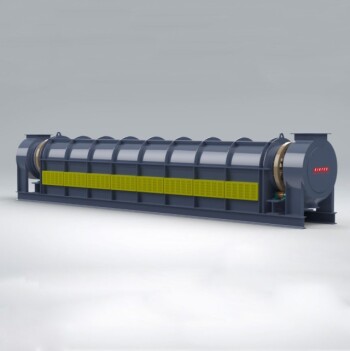
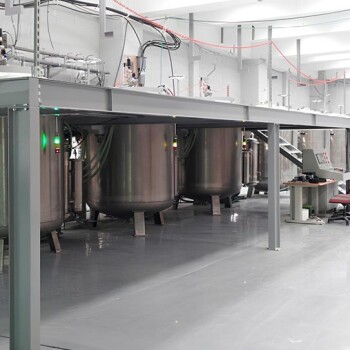
A calcining furnace acts as the critical thermal reactor for applying protective and conductive coatings to Lithium Iron Phosphate (LFP) surfaces. It facilitates the precise sintering of rare earth oxides or the pyrolysis of organic precursors to form uniform nanometer-scale layers. These modifications are essential for enhancing lithium-ion diffusion, increasing electronic conductivity, and protecting the material from chemical erosion during battery operation.
The calcining furnace transforms LFP from an inherently insulating material into a high-performance cathode by engineering its surface at the nano-level through controlled thermal decomposition and sintering. This process ensures both structural stability and high electrochemical activity.
Mechanisms of Surface Modification
Rare Earth Oxide Sintering
The furnace is used to sinter rare earth oxide slurries, such as lanthanum oxide, onto the surface of synthesized LFP powder. Through precise thermal process control, a uniform coating approximately 3 nanometers thick is formed.
This protective shell serves a dual purpose. It enhances the material's resistance to chemical erosion while accelerating lithium-ion diffusion by optimizing surface kinetics.
Carbon Network Formation
In addition to oxides, the furnace facilitates the carbonization and pyrolysis of organic precursors like sucrose. By heating mixtures to approximately 600°C, the furnace decomposes these sources into a thin, conductive carbon layer.
This carbon coating is vital because LFP is naturally an insulator. The furnace-built conductive carbon network allows for the electronic conductivity necessary for the material to function as an active electrode.
Environmental and Kinetic Control
Prevention of Iron Oxidation
Maintaining the chemical integrity of LFP requires a strictly controlled atmosphere. The furnace uses inert gases like Argon or reducing mixtures like Nitrogen-Hydrogen (N2/H2) to prevent the oxidation of divalent iron (Fe2+).
If the iron were to oxidize into trivalent iron (Fe3+) at high temperatures, the electrochemical performance would degrade. The furnace provides the stable thermal environment needed to prevent this transition.
Controlled Thermal Decomposition
During low-temperature phases (around 300°C), the furnace facilitates the thermal decomposition of organic precursors in a stable environment. This stage is critical for creating a "reducing micro-environment" locally around the particles.
This localized environment helps ensure that even as organic materials break down, the underlying LFP structure remains protected. The result is a highly conductive, amorphous carbon layer that adheres perfectly to the particle surface.
Understanding the Trade-offs
Temperature vs. Particle Growth
While high temperatures (600°C+) are necessary to form high-quality coatings, excessive heat can lead to unwanted particle growth or sintering of the LFP particles themselves. This reduces the surface-area-to-volume ratio, which can hinder the rate of lithium-ion discharge.
Coating Uniformity and Thickness
If the calcining process is too short, the coating may be discontinuous, leaving parts of the LFP exposed to erosion. Conversely, a coating that is too thick (exceeding a few nanometers) can act as a resistive barrier, slowing down the very ions it is meant to help transport.
Atmosphere Precision
The balance of the reducing atmosphere (N2/H2) must be exact. An insufficient reducing environment fails to prevent Fe2+ oxidation, while an overly aggressive one could potentially alter the stoichiometry of the LFP crystal lattice.
How to Apply This to Your Synthesis
Selecting the right furnace parameters depends on the specific performance metrics required for your LFP nanomaterials.
- If your primary focus is Ion Diffusion and Durability: Prioritize the sintering of rare earth oxides (like lanthanum oxide) at precise temperatures to achieve a 3nm protective shell.
- If your primary focus is Electronic Conductivity: Focus on high-temperature pyrolysis (approx. 600°C) of carbon precursors under a Nitrogen-Hydrogen atmosphere to build a robust carbon network.
- If your primary focus is Preventing Chemical Degradation: Ensure a stable, low-temperature carbonization phase (300°C) to establish a reducing micro-environment before ramping to final sintering temperatures.
The precision of the calcining furnace is the deciding factor in whether LFP nanomaterials achieve their theoretical potential in high-capacity battery applications.
Summary Table:
| Process Mechanism | Key Benefit | Critical Parameter |
|---|---|---|
| Rare Earth Sintering | Enhances ion diffusion & erosion resistance | ~3nm uniform coating thickness |
| Carbon Pyrolysis | Creates conductive networks for insulators | ~600°C in N2/H2 atmosphere |
| Atmosphere Control | Prevents Fe2+ oxidation to Fe3+ | Use of Argon or Nitrogen-Hydrogen |
| Thermal Decomposition | Establishes reducing micro-environments | Stable 300°C low-temp phase |
Elevate Your Battery Material Synthesis with KINTEK
Precision is the difference between an insulating material and a high-performance cathode. KINTEK specializes in advanced laboratory equipment, offering a comprehensive range of high-temperature furnaces (muffle, tube, atmosphere, and CVD) specifically designed to manage the delicate sintering and pyrolysis processes required for LFP surface modification.
Beyond our industry-leading furnaces, KINTEK provides a full suite of tools for battery researchers, including high-pressure reactors, crushing and milling systems, and specialized consumables like PTFE and ceramic crucibles. Whether you are focusing on rare earth oxide sintering or complex carbon network formation, our solutions ensure the atmospheric stability and thermal accuracy your research demands.
Ready to achieve superior electrochemical activity? Contact our technical experts today to find the perfect equipment tailored to your laboratory's needs.
References
- L. Li. Advancements in anode and cathode nanomaterials for high-performance Li-ion batteries. DOI: 10.54254/2755-2721/26/20230830
This article is also based on technical information from Kintek Solution Knowledge Base .
Related Products
- Electric Rotary Kiln Pyrolysis Furnace Plant Machine Calciner Small Rotary Kiln Rotating Furnace
- High Temperature Muffle Oven Furnace for Laboratory Debinding and Pre Sintering
- Electric Rotary Kiln Continuous Working Small Rotary Furnace Heating Pyrolysis Plant
- Graphite Vacuum Furnace Bottom Discharge Graphitization Furnace for Carbon Materials
- Vertical Laboratory Tube Furnace
People Also Ask
- What is a rotary kiln electric furnace? Achieve Superior Uniform Heating for Your Materials
- What are the characteristics of the slipping, slumping, and rolling modes of bed motion? Optimize Your Rotary Process
- What are the advantages of rotary kiln furnace? Achieve Superior Uniformity & Efficiency
- What is the temperature of a rotating kiln? It Depends on Your Material and Process Goal
- What are the principles of a rotary kiln? Master the Mechanics of High-Temperature Processing