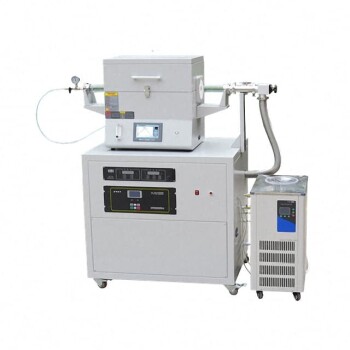
A controlled atmosphere tube furnace facilitates the construction of a carbon skeleton by providing an oxygen-free environment that allows for thermal decomposition without combustion. By introducing inert gases like high-purity nitrogen (N2) or argon, the furnace isolates the biomass from reactive oxygen. This enables the material to reach critical temperatures—often starting around 400°C—where organic polymers crack and recombine into a stable, porous carbon framework rather than burning into ash.
The core function of the tube furnace is to manage the transition from organic matter to an amorphous carbon skeleton by balancing inert gas protection with precise thermal control. This prevents carbon loss via oxidation while systematically purging volatile by-products.
Engineering the Inert Environment
Prevention of Oxidative Loss
The primary role of the tube furnace is to maintain a strictly inert atmosphere throughout the heating cycle. By purging the tube with nitrogen or argon, the furnace ensures that the carbon atoms within the biomass are not lost to the atmosphere as carbon dioxide. This preservation of fixed carbon is the prerequisite for building a high-yield carbon skeleton.
Volatile By-product Removal
A stable flow rate of inert gas is essential for maintaining a clean reaction environment. As the biomass decomposes, it releases volatile components and moisture that could interfere with the carbonization process if left stagnant. The continuous gas stream carries these by-products away, ensuring the resulting skeleton remains free of unwanted residues.
Maintaining Precision in Thermal Profiles
The tube furnace allows for programmed temperature control, which is vital for the gradual transformation of the material. By regulating the heating rate (often around 5 °C/min), the furnace prevents structural collapse and encourages the formation of a uniform amorphous carbon framework. This stability is critical for the material’s eventual mechanical strength and surface area.
The Chemical Transformation of Biomass
Thermal Cracking of Organic Polymers
Inside the furnace, the complex structures of lignin, cellulose, and hemicellulose begin to break down under high heat. In the absence of oxygen, these polymers do not burn; instead, they undergo thermal cracking. This process separates the lighter elements from the carbon, allowing the remaining atoms to begin forming a more rigid structure.
Dehydration and Deoxygenation Reactions
At temperatures near 400°C, the biomass undergoes intense dehydration, deoxygenation, and dehydrogenation. These reactions strip away hydrogen and oxygen atoms, which are the primary constituents of the volatile matter. As these elements depart, the carbon density of the remaining material increases significantly.
Preliminary Skeleton Recombination
As the volatile elements are removed, the remaining carbon atoms undergo recombination. They arrange themselves into a preliminary carbon skeleton that possesses initial porosity. This framework serves as the structural foundation that will later be refined during high-temperature chemical activation.
Understanding the Trade-offs
Gas Flow Rate Sensitivity
While gas flow is necessary to remove volatiles, an excessively high flow rate can lead to thermal gradients inside the tube. This can result in uneven carbonization, where the exterior of the biomass sample reaches the target temperature while the interior remains under-processed. Finding a balance is critical for structural consistency.
Heating Rate vs. Structural Integrity
A rapid heating rate may seem efficient but often causes the internal pressure of escaping volatiles to rupture the forming skeleton. Conversely, an overly slow heating rate increases energy consumption and may lead to a denser, less porous carbon structure. The choice of heating profile directly dictates the final pore distribution.
Inert Gas Selection
Nitrogen is the most common choice due to its cost-effectiveness and efficiency in most biomass applications. However, at extremely high temperatures (above 1000°C), nitrogen can occasionally react with certain biomass precursors to form nitrides. In these specialized cases, Argon—though more expensive—is required to ensure a truly non-reactive environment.
Applying Furnace Parameters to Your Goal
How to Apply This to Your Project
To achieve the best results for your specific biomass precursor, consider the following technical adjustments:
- If your primary focus is Maximum Surface Area: Use a slow heating rate (2-5 °C/min) and a consistent nitrogen purge to ensure the skeleton forms a delicate, high-porosity network without collapsing.
- If your primary focus is High Carbon Yield: Maintain a strict oxygen-free environment by pre-purging the furnace for at least 30 minutes before heating to prevent any initial oxidative loss.
- If your primary focus is Structural Strength: Target a higher carbonization temperature (closer to 800°C) to promote more extensive recombination and a more rigid amorphous carbon framework.
By masterfully controlling the atmosphere and thermal profile, the tube furnace transforms raw biomass into a high-value carbon foundation.
Summary Table:
| Parameter | Role in Carbonization | Impact on Carbon Skeleton |
|---|---|---|
| Inert Atmosphere | Prevents oxidative combustion | Maximizes fixed carbon yield and purity |
| Thermal Control | Manages organic polymer cracking | Ensures structural stability and uniform framework |
| Gas Flow Rate | Purges volatile by-products | Maintains clean reaction environment and porosity |
| Heating Rate | Regulates decomposition speed | Dictates final pore distribution and strength |
Elevate Your Material Research with KINTEK
Precision is the foundation of breakthrough discovery. KINTEK specializes in high-performance laboratory equipment, providing the controlled atmosphere tube furnaces, muffle furnaces, and CVD systems essential for successful biomass carbonization and carbon skeleton engineering.
Beyond thermal processing, our comprehensive portfolio includes high-temperature high-pressure reactors, crushing and milling systems, and specialized consumables like PTFE and ceramic crucibles. Whether you are focused on battery research or advanced material synthesis, KINTEK offers the reliability and technical support you need to achieve superior results.
Optimize your lab’s efficiency today—Contact our experts at KINTEK for tailored equipment solutions!
References
- Min Hou, Can Liu. Preparation of Biomass Biochar with Components of Similar Proportions and Its Methylene Blue Adsorption. DOI: 10.3390/molecules28176261
This article is also based on technical information from Kintek Solution Knowledge Base .
Related Products
- 1200℃ Controlled Atmosphere Furnace Nitrogen Inert Atmosphere Furnace
- 1700℃ Controlled Atmosphere Furnace Nitrogen Inert Atmosphere Furnace
- 1400℃ Controlled Atmosphere Furnace with Nitrogen and Inert Atmosphere
- Controlled Nitrogen Inert Hydrogen Atmosphere Furnace
- Mesh belt controlled atmosphere furnace
People Also Ask
- What is controlled atmosphere furnace? Precision Heating Without Oxidation for Superior Materials
- What is the function of a high-precision controlled atmosphere furnace for Alloy 617? Simulate Extreme VHTR Conditions
- What are the two primary purposes of using a controlled atmosphere? Master Protection vs. Material Modification
- What is the role of the furnace atmosphere? Master Precise Metallurgical Control for Your Heat Treatment
- What is a controlled atmosphere furnace? Achieve Purity and Precision in High-Temp Processing