The critical distinction lies in how mechanical force is applied to the particle structure. A dry impact-blending device is superior for preparing composite particles because it creates a uniform coating without shattering the host material. Conversely, a planetary ball mill often causes the fracture of brittle electrode particles due to its aggressive high-energy grinding mechanism.
While planetary ball mills rely on indiscriminate grinding that can compromise particle integrity, dry impact-blending uses optimized airflow and impact forces. This allows for the fusion of soft electrolytes onto hard electrodes, creating an ideal core-shell structure while preserving the active material.
The Mechanics of Particle Interaction
The Limitations of Planetary Ball Milling
Planetary ball mills operate via high-energy grinding. While effective for size reduction, this method applies force indiscriminately.
When processing composite particles for solid-state batteries, this aggressive energy often leads to the fracture of brittle electrode host particles. This structural degradation can negatively impact the electrochemical performance of the final battery cell.
The Dry Impact-Blending Advantage
In contrast, a dry impact-blending device utilizes a combination of airflow circulation and a high-speed impact mechanism.
This method is specifically designed to manage impact energy. It focuses on dispersing the particles rather than crushing them, ensuring the host material remains intact.
Achieving Plastic Deformation
The dry impact-blending device utilizes a high-speed rotor to generate powerful centrifugal and impact forces.
This creates intense collisions that break up agglomerates and induce plastic deformation. The softer electrolyte "guest" particles are mechanically fused onto the surface of the harder electrode "host" particles.
Engineering the Ideal Interface
Building Core-Shell Structures
The primary goal in solid-state battery preparation is creating a dense, continuous interface between the electrode and the electrolyte.
Dry impact-blending excels here by forming a dense coating layer (the shell) around the active material (the core). Because the impact energy is optimized, this occurs without pulverizing the core.
Solvent-Free Processing
This coating process is achieved entirely through mechanical force.
By utilizing high-intensity collision rather than chemical dissolution, the device creates a continuous coating without the use of solvents. This simplifies processing and eliminates potential contamination from solvent residues.
Understanding the Trade-offs
Impact vs. Grinding
It is essential to select the tool that matches the physical requirements of your materials.
Planetary Ball Mills are tools for comminution (size reduction). If your goal is to reduce particle size rapidly, they are effective, but they lack the finesse required for coating brittle materials without damage.
Dry Impact-Blending is a tool for surface engineering. It sacrifices the aggressive crushing power of a ball mill in exchange for precision, dispersion, and the preservation of the host particle's morphology.
Making the Right Choice for Your Goal
To select the correct equipment for your solid-state battery project, evaluate your specific structural requirements:
- If your primary focus is preserving particle integrity: Choose the dry impact-blending device to coat electrodes without fracturing them.
- If your primary focus is aggressive size reduction: Choose a planetary ball mill, acknowledging the risk of damaging brittle host structures.
By prioritizing the preservation of the electrode structure, you ensure a higher quality composite material for superior battery performance.
Summary Table:
| Feature | Dry Impact-Blending Device | Planetary Ball Mill |
|---|---|---|
| Primary Mechanism | High-speed impact & airflow circulation | High-energy grinding & collision |
| Structural Integrity | Preserves host particle morphology | High risk of fracturing brittle materials |
| Coating Quality | Uniform, dense core-shell layer | Indiscriminate, often non-uniform |
| Energy Application | Optimized for surface engineering | Optimized for size reduction (comminution) |
| Processing Type | Solvent-free mechanical fusion | Grinding (may require solvents) |
| Best Application | Core-shell composite particle preparation | Rapid material pulverization |
Elevate Your Solid-State Battery Research with KINTEK
Precise material engineering is the key to next-generation battery performance. At KINTEK, we understand that preserving the integrity of your active materials is non-negotiable. Whether you require advanced crushing and milling systems for size reduction or specialized equipment for composite particle preparation, our laboratory solutions are designed to meet the rigorous demands of battery research.
From planetary ball mills and hydraulic presses to high-performance high-temperature furnaces and ULT freezers, KINTEK provides the comprehensive tools and consumables (including PTFE and ceramic crucibles) needed to optimize your workflow and achieve superior electrochemical results.
Ready to refine your particle engineering process? Contact our technical experts today to find the perfect equipment for your laboratory.
Related Products
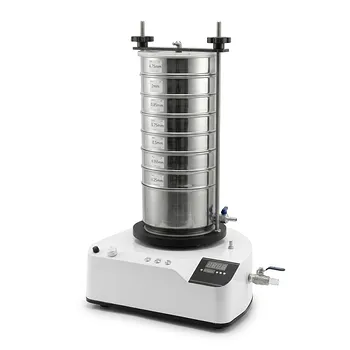
- Laboratory Vibratory Sieve Shaker Machine for Dry and Wet Three-Dimensional Sieving
- Three-dimensional electromagnetic sieving instrument
- High Energy Vibratory Laboratory Ball Mill Grinding Mill Single Tank Type
People Also Ask
- How does a laboratory vibratory sieve shaker facilitate the microstructural study of gas-atomized alloy powders?
- What role does a laboratory vibrating sieve shaker play in the LiFePO4 powder processing workflow? Ensure Batch Quality
- Why use a vibratory sieve shaker for PET powder? Achieve Precise Particle Size Control for Chemical Research
- What is the principle of vibratory sieve shaker? Achieve Accurate Particle Size Analysis
- What is the function of a vibratory sieve shaker? Achieve Precise Particle Size Analysis