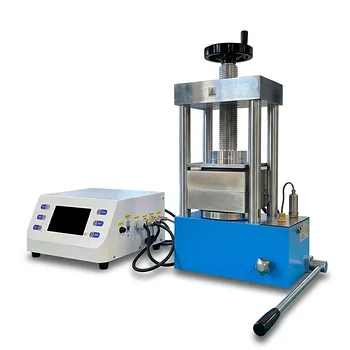
A four-column hydraulic press fundamentally improves the TiBw/TA15 microstructure by utilizing high extrusion force and constant velocity to induce severe plastic deformation. This intense deformation process is the physical catalyst that reorganizes the material's internal architecture, turning a raw composite into a high-performance structural component.
The press enhances the composite through three simultaneous mechanisms: forcing the directional alignment of TiB whiskers, triggering dynamic recrystallization to refine the matrix grain structure, and utilizing triaxial compressive stress to permanently close internal micro-voids.
The Mechanics of Microstructural Transformation
Directional Alignment of Reinforcements
The primary benefit of the four-column press is its ability to impose severe plastic deformation on the TA15 matrix.
As the material flows under this immense pressure, the rigid TiB whiskers (TiBw) are forced to rotate.
They align directionally along the extrusion axis, significantly boosting the material's strength in the direction of the load.
Grain Refinement via Dynamic Recrystallization
The high energy input and strain from the press trigger a phenomenon known as dynamic recrystallization (DRX) within the titanium alloy matrix.
Instead of retaining coarse, irregular grains, the matrix is forced to reorganize itself.
This results in a much finer, more uniform grain structure, which directly correlates to improved ductility and fatigue resistance.
Elimination of Internal Defects
The hydraulic press creates a state of triaxial compressive stress during the molding process.
Unlike simple compression, this forces material together from multiple directions, effectively crushing microscopic voids and closing unbonded regions.
This leads to a dense, seamless metallurgical interface free of the porosity that typically compromises structural integrity.
Critical Process Variables and Trade-offs
The Necessity of Constant Speed
The four-column hydraulic press is specifically valued for its ability to maintain a constant extrusion speed.
Fluctuations in speed can lead to uneven deformation rates, causing inconsistent grain sizes along the length of the component.
Stability in velocity ensures that the dynamic recrystallization process remains uniform throughout the entire part.
The Role of High Force Application
Achieving full density requires overcoming the material's natural resistance to flow.
If the extrusion force is insufficient, the triaxial stress may not be high enough to fully close the deepest micro-voids.
The press must be capable of delivering sustained, high-tonnage force to guarantee the elimination of density gradients and defects.
Making the Right Choice for Your Goal
To maximize the benefits of this process for your specific application:
- If your primary focus is anisotropic strength: Prioritize high deformation ratios to maximize the directional alignment of the TiB whiskers along the load-bearing axis.
- If your primary focus is fatigue resistance: Ensure strictly constant extrusion speeds to guarantee a uniform, fine-grained matrix via consistent dynamic recrystallization.
The combination of high force and controlled speed allows you to engineer the microstructure rather than simply accepting it.
Summary Table:
| Mechanism | Action of Hydraulic Press | Impact on Microstructure |
|---|---|---|
| Reinforcement Alignment | High extrusion force & severe plastic deformation | TiB whiskers align along the extrusion axis for anisotropic strength |
| Grain Refinement | Induction of Dynamic Recrystallization (DRX) | Coarse grains transformed into a fine, uniform matrix for better ductility |
| Defect Elimination | Application of triaxial compressive stress | Closure of micro-voids and porosity to ensure full material density |
| Consistency Control | Maintenance of constant extrusion velocity | Prevents density gradients and ensures uniform grain size throughout the part |
Elevate Your Advanced Material Processing with KINTEK
Unlock the full potential of your TiBw/TA15 composites and other high-performance alloys. KINTEK specializes in precision-engineered laboratory equipment, including robust four-column hydraulic presses (pellet, hot, and isostatic) designed to deliver the constant velocity and high-tonnage force required for superior microstructural refinement.
Beyond extrusion molding, our comprehensive portfolio supports every stage of your research and production, from high-temperature vacuum furnaces and crushing systems to high-pressure reactors and battery research tools.
Ready to achieve high-density, defect-free structural components? Contact us today to consult with our experts on the perfect high-pressure and thermal solution for your laboratory or industrial facility.
Related Products
- Automatic High Temperature Heated Hydraulic Press Machine with Heated Plates for Lab
- Heated Hydraulic Press Machine with Heated Plates for Vacuum Box Laboratory Hot Press
- 24T 30T 60T Heated Hydraulic Press Machine with Heated Plates for Laboratory Hot Press
- Heated Hydraulic Press Machine with Heated Plates for Vacuum Box Laboratory Hot Press
- Automatic Heated Hydraulic Press Machine with Heated Plates for Laboratory Hot Press 25T 30T 50T
People Also Ask
- What is a heated hydraulic press used for? Essential Tool for Curing, Molding, and Laminating
- Why is a heated hydraulic press used for warm pressing NASICON green tapes? Optimize Your Solid Electrolyte Density
- Why is a heated laboratory hydraulic press necessary for composite laminates? Achieve Void-Free Structural Integrity
- What is a hot hydraulic press? Harness Heat and Pressure for Advanced Manufacturing
- How is a heated hydraulic press used for Li-LLZO batteries? Optimize Interfacial Bonding with Thermal-Pressure