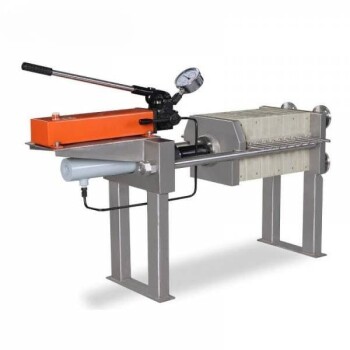
A high-performance laboratory hydraulic press secures the quality of Polybutylene Succinate (PBS) and Baobab Powder (BP) composite sheets by applying uniform, constant pressure at a specific temperature. This precise control forces the composite melt to flow completely into the mold, ensuring the material achieves the necessary structural integrity for testing.
By eliminating air voids and guaranteeing uniform thickness, the hydraulic press transforms a raw composite melt into a homogeneous sample. This physical consistency is the absolute baseline required to extract valid data on dynamic viscosity and moduli.
The Mechanics of Sample Preparation
Controlling the Melt Flow
To create a usable sample, the PBS and Baobab Powder mixture must transition from a solid to a cohesive melt. The hydraulic press, functioning as a compression molder, maintains a set temperature that allows the material to flow freely.
Achieving Uniform Distribution
Constant pressure is applied to the mold during this phase. This ensures the composite melt reaches every corner of the mold cavity, preventing structural gaps or weak points in the final sheet.
Elimination of Defects
One of the primary functions of this high-performance equipment is the discharge of air bubbles. As the press applies force to the flowable melt, trapped air is expelled, resulting in a dense, void-free material.
The Impact on Rheological Data
Criticality of Uniform Thickness
Rheological testing requires samples with precise geometric dimensions. The hydraulic press produces thin-film samples with uniform thickness across the entire sheet.
Ensuring High Density
By compressing the material thoroughly, the press ensures high density. Variations in density would cause inconsistencies in how the material reacts to stress during testing.
Validity of Viscosity and Moduli Metrics
The ultimate goal of using this specific equipment is to remove physical variables that could skew data. A defect-free sample is the only way to obtain accurate measurements for:
- Dynamic viscosity
- Storage modulus
- Loss modulus
Risks of Inadequate Processing
The Consequence of Air Voids
If the press fails to discharge all air bubbles, the sample will contain internal defects. These voids act as structural flaws that disrupt the transmission of force during rheological testing.
The Problem of Inconsistent Pressure
Without uniform and constant pressure, the composite sheet may exhibit density gradients. This means different parts of the same sample could yield different property values, rendering the dataset unreliable.
Ensuring Data Integrity
Making the Right Choice for Your Goal
- If your primary focus is Structural Analysis: Ensure the press settings force the melt to flow fully to achieve high density and eliminate internal defects.
- If your primary focus is Rheological Precision: prioritize uniform thickness to guarantee accurate readings for storage and loss moduli.
A high-performance press is not just a molding tool; it is a calibration instrument that ensures your physical sample truthfully represents the material's chemical properties.
Summary Table:
| Parameter | Importance in Sample Preparation | Impact on Rheological Testing |
|---|---|---|
| Temperature Control | Ensures complete melt flow into the mold | Prevents structural gaps and weak points |
| Constant Pressure | Eliminates air bubbles and voids | Guarantees high density and data integrity |
| Precision Thickness | Maintains uniform sheet geometry | Ensures accurate dynamic viscosity and moduli |
| Material Homogeneity | Consistent distribution of Baobab Powder | Prevents density gradients and data skewing |
Elevate Your Material Research with KINTEK Precision
Don't let sample defects compromise your rheological data. KINTEK specializes in high-performance laboratory hydraulic presses (pellet, hot, and isostatic) designed to deliver the uniform pressure and thermal stability required for complex composites like PBS and Baobab Powder.
Our extensive portfolio—ranging from crushing and milling systems to high-temperature furnaces and vacuum reactors—empowers researchers to achieve physical consistency from raw material to final testing. Let us provide the tools you need for absolute precision in dynamic viscosity and moduli measurements.
Ready to optimize your sample preparation? Contact KINTEK today for a tailored solution!
References
- Musa Abubakar Tadda, Dezhao Liu. Impacts of Baobab (Adansonia digitata) Powder on the Poly(Butylene Succinate) Polymer Degradability to Form an Eco-Friendly Filler-Based Composite. DOI: 10.3389/fmats.2021.768960
This article is also based on technical information from Kintek Solution Knowledge Base .
Related Products
- Heated Hydraulic Press Machine with Heated Plates for Vacuum Box Laboratory Hot Press
- Automatic High Temperature Heated Hydraulic Press Machine with Heated Plates for Lab
- Manual High Temperature Heated Hydraulic Press Machine with Heated Plates for Lab
- Heated Hydraulic Press Machine with Integrated Manual Heated Plates for Lab Use
- 24T 30T 60T Heated Hydraulic Press Machine with Heated Plates for Laboratory Hot Press
People Also Ask
- Why is a heated laboratory hydraulic press necessary for composite laminates? Achieve Void-Free Structural Integrity
- What is the core function of a laboratory heated hydraulic press in CSP? Revolutionize Low-Temp Ceramic Sintering
- What role does a heated hydraulic press play in Cold Sintering (CSP)? Enhancing LATP-Halide Densification
- How is a heated hydraulic press used for Li-LLZO batteries? Optimize Interfacial Bonding with Thermal-Pressure
- What are heated hydraulic presses used for? Molding Composites, Vulcanizing Rubber, and More