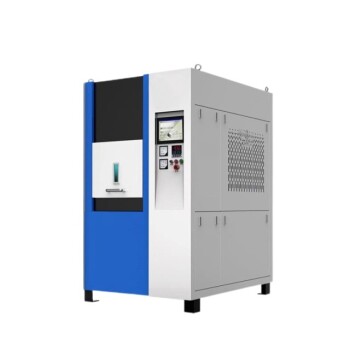
A high-temperature sintering furnace acts as a precision stress-test environment for halide solid electrolyte materials. It contributes to compatibility testing by subjecting materials to exact thermal profiles, allowing researchers to determine if the electrolyte will chemically react or decompose when in contact with electrode materials during high-heat manufacturing steps.
Core Insight Reliability in solid-state batteries depends on the chemical stability of the electrolyte during the co-sintering process. The high-temperature furnace simulates this critical manufacturing phase, acting as the primary tool to verify that materials can withstand specific thermal histories without degrading or triggering adverse reactions.
Simulating Real-World Manufacturing
Replicating Co-Sintering Processes
The primary contribution of the furnace is its ability to simulate co-sintering.
In battery manufacturing, the solid electrolyte and electrode are often heated together to form a cohesive unit. The furnace replicates this environment to see how the materials behave when processed jointly.
Controlled Heating Rates
Precision is the defining feature of these furnaces. They do not simply "heat up" materials; they follow specific heating rates, such as 5 K/min.
This controlled ramp-up is crucial because rapid temperature changes can induce thermal shock or alter reaction kinetics, leading to false negatives or positives in compatibility data.
Specific Holding Temperatures
The furnace maintains materials at specific holding temperatures, such as 170°C or 320°C, for set durations.
These specific thermal plateaus mirror the actual conditions a battery cell would experience during fabrication, ensuring the test results are relevant to real-world production.
Verifying Material Integrity
Detecting Chemical Reactions
The furnace environment allows researchers to observe if the halide solid electrolyte reacts with the electrode materials.
At elevated temperatures, materials that are stable at room temperature may begin to interact. The furnace exposes these potential incompatibilities before the materials are integrated into a full cell.
Monitoring Decomposition
Beyond interaction with electrodes, the furnace tests the intrinsic stability of the electrolyte itself.
It verifies whether the electrolyte undergoes thermal decomposition under the specific thermal history defined by the heating rate and holding temperature.
Understanding the Trade-offs
The Scope of Simulation
While a high-temperature sintering furnace provides critical thermal data, it focuses primarily on temperature-induced changes.
It isolates the thermal variable effectively. However, it is important to remember that in a full production line, other variables such as pressure and mechanical stress also play a role in material compatibility.
Sensitivity to Parameters
The accuracy of the compatibility test is highly dependent on the chosen parameters.
Using a heating rate or holding temperature that deviates even slightly from the target manufacturing process (e.g., varying from the 5 K/min standard) can yield results that do not accurately predict final cell performance.
Applying Thermal Analysis to Your Research
To maximize the value of your compatibility testing, align your furnace parameters with your specific research objectives.
- If your primary focus is process optimization: Prioritize testing different heating rates (e.g., 5 K/min) to find the fastest processing time that maintains material stability.
- If your primary focus is material screening: Focus on the holding temperatures (e.g., 170°C or 320°C) to identify the maximum thermal threshold your electrolyte can withstand before decomposing.
By strictly controlling the thermal history, you transform the sintering furnace from a simple heater into a definitive validation tool for solid-state battery chemistry.
Summary Table:
| Feature | Contribution to Compatibility Testing |
|---|---|
| Co-Sintering Simulation | Replicates joint heating of electrolyte and electrode to observe chemical interactions. |
| Precision Heating Rates | Controls thermal ramp-up (e.g., 5 K/min) to prevent thermal shock and study kinetics. |
| Specific Holding Temps | Maintains plateaus (e.g., 170°C, 320°C) to mirror real-world fabrication conditions. |
| Decomposition Analysis | Identifies the intrinsic thermal thresholds where electrolyte materials begin to degrade. |
| Reaction Detection | Exposes potential incompatibilities between materials before full-scale integration. |
Elevate Your Solid-State Battery Research with KINTEK
Precise thermal control is the backbone of material integrity. KINTEK specializes in advanced laboratory equipment designed for the most demanding research environments. From our precision high-temperature muffle and tube furnaces to our robust vacuum and atmosphere-controlled systems, we provide the exact thermal profiles needed for your halide solid electrolyte and electrode compatibility tests.
Our extensive portfolio supports every stage of your workflow, featuring:
- High-Temperature Sintering & Vacuum Furnaces for rigorous thermal history simulation.
- Hydraulic Pellet & Isostatic Presses for superior electrode/electrolyte contact.
- Crushing, Milling, and Sieving Systems for precise material preparation.
- Battery Research Tools & Consumables tailored for next-generation energy storage.
Don't let thermal instability compromise your innovation. Contact KINTEK today to consult with our experts and find the perfect equipment solution for your laboratory.
Related Products
- 2200 ℃ Tungsten Vacuum Heat Treat and Sintering Furnace
- Vacuum Heat Treat and Pressure Sintering Furnace for High Temperature Applications
- High Temperature Muffle Oven Furnace for Laboratory Debinding and Pre Sintering
- 2200 ℃ Graphite Vacuum Heat Treat Furnace
- Ultra-High Temperature Graphite Vacuum Graphitization Furnace
People Also Ask
- What is the melting point of tungsten in a vacuum? The Real Limit is Sublimation, Not Melting
- What happens to tungsten when heated? Discover Its Extreme Heat Resistance and Unique Properties
- How does a high-temperature vacuum sintering furnace facilitate the post-treatment of Zirconia coatings?
- How does a high-temperature vacuum sintering furnace contribute to the formation of Fe-Cr-Al porous materials?
- Why is it necessary to use sintering aids for PLS? Achieve Full Density in Ultra-High Temperature Ceramics