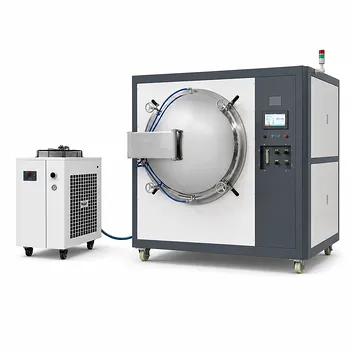
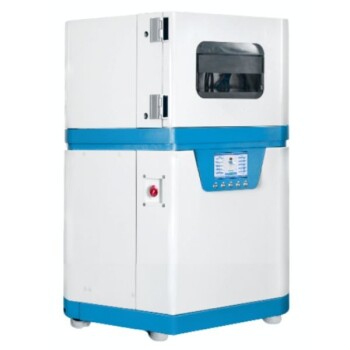
The primary function of a high vacuum environment in a vacuum hot pressing furnace is to ensure chemical purity and physical continuity within the composite material. By maintaining a vacuum (often reaching 0.1 Pa), the system prevents the rapid oxidation of aluminum powder that naturally occurs at high temperatures. Simultaneously, it actively extracts volatile gases and adsorbed air from the interstitial spaces between particles, clearing the path for creating a dense, high-strength material.
Core Takeaway The vacuum environment acts as an essential purification tool, eliminating the "oxide barrier" and "gas pockets" that typically weaken aluminum composites. This allows heat and pressure to fuse the material at an atomic level, resulting in near-perfect density and superior mechanical performance.
Overcoming the Chemistry of Aluminum
The Critical Battle Against Oxidation
Aluminum has a notoriously high affinity for oxygen. When exposed to high temperatures during processing, aluminum powder will instantly form a tough oxide film if air is present.
This film acts as a ceramic barrier. It prevents the metal particles from physically touching and bonding with one another or with reinforcement materials (like ceramics or diamonds).
By removing oxygen from the chamber, the vacuum ensures that the particle surfaces remain metallic and reactive. This is the prerequisite for forming a cohesive solid rather than a loosely packed cluster of oxidized particles.
Protecting Sensitive Reinforcements
It is not just the aluminum matrix that needs protection. Many high-performance composites use reinforcements like diamond particles.
Without a vacuum, diamond particles can undergo graphitization or oxidation at sintering temperatures. The vacuum environment preserves the structural integrity of these reinforcements, ensuring they retain their hardness and wear resistance in the final product.
Enhancing Structural Density
Removing the Invisible Barriers
Before heat is even applied, the spaces between powder particles are filled with air and adsorbed moisture.
If these volatile gases are not removed, they become trapped inside the material as it densifies. This results in internal porosity, which significantly lowers the material's strength and fatigue resistance.
The vacuum system actively "degasses" the powder. It extracts these impurities from the deep gaps between particles, reducing the likelihood of void formation.
Facilitating Diffusion Bonding
Once the surfaces are clean (free of oxides) and the gaps are empty (free of gas), the physics of bonding changes.
The vacuum allows for cleaner particle contact. Under heat and pressure, atoms can diffuse across the boundaries between the aluminum matrix and the reinforcement.
This creates a metallurgical bond—where the materials are fused at an atomic level—rather than a weak mechanical bond. This leads to significantly higher interfacial strength.
The Synergy of Vacuum and Pressure
Driving Plastic Flow
While the vacuum prepares the environment, the "hot pressing" aspect provides the force. The furnace applies uniaxial mechanical pressure (e.g., 30 MPa) while the material is hot (e.g., 460℃ - 823K).
Because the vacuum has removed the gas resistance, this pressure effectively forces the semi-solid or liquid aluminum to flow.
Filling the Interstitial Gaps
This process is known as plastic flow. The aluminum matrix is forced into the microscopic voids between hard reinforcement particles (like Boron Carbide or B4C).
This action eliminates residual pores during the formation of sintering necks. The result is a composite with exceptional relative density (often exceeding 99%), directly translating to improved hardness and wear resistance.
Understanding the Trade-offs
Process Complexity and Speed
Vacuum hot pressing is a batch process, not a continuous one. Creating a high vacuum (0.1 Pa) takes time and requires sophisticated sealing and pumping systems.
This makes the cycle time longer compared to atmospheric sintering methods. It is a trade-off between throughput volume and material quality.
Material Volatility Risks
While vacuum removes impurities, extremely high vacuums at high temperatures can theoretically vaporize certain desirable alloying elements if they have high vapor pressures (like Zinc or Magnesium).
However, for standard aluminum composites, the benefits of removing oxygen and hydrogen far outweigh this risk, provided the vacuum levels and temperatures are precisely controlled.
Making the Right Choice for Your Goal
- If your primary focus is Tensile Strength: Prioritize the vacuum level to ensure zero oxidation, as oxide inclusions act as crack initiation sites that lower strength.
- If your primary focus is Wear Resistance: Focus on the synergy between vacuum and pressure (30+ MPa) to maximize density and eliminate micropores that lead to surface degradation.
- If your primary focus is Thermal Conductivity: Ensure the vacuum cycle includes a dwell time for degassing to minimize interfacial thermal resistance between the matrix and reinforcement.
In summary, the vacuum environment transforms aluminum powder from a reactive, porous aggregate into a chemically pure, fully dense composite capable of enduring extreme mechanical stress.
Summary Table:
| Feature | Impact of High Vacuum (0.1 Pa) | Resulting Material Benefit |
|---|---|---|
| Oxidation Control | Prevents formation of tough Al-oxide ceramic barriers | Stronger atomic-level metallurgical bonding |
| Degassing | Extracts trapped air and adsorbed moisture from powder | Eliminates internal porosity and void formation |
| Reinforcement Care | Prevents graphitization of diamond/ceramic particles | Preserves hardness and wear resistance |
| Sintering Synergy | Removes gas resistance during 30+ MPa pressure | Achieves >99% relative density and plastic flow |
Elevate Your Material Science with KINTEK
Precision engineering starts with a controlled environment. KINTEK specializes in advanced laboratory equipment, offering high-performance vacuum hot pressing furnaces designed to eliminate the 'oxide barrier' and achieve near-perfect density in your aluminum-based composites.
From high-temperature furnaces and hydraulic presses to specialized battery research tools and ceramic consumables, we provide the comprehensive solutions needed for cutting-edge research and industrial production.
Ready to optimize your sintering process? Contact KINTEK today to discuss your project requirements!
Related Products
- Vacuum Hot Press Furnace Heated Vacuum Press Machine Tube Furnace
- 600T Vacuum Induction Hot Press Furnace for Heat Treat and Sintering
- Vacuum Hot Press Furnace Machine Heated Vacuum Press
- Vacuum Hot Press Furnace Machine for Lamination and Heating
- Vacuum Heat Treat and Pressure Sintering Furnace for High Temperature Applications
People Also Ask
- What advantages does a vacuum hot press furnace provide for LSLBO ceramic electrolytes? Achieve 94% Relative Density
- What role does a Vacuum Hot Press (VHP) furnace play in the densification of austenitic stainless steel 316 composites?
- What are the advantages of using a vacuum hot pressing furnace? Superior Densification for 2024Al/Gr/SiC Composites
- What are the advantages of a vacuum hot press furnace for LTPO solid electrolytes? Boost Density and Conductivity
- What core processing conditions does a vacuum hot press furnace provide? Achieve High-Density Cu-SiC/Diamond Composites