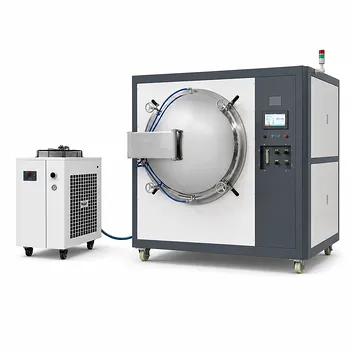
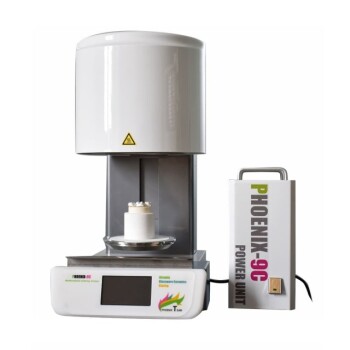
A hot press sintering furnace provides the critical thermodynamic environment required to transform titanium and aluminum precursors into a high-performance Ti/Al3Ti composite. By executing a precise, multi-stage heating profile—specifically targeting 660°C and 710°C—the furnace melts the aluminum layers to trigger an interfacial diffusion reaction. This process creates the intermetallic Al3Ti phase in situ, resulting in a material renowned for its high hardness and penetration resistance.
Core Takeaway The furnace functions as a complex chemical reactor rather than a simple heater. It synchronizes staged heating with dynamic pressure regulation—applying force to maximize contact during solid states while reducing it during melting—to ensure the correct chemical stoichiometry and a dense, oxidation-free structure.
The Mechanism of Reaction Synthesis
Staged Thermal Control
The synthesis of Ti/Al3Ti is not a linear heating process; it requires precise thermal staging. The furnace heats the material to specific plateaus, notably 660°C and 710°C.
Triggering the Liquid Phase
At the 660°C threshold, the furnace melts the aluminum component. This transition from solid to liquid is the catalyst that triggers the interfacial diffusion reaction between the titanium and the molten aluminum.
In Situ Phase Generation
Rather than mechanically mixing separate components, the furnace facilitates the growth of the intermetallic Al3Ti phase directly within the matrix. This in situ generation creates a stronger, more cohesive internal structure compared to traditional mixing methods.
The Role of Pressure and Environment
Dynamic Pressure Regulation
Pressure application is not static; it must adapt to the material's phase. During the solid-solid diffusion stage (600-650°C), the furnace applies continuous pressure to ensure tight contact and minimize physical gaps between layers.
Managing the Molten State
Crucially, when the aluminum melts, the furnace must allow for pressure reduction, potentially down to 0 MPa. This prevents the liquid aluminum from being squeezed out of the mold, ensuring the chemical ratio (stoichiometry) remains accurate for the reaction.
Vacuum Protection
Titanium is highly reactive at elevated temperatures. The furnace operates under a high vacuum to prevent oxidation and nitridation. This ensures the final composite maintains pure metallic and intermetallic bonds without brittle oxide inclusions.
Understanding the Trade-offs
The Risk of Pressure Mismanagement
The primary challenge in this process is the synchronization of pressure with temperature. If high pressure is maintained while the aluminum is liquid, the reactant is ejected, leading to incomplete compound formation and poor structural integrity.
Density vs. Stoichiometry
While high pressure generally improves densification (eliminating pores), it competes with the need to contain the liquid phase. The process requires a delicate balance: enough pressure to bond the solid Ti, but sufficient relaxation to retain the liquid Al for reaction.
Making the Right Choice for Your Goal
To maximize the quality of your Ti/Al3Ti composites, align your furnace parameters with your specific objectives:
- If your primary focus is Chemical Purity: Prioritize high-vacuum capabilities to eliminate oxygen and prevent the embrittlement of the titanium matrix.
- If your primary focus is Structural Homogeneity: Ensure the furnace offers precise, programmable pressure ramping to relax force strictly during the aluminum melting window.
Successful synthesis relies not just on reaching high temperatures, but on the precise orchestration of heat, pressure, and atmosphere to dictate the material's internal evolution.
Summary Table:
| Process Stage | Temperature | State of Aluminum | Pressure Strategy | Purpose |
|---|---|---|---|---|
| Solid State | 600-650°C | Solid | High / Continuous | Maximize layer contact & diffusion |
| Phase Trigger | 660°C | Melting | Reduced (to 0 MPa) | Prevent liquid loss; maintain stoichiometry |
| Reaction Synthesis | 710°C+ | Liquid / Intermetallic | Managed | Facilitate in situ Al3Ti phase growth |
| Vacuum Env. | All Stages | N/A | High Vacuum | Prevent oxidation & nitridation of Ti |
Elevate Your Material Research with KINTEK Advanced Sintering Solutions
Precise control over the thermal and thermodynamic environment is the difference between a brittle failure and a high-performance composite. KINTEK specializes in high-precision laboratory equipment, including hot press sintering furnaces, vacuum furnaces, and induction melting systems designed for demanding reaction synthesis.
Whether you are developing Ti/Al3Ti composites or researching advanced battery materials, our equipment provides the dynamic pressure regulation and high-vacuum integrity required for purity and density. Beyond furnaces, we offer a complete range of pellet, hot, and isostatic hydraulic presses, along with high-temperature consumables like ceramics and crucibles.
Ready to optimize your synthesis process? Contact KINTEK today to discuss your technical requirements!
Related Products
- 600T Vacuum Induction Hot Press Furnace for Heat Treat and Sintering
- Vacuum Heat Treat and Pressure Sintering Furnace for High Temperature Applications
- Vacuum Heat Treat and Sintering Furnace with 9MPa Air Pressure
- Vacuum Hot Press Furnace Heated Vacuum Press Machine Tube Furnace
- Vacuum Hot Press Furnace Machine Heated Vacuum Press
People Also Ask
- What role does an induction vacuum hot pressing furnace play in sintering? Achieve 98% Density in Carbide Blocks
- What advantages does a vacuum hot press furnace provide for LSLBO ceramic electrolytes? Achieve 94% Relative Density
- What role does a Vacuum Hot Press (VHP) furnace play in the densification of austenitic stainless steel 316 composites?
- What are the advantages of a vacuum hot press furnace for W-50%Cu? Achieve 99.6% Density at Lower Temperatures
- What role does mechanical pressure play during the vacuum diffusion bonding of tungsten and copper? Keys to Solid Bonding