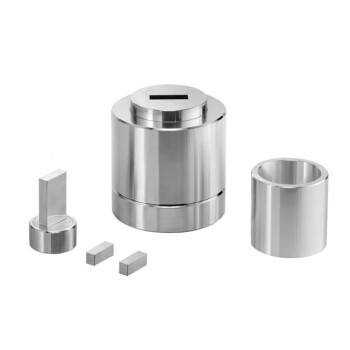
A laboratory hydraulic press serves as the fundamental densification tool in the preparation of iodo-vanadate-lead ceramics. By applying uniform pressure to precursor powders within a mold, the press transforms loose material into dense, cylindrical "green bodies," creating the necessary physical architecture for successful chemical synthesis.
Core Takeaway The hydraulic press does not merely shape the powder; it critically reduces the distance between reactant particles to increase their effective contact area. This proximity is the prerequisite for promoting solid-state diffusion and ensuring the efficient binding of iodine within the ceramic matrix during heat treatment.
The Mechanics of Green Body Formation
Achieving Uniform Compaction
The primary role of the hydraulic press is to apply significant, uniform force to the iodo-vanadate-lead precursor powders. This process forces the loose particles to rearrange and pack tightly within a precision mold.
Creating the Green Body
This compaction results in a "green body"—a consolidated pellet with specific geometric integrity. This state provides the material with sufficient handling strength and initial density, which are necessary foundations for the subsequent processing steps.
Minimizing Macroscopic Defects
By applying controlled pressure, the press eliminates large internal voids and air pockets. Removing these macro-defects is essential to prevent severe deformation or cracking when the material is eventually subjected to thermal treatment.
Impact on Chemical Synthesis
Reducing Reactant Distance
The most critical contribution of the press is the reduction of physical space between the precursor particles. High compaction pressure minimizes inter-particle voids, bringing the reactants into intimate contact.
Promoting Solid-State Diffusion
This increased contact area is the driving force for solid-state diffusion. Because the particles are physically closer, atoms can diffuse across grain boundaries more effectively during heat treatment, facilitating the chemical reactions required to form the final ceramic phase.
Enhancing Iodine Binding Efficiency
For iodo-vanadate-lead ceramics specifically, high-density compaction directly correlates to chemical stability. By maximizing particle contact and diffusion, the process improves the efficiency with which iodine is bound within the ceramic matrix, a critical factor for the material's final performance.
Common Pitfalls to Avoid
Inconsistent Pressure Application
While pressure is vital, it must be applied uniformly. Inconsistent pressure or poor mold precision can lead to density gradients within the pellet, causing warping or heterogeneous properties in the final ceramic.
Neglecting Pressure-Holding Time
Simply reaching peak pressure is often insufficient; precise control over the holding time is required. Rushing this stage may result in "spring-back" effects or trapped air, which can reintroduce micro-cracks that compromise the structural integrity of the green body.
Making the Right Choice for Your Goal
To maximize the effectiveness of your hydraulic press in this specific application:
- If your primary focus is Chemical Stability: Prioritize achieving the highest possible green density to maximize particle contact, which secures iodine retention and binding.
- If your primary focus is Geometric Integrity: Focus on the uniformity of pressure application and mold precision to eliminate internal voids that lead to cracking during heat treatment.
The success of your iodo-vanadate-lead ceramic relies not just on the chemistry of the powder, but on the mechanical precision of the initial compaction.
Summary Table:
| Feature | Role in Ceramic Preparation | Impact on Material Performance |
|---|---|---|
| Particle Compaction | Reduces inter-particle distance | Increases contact area for solid-state diffusion |
| Densification | Eliminates voids and air pockets | Prevents cracking and deformation during heating |
| Geometric Shaping | Creates cylindrical green bodies | Ensures structural integrity and handling strength |
| Pressure Control | Uniform force application | Improves iodine binding efficiency and matrix stability |
Elevate Your Material Research with KINTEK Precision
Achieve uncompromising density and chemical stability in your iodo-vanadate-lead ceramic green bodies. KINTEK specializes in high-performance laboratory equipment, offering a comprehensive range of hydraulic presses (pellet, hot, isostatic), crushing and milling systems, and high-temperature furnaces designed for the rigors of advanced ceramic synthesis.
Whether you are focusing on battery research, iodine binding efficiency, or structural ceramics, our expertise in high-pressure reactors and precision consumables like PTFE and crucibles ensures your lab operates at peak efficiency.
Ready to optimize your compaction process? Contact KINTEK today to discuss our tailored solutions for your specific material science needs.
References
- Erik V. Johnstone, Neil C. Hyatt. Synthesis and characterization of iodovanadinite using PdI<sub>2,</sub> an iodine source for the immobilisation of radioiodine. DOI: 10.1039/d0ra04114a
This article is also based on technical information from Kintek Solution Knowledge Base .
Related Products
- Heated Hydraulic Press Machine with Integrated Manual Heated Plates for Lab Use
- Laboratory Manual Hydraulic Pellet Press for Lab Use
- Laboratory Hydraulic Press Split Electric Lab Pellet Press
- Manual Lab Heat Press
- Automatic Laboratory Hydraulic Pellet Press Machine for Lab Use
People Also Ask
- Why is a heated laboratory hydraulic press necessary for composite laminates? Achieve Void-Free Structural Integrity
- What role does a heated hydraulic press play in Cold Sintering (CSP)? Enhancing LATP-Halide Densification
- What technical conditions does a heated hydraulic press provide for PEO batteries? Optimize Solid-State Interfaces
- Why is the heating function of a laboratory hydraulic press essential for MEA assembly in DEFC? Optimize Cell Bonding
- What are heated hydraulic presses used for? Molding Composites, Vulcanizing Rubber, and More