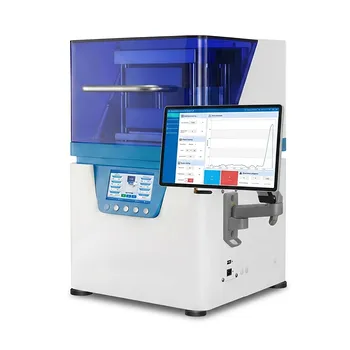
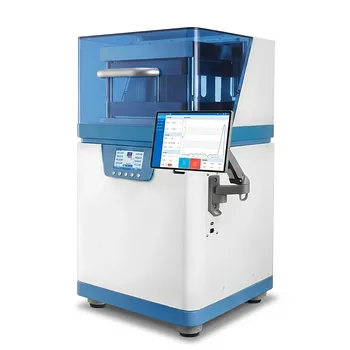
A laboratory hydraulic press is the critical tool used to transform opaque catalyst powders into transparent, solid pellets for FTIR analysis. By applying high static pressure to a mixture of the catalyst and potassium bromide (KBr), the press eliminates light-scattering gaps between particles. This physical transformation allows infrared radiation to pass through the sample, enabling the precise detection of molecular vibrations and surface chemical states.
Core Takeaway: The hydraulic press converts loose powder into a uniform, optically transparent medium, which is essential for minimizing signal interference and ensuring that infrared light can interact directly with the catalyst's internal bonding and surface functional groups.
Overcoming the Problem of Light Scattering
The Physical Barrier of Powders
Raw catalyst powders are naturally opaque and highly reflective. When infrared light hits a loose powder, it scatters in multiple directions rather than penetrating the sample, resulting in a "noisy" spectrum with poor resolution.
The Role of KBr as a Matrix
Potassium bromide (KBr) is used because it is transparent to infrared light. By mixing a small amount of catalyst—typically at a 1:100 ratio—with KBr, the hydraulic press can fuse the mixture into a single, cohesive window that hosts the sample in a diluted state.
Creating a Clear Light Path
The press applies uniform force to a pellet die, forcing the KBr to flow and encapsulate the catalyst particles. This creates a thin, dense pellet with a consistent thickness, which is a fundamental requirement for the infrared beam to travel through the sample to the detector.
Enhancing Analytical Precision and Detail
Monitoring Metal Oxide Vibrations
The high-pressure molding process allows researchers to observe specific metal oxide bonding vibrations, such as Ni-O, Cd-O, and Al-O. Without the transparency provided by the press, these fine spectral signals would be lost to background interference.
Characterizing Surface States
A well-pressed pellet enables the characterization of surface hydroxyl groups and framework shifts. For example, in zeolite catalysts, the press facilitates the identification of Si/Al-O vibrations near 1025 cm⁻¹, confirming whether metal ions have been successfully embedded into the structure.
Ensuring Signal Intensity
By producing a flat, uniform surface, the hydraulic press ensures a consistent light path during transmission mode. This standardization maximizes signal intensity and allows for the accurate determination of chemical bonding states between active components and their carriers.
Understanding the Trade-offs and Pitfalls
The Risk of Pressure Imbalance
Applying incorrect pressure can compromise the analysis. Under-pressuring results in an opaque, crumbly pellet that scatters light, while over-pressuring (typically exceeding 7 tons for standard dies) can crack the pellet or cause the KBr to recrystallize, distorting the optical path.
Contamination and Moisture Sensitivity
KBr is highly hygroscopic, meaning it absorbs moisture from the air rapidly. If the pressing process is not handled quickly or in a controlled environment, water peaks will appear in the FTIR spectrum, potentially masking the very surface hydroxyls or functional groups the researcher intended to study.
Sample Concentration Accuracy
If the catalyst is not distributed evenly within the KBr before pressing, the resulting pellet will have "hot spots." This leads to detector saturation, where the infrared signal is completely absorbed in some areas, making it impossible to quantify the chemical species present.
How to Optimize Your Sample Preparation
Effective catalyst characterization depends on the quality of the pellet produced by the hydraulic press.
- If your primary focus is surface-adsorbed species: Ensure the press applies between 5 to 7 tons of pressure to create a self-supporting pellet that is thin enough for high-resolution transmission.
- If your primary focus is structural framework analysis: Use a precise 1:100 dilution ratio to prevent the signal from becoming too intense, which allows for the clear identification of specific framework vibrations like Si/Al-O.
- If your primary focus is multi-technique consistency: Use the hydraulic press to maintain a standardized pellet diameter (e.g., 1.2 cm) to ensure the sample can be reliably compared across FTIR, XRD, and XPS instruments.
By mastering the mechanical application of pressure, you ensure that the resulting spectroscopic data is a true reflection of the catalyst's chemical identity rather than an artifact of poor sample preparation.
Summary Table:
| Aspect | Role of Hydraulic Press | Analytical Benefit |
|---|---|---|
| Transparency | Fuses KBr and catalyst into a solid window | Eliminates light scattering for a clear signal path |
| Uniformity | Applies high static pressure (5-7 tons) | Ensures consistent thickness and signal intensity |
| Precision | Encapsulates particles in a diluted state | Detects fine molecular vibrations and surface states |
| Stability | Creates a self-supporting, flat pellet | Allows for reproducible results across different instruments |
Elevate Your Catalyst Research with KINTEK Precision
Precise FTIR analysis starts with flawless sample preparation. KINTEK specializes in high-performance laboratory equipment designed to meet the rigorous demands of material science. Our range of manual and automated laboratory hydraulic presses, paired with precision-engineered pellet dies, ensures you achieve the perfectly transparent, uniform KBr pellets required for high-resolution spectroscopy.
Beyond pelleting, KINTEK offers a comprehensive portfolio to support your entire workflow, including:
- Crushing and milling systems for optimal powder homogenization.
- High-temperature furnaces (Muffle, Vacuum, CVD) for catalyst synthesis.
- Consumables such as high-purity KBr, ceramics, and crucibles.
Whether you are characterizing zeolite frameworks or monitoring surface hydroxyls, our tools provide the reliability you need for consistent, publication-quality data. Contact KINTEK today to find the perfect hydraulic press and preparation tools for your laboratory!
References
- Yusmaniar Yusmaniar, Sigit Dwi Yudanto. Preparation, Characterization, and Photocatalytic Activity of Ni-Cd/Al2O3 Composite Catalyst. DOI: 10.9767/bcrec.20045
This article is also based on technical information from Kintek Solution Knowledge Base .
Related Products
- Laboratory Hydraulic Press Split Electric Lab Pellet Press
- Laboratory Hydraulic Press Lab Pellet Press Machine for Glove Box
- Laboratory Hydraulic Press Lab Pellet Press for Button Battery
- Automatic Laboratory Hydraulic Pellet Press Machine for Lab Use
- Fully Automatic Heated Hydraulic Lab Press for Materials Sintering and Sample Preparation
People Also Ask
- What role does a laboratory hydraulic press play in platinum recovery research? Enhancing Sample Precision
- What are the specific applications of a lab hydraulic press in biochar evaluation? Optimize density and data accuracy.
- What are the roles of a laboratory hydraulic press and stainless steel molds in the preparation of graphite samples?
- What is the role of a laboratory hydraulic press in electrode prep? Maximize Energy Density & Sealing Precision
- Why must a laboratory hydraulic press equipped with cylindrical molds be used when preparing BZY green bodies? High Density