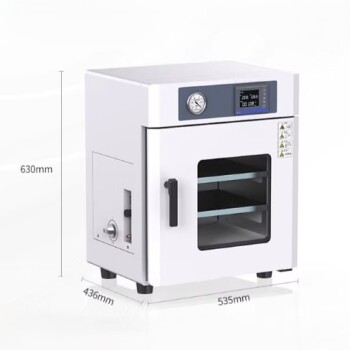
Reliability stems from environmental precision. A laboratory atmosphere furnace ensures the reliability of the pre-oxidation process by maintaining rigorous control over temperature and atmospheric composition. By sustaining specific thermal conditions, such as 800°C or 900°C in an air environment for a set duration, the furnace guarantees the consistent formation of a dense chromium oxide protective film on the alloy's surface.
The core value of these furnaces lies in their ability to create a reproducible baseline for testing. By ensuring a uniform protective layer forms every time, researchers can isolate variables when analyzing how materials fail under the reducing effects of liquid magnesium or fatigue stress.
The Mechanics of Consistent Oxidation
Precise Temperature Regulation
To achieve a reliable pre-oxidation layer, the furnace must hold steady temperatures without fluctuation.
Common protocols involve heating the specimen to 800°C or 900°C. This thermal stability is non-negotiable for activating the chemical reactions necessary for uniform surface modification.
Time-Based Saturation
Temperature alone is insufficient; the duration of exposure determines the thickness and quality of the oxide layer.
The standard process often requires a hold time of 3 hours. The furnace’s ability to maintain the set temperature for this exact duration ensures the reaction reaches the necessary completion point.
Stable Atmospheric Environment
Unlike vacuum processes that remove gases, this specific pre-oxidation process utilizes an air atmosphere.
The furnace circulates this atmosphere to ensure oxygen is available to react with the chromium in the alloy. This controlled exposure is what creates the dense chromium oxide film required for protection.
The Role of the Oxide Film
Creating the Chromium Oxide Barrier
The primary output of this furnace process is a dense chromium oxide film.
This layer acts as a shield for the underlying alloy substrate. The reliability of the furnace directly correlates to the density and integrity of this film.
Establishing a Testing Baseline
Reliability in the furnace allows researchers to trust that the starting condition of every specimen is identical.
If the furnace fluctuated, the oxide film would be inconsistent. This would make it impossible to determine if a material failed due to inherent structural weakness or poor surface preparation.
Understanding the Trade-offs: Failure Analysis
The Reducing Effect of Liquid Magnesium
While the furnace creates the protective film, the ultimate goal often involves testing that film's limits.
Research utilizes these furnaces to investigate how this pre-oxidation film fails when exposed to liquid magnesium. The furnace ensures the initial film is perfect so that the degradation caused by the magnesium's reducing effect can be accurately measured.
Fatigue and Cycle Damage
The reliability of the equipment is critical when studying complex failure modes like fatigue life.
Researchers analyze damage caused by alternating cycles of oxidation and metal infiltration. The furnace provides the stable environment needed to simulate these repetitive stresses without introducing external errors.
Making the Right Choice for Your Goal
To ensure your material analysis is valid, you must match your thermal processing to your specific research objectives.
- If your primary focus is Protective Coating: Prioritize a furnace that maintains strict temperature uniformity at 800°C–900°C to guarantee a dense, unbroken chromium oxide layer.
- If your primary focus is Fatigue Analysis: Ensure your process creates a repeatable baseline film, allowing you to accurately attribute failure to liquid magnesium infiltration rather than inconsistent heating.
Consistency in your thermal processing is the only way to distinguish between a material flaw and a manufacturing variable.
Summary Table:
| Feature | Specification | Impact on Reliability |
|---|---|---|
| Temperature Control | 800°C - 900°C Stability | Ensures activation of chemical reactions for uniform film formation. |
| Hold Time | Standard 3-hour duration | Guarantees the necessary thickness and completion of the oxide layer. |
| Atmosphere | Controlled Air Environment | Provides consistent oxygen levels for a dense chromium oxide barrier. |
| Surface Outcome | Dense Chromium Oxide Film | Creates a repeatable baseline for magnesium reduction and fatigue testing. |
Elevate Your Material Research with KINTEK Precision
Consistency in thermal processing is the only way to distinguish between a material flaw and a manufacturing variable. KINTEK specializes in high-performance laboratory equipment designed to deliver the environmental precision your research demands.
Whether you require high-temperature atmosphere or vacuum furnaces for reliable pre-oxidation, crushing and milling systems for sample preparation, or high-pressure reactors and autoclaves for advanced material testing, our comprehensive portfolio has you covered.
Maximize your lab's accuracy and reproducibility today. Contact our experts to find the perfect solution for your alloy research!
References
- Namurata Sathirachinda Pålsson, Sinthu Chanthapan. Effect of liquid magnesium on high temperature failure of heat resistant alloy. DOI: 10.1016/j.engfailanal.2017.03.021
This article is also based on technical information from Kintek Solution Knowledge Base .
Related Products
- 1200℃ Controlled Atmosphere Furnace Nitrogen Inert Atmosphere Furnace
- Laboratory Vacuum Tilt Rotary Tube Furnace Rotating Tube Furnace
- Lab-Scale Vacuum Induction Melting Furnace
- 1700℃ Controlled Atmosphere Furnace Nitrogen Inert Atmosphere Furnace
- 1400℃ Controlled Atmosphere Furnace with Nitrogen and Inert Atmosphere
People Also Ask
- What is a controlled atmosphere furnace? Achieve Purity and Precision in High-Temp Processing
- What is the function of a controlled atmosphere furnace? Master Nitriding for AISI 52100 & 1010 Steel
- What is a controlled atmosphere furnace for heat treatment? Master Surface Chemistry and Metallurgy
- What is the necessity of a controlled atmosphere furnace for corrosion research? Replicating Realistic Industrial Risks
- Can you braze copper to brass without flux? Yes, but only under these specific conditions.