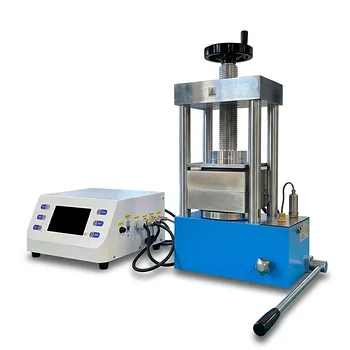
A large-scale hot extrusion hydraulic press acts as a critical mechanism for transforming mechanically alloyed powders or ingots of FeCrAl and 14YWT alloys into high-density solid materials. By applying massive axial pressure within a specific temperature window of 800°C to 850°C, the press forces the material through significant plastic deformation to achieve structural refinement.
The core function of this process is to achieve high material density through intense deformation while simultaneously establishing a specific initial deformed structure. This structure is not just an end product but a necessary precursor for subsequent recrystallization research.
The Mechanics of Densification
The Role of Massive Axial Pressure
The primary driver for densification is the application of massive axial pressure. This force is directed along the axis of the material, compressing mechanically alloyed powders or ingots.
By forcing the material through the extrusion die, the press eliminates internal voids and porosity inherent in the starting material. This mechanical compression is essential for achieving the high density required for advanced alloy performance.
Controlled Thermal Environment
Pressure alone is insufficient for these alloys; the process requires a high-temperature environment. The extrusion typically occurs between 800°C and 850°C.
This thermal energy lowers the material's yield strength, allowing it to flow under pressure without fracturing. It facilitates the consolidation of the alloy components into a unified solid mass.
Structural Transformation
Intense Plastic Deformation
As the FeCrAl and 14YWT alloys pass through the press, they undergo large-scale deformation. This is not merely a change in shape, but a fundamental alteration of the internal material state.
The intense plastic deformation ensures that the constituent elements are physically forced together at a microscopic level. This creates a more homogeneous and solid internal structure compared to the raw state.
Grain Structure Refinement
One of the most critical outcomes of this process is the refinement of the grain structure. The combination of heat and extreme pressure breaks down coarse grains.
This results in a finer, more uniform microstructure. A refined grain structure is generally associated with improved mechanical properties and material consistency.
Understanding the Operational Context
The "Initial Deformed Structure"
It is important to recognize that the output of this extrusion process is often an intermediate state for research purposes. The reference highlights that this process provides a specific initial deformed structure.
This structure is characterized by the stress and strain history of the extrusion. Researchers use this specific state as a baseline to study recrystallization, investigating how new, strain-free grains form from the deformed matrix.
Operational Constraints
The effectiveness of this densification is tightly bound to the temperature parameters (800°C–850°C). Deviating from this range could result in either insufficient densification (too cold) or excessive grain growth/structural changes (too hot).
The process relies on the synergy between thermal softening and mechanical compression. If either variable is misaligned, the desired refined grain structure cannot be achieved.
Making the Right Choice for Your Goal
When utilizing hot extrusion for FeCrAl and 14YWT alloys, your objectives will dictate how you view the output.
- If your primary focus is Material Density: Rely on the massive axial pressure to eliminate porosity and consolidate mechanically alloyed powders into a solid, high-density form.
- If your primary focus is Microstructure Research: Utilize the specific deformed structure created by the intense plastic deformation as a controlled starting point for recrystallization studies.
The hot extrusion hydraulic press is the definitive tool for converting loose alloy potential into a dense, refined reality ready for advanced analysis.
Summary Table:
| Process Parameter | Action/Mechanism | Material Impact |
|---|---|---|
| Massive Axial Pressure | Compression through extrusion die | Eliminates porosity and internal voids |
| Temperature (800°C-850°C) | Thermal softening | Lowers yield strength for plastic flow |
| Plastic Deformation | Microscopic element consolidation | Creates a homogeneous, solid structure |
| Structural Refinement | Breakdown of coarse grains | Produces a fine, uniform microstructure |
| Research Baseline | Stress/strain history retention | Provides initial structure for recrystallization |
Precision Control for Your Advanced Material Synthesis
Unlock the full potential of FeCrAl and 14YWT alloys with KINTEK’s high-performance laboratory solutions. Whether you are conducting recrystallization research or producing high-density solid materials, our specialized hydraulic presses (pellet, hot, isostatic) and high-temperature furnaces provide the exact thermal and mechanical conditions required for superior structural refinement.
From high-pressure reactors to advanced crushing and milling systems, KINTEK equips your laboratory with the precision tools needed for the most demanding material science applications.
Ready to elevate your research outcomes? Contact KINTEK today to discuss our range of custom laboratory equipment and consumables!
References
- Eda Aydogan, S.A. Maloy. Effect of High-Density Nanoparticles on Recrystallization and Texture Evolution in Ferritic Alloys. DOI: 10.3390/cryst9030172
This article is also based on technical information from Kintek Solution Knowledge Base .
Related Products
- Automatic High Temperature Heated Hydraulic Press Machine with Heated Plates for Lab
- 24T 30T 60T Heated Hydraulic Press Machine with Heated Plates for Laboratory Hot Press
- Heated Hydraulic Press Machine with Heated Plates for Vacuum Box Laboratory Hot Press
- Heated Hydraulic Press Machine with Heated Plates for Vacuum Box Laboratory Hot Press
- Manual High Temperature Heated Hydraulic Press Machine with Heated Plates for Lab
People Also Ask
- Why is a heated hydraulic press used for warm pressing NASICON green tapes? Optimize Your Solid Electrolyte Density
- What is a heated hydraulic press used for? Essential Tool for Curing, Molding, and Laminating
- Why is a heated laboratory hydraulic press necessary for composite laminates? Achieve Void-Free Structural Integrity
- What is a hot hydraulic press? Harness Heat and Pressure for Advanced Manufacturing
- What is the core function of a laboratory heated hydraulic press in CSP? Revolutionize Low-Temp Ceramic Sintering