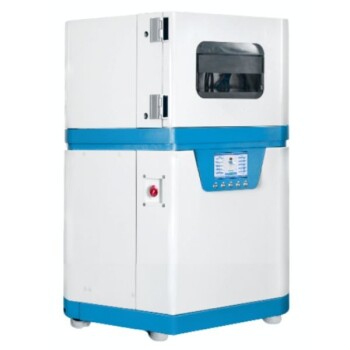
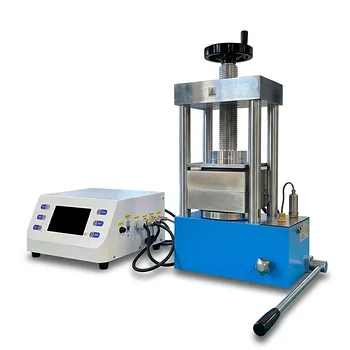
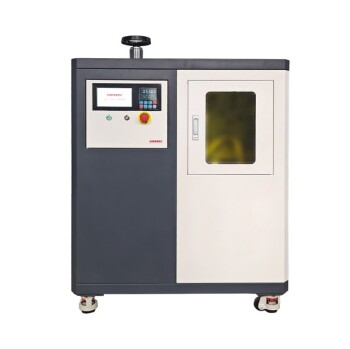
A precision hot press serves as a critical determinant of PEM electrolysis stack efficiency by establishing the physical foundation required for optimal electrochemical reactions. It influences performance by applying strictly controlled temperature and pressure to fuse the catalyst layer, proton exchange membrane, Titanium felt porous transport layer (PTL), and carbon-based gas diffusion layer (GDL) into a unified assembly.
The core value of a precision hot press lies in its ability to facilitate molecular-level bonding, which simultaneously minimizes electrical contact resistance and maximizes the mechanical seal necessary for safe, high-pressure operation.
Optimizing Electrochemical Interfaces
The primary role of the hot press is to transition the stack components from loose layers into a cohesive unit. This has direct implications for the electrical efficiency of the stack.
Reducing Contact Resistance
In a PEM stack, electricity must pass through multiple layers. If these layers merely touch, the resistance is high, leading to energy loss in the form of heat.
A precision hot press applies force to create molecular-level contact between interfaces. This tight bonding significantly reduces interlayer contact resistance, allowing electrons to flow freely and improving overall voltage efficiency.
Bonding Diverse Materials
The assembly process involves distinct materials that do not naturally adhere well. Specifically, the machine bonds the catalyst layer and proton exchange membrane with the Titanium felt PTL and carbon-based GDL.
By successfully fusing these dissimilar materials, the hot press ensures a uniform active area where the electrochemical reaction can occur without interruption.
Ensuring Mechanical Durability
Beyond electrical performance, the hot press influences the physical robustness of the Membrane Electrode Assembly (MEA).
Enhancing Structural Strength
The MEA is the heart of the electrolyzer, but it is fragile on its own. The hot press process enhances the mechanical strength of the assembly.
This reinforcement prevents the components from shifting or delaminating during handling and operation, protecting the sensitive membrane from physical damage.
Sealing for High Pressure
PEM electrolysis often operates at high pressures to generate compressed hydrogen directly.
The bonding achieved during hot pressing ensures long-term sealing integrity. A proper seal is vital to contain high-pressure gases and prevent cross-over leaks, which are safety hazards and efficiency killers.
Understanding the Precision Trade-offs
While the hot press is essential, the "precision" aspect is where the challenge lies. The influence on performance depends entirely on the accuracy of the control parameters.
The Balance of Pressure
The pressure applied must be high enough to reduce resistance but low enough to avoid crushing the porous layers.
If the Titanium felt PTL or Carbon GDL is over-compressed, the pore structure collapses, hindering mass transport. If pressure is too low, contact resistance remains high.
Thermal Control Limitations
Temperature is required to soften the ionomer and create a bond, but excessive heat degrades the membrane.
The machine must maintain a thermal profile that facilitates bonding without thermally stressing the polymer materials, as this would compromise the stack's lifespan.
Making the Right Choice for Your Goal
The configuration of your hot press process should align with your specific performance targets.
- If your primary focus is Electrical Efficiency: Prioritize parameters that maximize molecular-level contact to drive down interlayer resistance.
- If your primary focus is Operational Safety: Focus on the uniformity of the bond to ensure robust sealing against high-pressure leaks.
A precision hot press transforms raw components into a high-performance stack by balancing electrical connectivity with mechanical resilience.
Summary Table:
| Influence Factor | Impact on PEM Stack Performance | Critical Parameter |
|---|---|---|
| Interfacial Contact | Minimizes electrical resistance for higher voltage efficiency | Precise Pressure Loading |
| Material Bonding | Fuses catalyst layers, PTL (Titanium felt), and GDL (Carbon) | Uniform Thermal Control |
| Structural Integrity | Prevents delamination and enhances mechanical durability | Dwell Time & Stability |
| Sealing Capacity | Ensures safety and gas containment under high-pressure | Uniformity of Force |
Elevate Your Hydrogen Research with KINTEK Precision Solutions
Precision is the foundation of a high-performance PEM electrolysis stack. At KINTEK, we specialize in the advanced laboratory equipment necessary to bridge the gap between material science and functional efficiency.
Our hydraulic presses (pellet, hot, isostatic) are engineered to provide the exacting pressure and thermal profiles required to bond delicate catalyst layers and membranes without compromising porous transport structures. Whether you are developing Membrane Electrode Assemblies (MEAs) or optimizing battery research, our comprehensive portfolio—including high-temperature furnaces, crushing systems, and cooling solutions—ensures your lab has the tools to achieve superior results.
Ready to minimize contact resistance and maximize your stack’s lifespan?
Contact a KINTEK Specialist Today to find the perfect precision hot press for your electrolysis and fuel cell applications.
References
- Julia Melke, Christian Kallesøe. Recycalyse – New Sustainable and Recyclable Catalytic Materials for Proton Exchange Membrane Electrolysers. DOI: 10.1002/cite.202300143
This article is also based on technical information from Kintek Solution Knowledge Base .
Related Products
- Automatic Laboratory Heat Press Machine
- Automatic Heated Hydraulic Press Machine with Heated Plates for Laboratory Hot Press 25T 30T 50T
- 30T 40T Split Automatic Heated Hydraulic Press Machine with Heated Plates for Laboratory Hot Press
- Automatic High Temperature Heated Hydraulic Press Machine with Heated Plates for Lab
- Manual High Temperature Heated Hydraulic Press Machine with Heated Plates for Lab
People Also Ask
- What are the core advantages of using a laboratory hot press to produce Bi2Se3? Achieve 93% Density & High Conductivity
- Why is a laboratory hot press necessary for all-solid-state battery assembly? Reduce Impedance and Enhance Performance
- How does a three-stage pressure program affect rice husk particleboards? Optimize Bond Strength & Stability
- What is the primary function of a laboratory hot press in MEA assembly? Optimize Fuel Cell Bonding & Performance
- How does a laboratory hot press improve alloy performance? Optimize Liquid Phase Sintering for High-Strength Materials