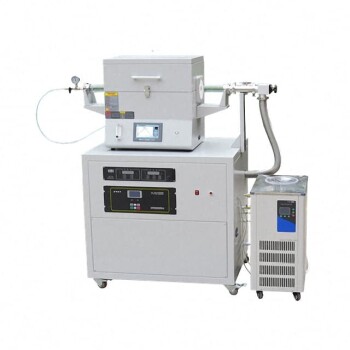
In a horizontal tube vacuum gasification furnace, a quartz tube serves as the central vessel that enables fractional condensation by sustaining a precise axial temperature gradient along its length. By creating distinct temperature zones within a high-vacuum environment, the tube forces different elements to condense at specific physical locations based on their unique vapor pressures.
The quartz tube transforms the furnace from a simple heater into a multi-stage separator. Its ability to maintain a controlled temperature drop allows for the simultaneous removal of volatile impurities and the collection of purified metal in a single operational step.
The Mechanics of Separation
Creating the Axial Temperature Gradient
The defining feature of this system is not just high heat, but the distribution of that heat. The quartz tube allows for the establishment of a specific axial temperature gradient—a controlled decrease in temperature from one end of the tube to the other.
Instead of the entire tube being held at a uniform reaction temperature, the heat profile changes along the tube's length. This creates distinct thermal zones within the same continuous vacuum chamber.
Leveraging Vapor Pressure Differences
Different elements possess different vapor pressures, meaning they condense from gas to solid (or liquid) at different temperatures.
As the vapor mixture travels down the quartz tube, it passes through these progressively cooler zones.
Distinct Deposition Zones
Because of the thermal gradient, specific elements "drop out" of the vapor stream at specific locations.
Impurities with high vapor pressures, such as sodium, potassium, and zinc, will travel further down the tube to cooler zones before condensing.
The primary metal (such as magnesium) will condense in a specific, hotter zone. This physical separation prevents the re-contamination of the primary metal by the impurities.
Material Role and Environment
High-Temperature Resistance
The quartz tube acts as the central reaction chamber. It must maintain structural integrity while subjected to the intense heat required to gasify the raw materials.
While supplementary components (like corundum tubes) may be used for specific high-heat transport channels in some configurations, the quartz vessel itself provides the essential containment for the reaction.
Maintaining a High-Vacuum Environment
For fractional condensation to work effectively, the atmosphere must be strictly controlled.
The quartz tube provides a sealed environment capable of holding a high vacuum. This vacuum lowers the boiling points of the metals, facilitating gasification at achievable temperatures and ensuring the vapor flows predictably toward the condensation zones.
Understanding the Trade-offs
Temperature Gradient Precision
The efficiency of the separation relies entirely on the precision of the temperature gradient.
If the temperature transition along the quartz tube is too gradual or too steep, the deposition zones may overlap. This results in "co-condensation," where impurities mix with the primary metal, defeating the purpose of the fractional setup.
Material Limitations
While quartz offers excellent thermal shock resistance and optical clarity, it has upper temperature limits compared to ceramics like corundum.
Care must be taken to ensure the reaction temperatures do not exceed the softening point of the quartz, particularly in the hottest zones of the furnace.
Optimizing the Process for Purity
To effectively utilize a quartz tube for fractional condensation, you must align your operational parameters with your specific purification targets.
- If your primary focus is High Purity: Ensure the axial temperature gradient is strictly controlled to create wide, non-overlapping spacing between the condensation zones of the magnesium and the impurities.
- If your primary focus is Process Efficiency: Leverage the single-step capability of the tube to remove multiple impurities (Zn, Na, K) simultaneously, rather than running multiple purification cycles.
By controlling the thermal profile along the quartz tube, you turn simple physics into a sophisticated purification tool.
Summary Table:
| Component/Factor | Role in Fractional Condensation | Benefit |
|---|---|---|
| Axial Temp Gradient | Creates distinct thermal zones along the tube length | Allows elements to condense at specific physical locations |
| Vapor Pressure | Determines the specific condensation point of each element | Facilitates physical separation of impurities from primary metal |
| High Vacuum | Lowers boiling points and ensures predictable vapor flow | Enables gasification at lower temperatures and prevents oxidation |
| Quartz Vessel | Acts as a high-temperature, sealed reaction chamber | Maintains structural integrity and high-vacuum environment |
Elevate Your Material Purity with KINTEK Precision
Ready to optimize your thermal processing? KINTEK specializes in advanced laboratory equipment and consumables designed for high-performance research. Whether you need high-precision horizontal tube furnaces, specialized quartz and corundum tubes, or robust vacuum gasification systems, our solutions ensure the precise temperature control required for effective fractional condensation.
From high-temperature furnaces (muffle, tube, vacuum, CVD) to crushing and milling systems and essential ceramics, we empower labs to achieve superior results in metal purification and battery research.
Unlock the full potential of your lab's efficiency—contact KINTEK today for a custom consultation!
Related Products
- Horizontal High Temperature Graphite Vacuum Graphitization Furnace
- Vacuum Sealed Continuous Working Rotary Tube Furnace Rotating Tube Furnace
- Laboratory High Pressure Vacuum Tube Furnace
- Laboratory Vacuum Tilt Rotary Tube Furnace Rotating Tube Furnace
- Split Chamber CVD Tube Furnace with Vacuum Station Chemical Vapor Deposition System Equipment Machine
People Also Ask
- Can a horizontal furnace be used vertically? Understanding the Critical Design and Safety Factors
- What is a horizontal furnace? The Ideal Heating Solution for Tight Spaces
- Can a horizontal furnace be installed vertically? The Critical Safety Risks Explained
- Where is a horizontal furnace installed? A Guide to Space-Saving Heating Solutions
- Where are horizontal furnaces used? Achieve Superior Thermal Processing for Your Materials