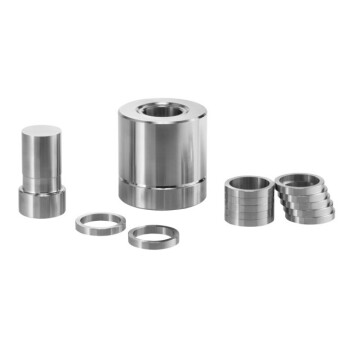
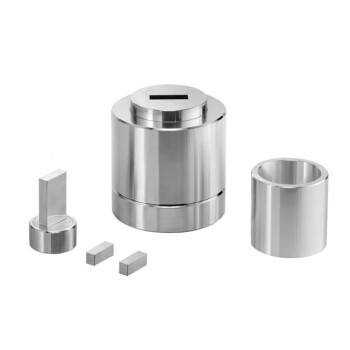
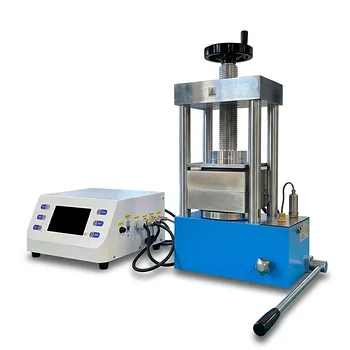
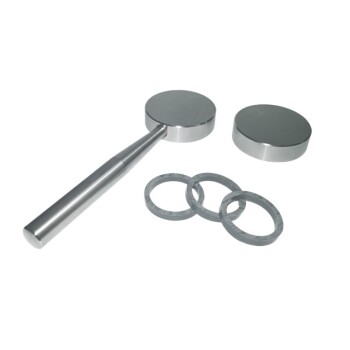
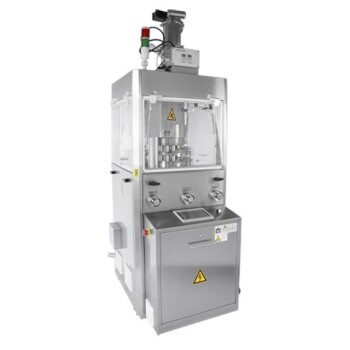
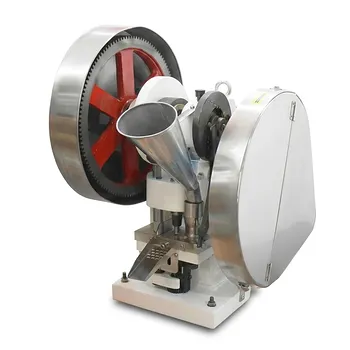
The uniaxial hydraulic press is the primary mechanical tool used to consolidate loose uranium dioxide ($UO_2$) powder into a dense, solid "green pellet." By applying high axial pressure—often reaching 700 MPa—within a precision die, the press reduces inter-particle voids and maximizes contact between powder grains. This mechanical compaction is the critical first step that defines the final density, structural integrity, and microstructural quality of the nuclear fuel after the sintering process.
The uniaxial hydraulic press transforms loose ceramic powder into a geometrically precise green body, establishing the necessary particle-to-particle contact and pore reduction required for successful high-temperature sintering and theoretical density maximization.
Mechanical Consolidation of Nuclear Powder
Formation of the Green Pellet
The press takes calcined $UO_2$ powder, sometimes mixed with additives like $Gd_2O_3$, and compresses it into a cylindrical or disk-shaped body. At this stage, the pellet is known as a "green body," meaning it is held together by mechanical interlocking rather than chemical bonds.
This process provides the pellet with sufficient initial strength to be handled and transported to the sintering furnace without crumbling or deforming.
Increase in Contact Density
High-pressure compaction forces the individual powder particles into closer proximity, significantly increasing contact density. This close contact is essential because it allows for efficient solid-state reactions to occur during later stages of fabrication.
By reducing the distance between particles, the press facilitates the solid-phase diffusion needed to turn a collection of grains into a monolithic ceramic.
Engineering the Final Microstructure
Elimination of Large Internal Voids
A primary function of the hydraulic press is to minimize internal porosity and eliminate large voids within the powder compact. Reducing these internal gaps is vital for achieving a final product with a high theoretical density (often greater than 90%).
Uniformly distributed, smaller pores are easier to "close" during sintering, whereas large gaps created by poor pressing can lead to structural weaknesses.
Facilitating Grain Growth
The precision and uniformity of the pressure applied by the press directly influence the grain boundaries and microstructure of the finished fuel.
Proper compaction ensures that as the pellet is heated, grain growth occurs evenly throughout the material, resulting in a refined microstructure that can withstand the intense environment of a nuclear reactor.
Precision Control and Structural Integrity
Minimizing Internal Density Gradients
One of the most technical roles of the uniaxial press is the management of internal density gradients. High-precision hydraulic control ensures that pressure is applied uniformly across the powder mass.
If density is uneven, the pellet may shrink at different rates during sintering, leading to warping, cracking, or dimensional instability.
Meeting Geometric Tolerances
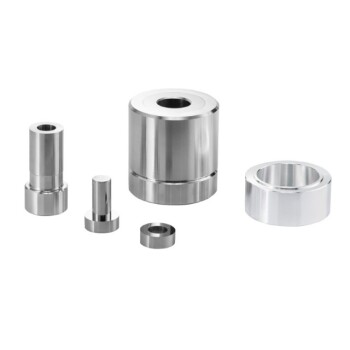
Nuclear fuel must meet exacting geometric tolerances to fit within cladding tubes. The hydraulic press, used in conjunction with high-quality steel dies, ensures the green pellets have consistent diameters and heights.
This consistency reduces the need for extensive post-sintering grinding, which minimizes waste and improves production efficiency.
Understanding the Trade-offs and Pitfalls
The Risk of Lamination and Cracking
If the pressure is applied too rapidly or released too quickly, the air trapped between particles can cause lamination cracks. These are horizontal splits in the green pellet that render it useless for fuel fabrication.
Achieving the right balance between production speed and de-airing time is a constant challenge in hydraulic pressing operations.
Tooling Wear and Contamination
The abrasive nature of $UO_2$ powder means that the steel dies and punches are subject to significant mechanical wear.
As tools wear down, the precision of the pellet dimensions decreases, and there is a risk of introducing metallic impurities into the fuel, which can negatively impact the chemical purity required for reactor-grade material.
How to Optimize Pressing for Your Goal
Choosing the Right Parameters
Successfully preparing $UO_2$ pellets requires aligning the press operation with the specific characteristics of the source powder and the desired final specifications.
- If your primary focus is maximizing theoretical density: Prioritize higher compaction pressures (e.g., 700 MPa) to ensure the smallest possible initial pore size before sintering.
- If your primary focus is preventing structural defects: Focus on precision pressure control and slow decompression cycles to eliminate internal density gradients and lamination.
- If your primary focus is high-throughput production: Invest in high-durability steel dies and automated hydraulic systems that maintain geometric tolerances over thousands of cycles.
The uniaxial hydraulic press is the fundamental bridge between loose nuclear powder and a robust, high-performance ceramic fuel pellet.
Summary Table:
| Process Phase | Function of Hydraulic Press | Impact on Final Fuel |
|---|---|---|
| Powder Compaction | Applies axial pressure (up to 700 MPa) | Creates a stable "green body" for handling |
| Void Reduction | Minimizes internal porosity | Enables high theoretical density (>90%) |
| Microstructure Engineering | Facilitates particle-to-particle contact | Promotes uniform grain growth during sintering |
| Precision Forming | Controls geometric tolerances | Ensures fit within fuel cladding tubes |
| Density Management | Minimizes internal gradients | Prevents warping and cracking during sintering |
Elevate Your Material Synthesis with KINTEK Precision
At KINTEK, we understand that the integrity of your research depends on the precision of your equipment. Whether you are fabricating $UO_2$ fuel pellets or advanced technical ceramics, our high-performance hydraulic presses (pellet, hot, and isostatic) provide the uniform pressure control needed to eliminate density gradients and prevent lamination.
Our comprehensive laboratory portfolio supports your entire workflow:
- Material Preparation: Advanced crushing, milling, and sieving systems.
- Thermal Processing: High-temperature furnaces (muffle, tube, vacuum, and CVD) for superior sintering results.
- Specialized Solutions: High-pressure reactors, autoclaves, and high-purity ceramic crucibles.
Ready to achieve superior pellet density and structural integrity? Contact KINTEK today to consult with our experts on the perfect pressing and sintering solution for your laboratory's specific needs.
References
- Sonia García-Gómez, Joan de Pablo Ribas. Oxidative dissolution mechanism of both undoped and Gd<sub>2</sub>O<sub>3</sub>-doped UO<sub>2</sub>(s) at alkaline to hyperalkaline pH. DOI: 10.1039/d3dt01268a
This article is also based on technical information from Kintek Solution Knowledge Base .
Related Products
- kbr pellet press 2t
- Laboratory Hydraulic Pellet Press for XRF KBR FTIR Lab Applications
- Automatic Laboratory Hydraulic Pellet Press Machine for Lab Use
- Automatic Laboratory Hydraulic Press for XRF & KBR Pellet Press
- Laboratory Manual Hydraulic Pellet Press for Lab Use
People Also Ask
- How do you prepare samples for IR spectroscopy? A Step-by-Step Guide for Solids, Liquids, and Gases
- What measurement methods are commonly used for powder samples in infrared spectroscopy? Optimize Your FTIR Analysis
- Why KBr is used in IR spectrophotometry? A Key to Transparent Sample Analysis
- How are a KBr pellet press and mortar utilized in FTIR analysis of activated carbon? Expert Sample Prep Guide
- How do you prepare KBr pellets for FTIR analysis? Master the Technique for High-Quality IR Spectra