Vacuum freeze drying outperforms heat drying in the preparation of anaerobic sludge samples by utilizing sublimation to remove moisture without damaging the sample's physical architecture. Unlike heat drying, which often causes delicate biological structures to shrink or collapse due to liquid evaporation, vacuum freeze drying maintains the sample's original volume and shape. This preservation is a prerequisite for generating accurate, high-fidelity images during Scanning Electron Microscopy (SEM).
By removing moisture through sublimation rather than evaporation, vacuum freeze drying prevents the structural collapse associated with heat drying, ensuring that critical internal features like microporous channels remain intact for analysis.
The Mechanism of Structural Preservation
Sublimation vs. Evaporation
The primary technical advantage of a vacuum freeze dryer lies in its ability to facilitate sublimation.
This process transitions water directly from a solid state (ice) to a gas phase, bypassing the liquid phase entirely.
Preventing Cellular Collapse
Standard heat drying relies on evaporation, which creates surface tension forces that can be destructive to biological matter.
This physical stress frequently causes the shrinkage or collapse of microbial cells.
Freeze drying eliminates these forces, preserving the original three-dimensional structure of the sludge components.
Critical Implications for Microscopy
Accuracy in SEM Imaging
For Scanning Electron Microscopy (SEM), the physical fidelity of the sample is paramount.
If the sample preparation alters the shape of the subject, the resulting data is compromised.
Vacuum freeze drying ensures that the visual data reflects the true state of the anaerobic sludge, rather than artifacts created by the drying process.
Visualizing Functional Channels
Anaerobic sludge relies on a complex network of internal structures to function.
Specifically, the sludge contains internal microporous channels that are responsible for vital processes like nutrient transport and gas emission.
Heat drying often destroys these delicate porous structures, rendering them invisible or distorted under a microscope; freeze drying keeps them open and observable.
Understanding the Risks of Improper Drying
The Danger of False Data
The choice between heat and freeze drying is not merely aesthetic; it determines data validity.
Using heat drying for SEM preparation risks creating "artifacts"—structural errors that look real but were caused by the prep method.
Loss of Functional Context
If the microporous channels collapse during heat drying, you cannot accurately assess the sludge's biological efficiency.
You may falsely conclude that the sludge lacks the capacity for adequate gas emission or nutrient flow, simply because the channels were destroyed during preparation.
Ensuring Data Integrity in Your Analysis
To select the correct preparation method, you must align your protocol with your analytical goals.
- If your primary focus is Microbial Morphology: You must use vacuum freeze drying to prevent cell shrinkage and maintain the true shape of the biological entities.
- If your primary focus is Functional Analysis: You must use vacuum freeze drying to preserve the microporous channels required to understand nutrient transport and gas emission pathways.
True insight into anaerobic sludge dynamics requires a preparation method that respects the delicate physical structure of the sample.
Summary Table:
| Feature | Vacuum Freeze Drying (Sublimation) | Heat Drying (Evaporation) |
|---|---|---|
| Phase Transition | Solid to Gas (Bypasses Liquid) | Liquid to Gas |
| Structural Integrity | Preserves 3D shape & volume | Causes shrinkage and collapse |
| Surface Tension | Eliminated | High (damages delicate tissues) |
| Micro-channels | Intact and observable | Often destroyed or distorted |
| Data Accuracy | High fidelity for SEM | Risk of artifacts and false data |
Elevate Your Research with Precision Sample Preparation
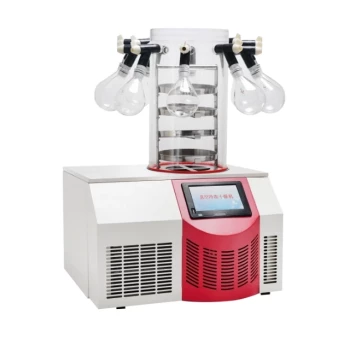
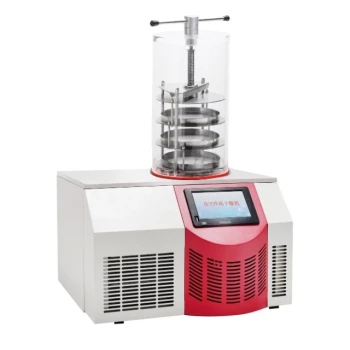
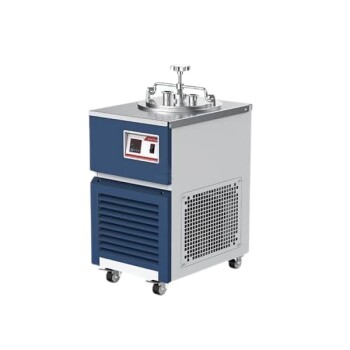
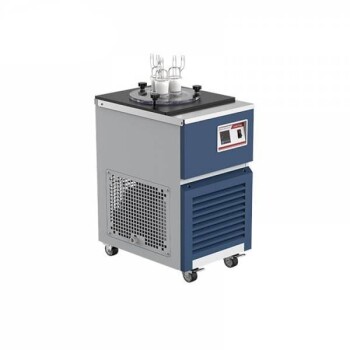
Don't compromise your microscopic analysis with structural artifacts. KINTEK specializes in advanced laboratory solutions designed to preserve the integrity of your most delicate biological samples. Whether you are analyzing anaerobic sludge or complex microbial communities, our high-performance vacuum freeze dryers (cold traps and freeze dryers) ensure your SEM imaging reflects true biological morphology.
From high-temperature furnaces and crushing systems to specialized PTFE consumables and ceramics, KINTEK provides the comprehensive tools needed for rigorous material and biological research.
Ready to achieve superior imaging results? Contact KINTEK today to discover how our freeze drying and cooling solutions can enhance your laboratory's analytical accuracy!
References
- Cancan Zhu, Zhiwei Wang. Effect of methylene blue on the properties and microbial community of anaerobic granular sludge. DOI: 10.15376/biores.13.3.6033-6046
This article is also based on technical information from Kintek Solution Knowledge Base .
Related Products
- Benchtop Laboratory Vacuum Freeze Dryer
- High Performance Laboratory Freeze Dryer
- High Performance Laboratory Freeze Dryer for Research and Development
- Benchtop Laboratory Freeze Dryer for Lab Use
- Vacuum Cold Mounting Machine for Sample Preparation
People Also Ask
- What are the technical advantages of using a laboratory freeze dryer for porous carbon precursors? Preserve 3D Networks
- How do laboratory freeze dryers support scientific research? Preserve Sample Integrity for Reproducible Results
- Why is a laboratory freeze dryer preferred over traditional heating? Preserve Biochar Structure & Maximize Porosity
- What types of liquid samples can be processed using a laboratory freeze dryer? Preserve Your Sensitive Materials
- What role do laboratory freeze dryers play in the food industry? Unlock Superior Food Preservation