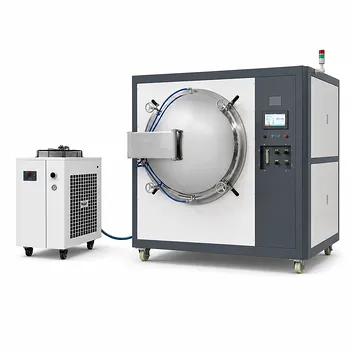
The vacuum hot press furnace ensures a robust CuAlMn skeleton by applying simultaneous thermal and mechanical energy. By heating the alloy to 780°C while exerting mechanical pressure, the furnace forces metal powder particles into close contact, driving plastic deformation and rapid atomic diffusion around sodium chloride space holders.
The synergistic application of heat and pressure—known as pressure-assisted sintering—creates a high-strength, continuous metal framework by fusing particles at the atomic level, yielding structural integrity far superior to cold-press methods.
The Mechanisms of Skeleton Formation
To understand how a loose powder transforms into a robust metal skeleton, one must look at how the furnace manipulates the microstructure of the CuAlMn alloy.
Promoting Atomic Diffusion
At 780°C, the thermal energy increases the mobility of atoms within the metal powder. However, heat alone often leaves gaps between particles. The vacuum hot press introduces mechanical pressure to physically force these heated particles together, significantly accelerating atomic diffusion across particle boundaries.
Inducing Plastic Deformation
The applied pressure does more than just hold the powder in place; it causes plastic deformation. The metal particles physically change shape to fill voids and conform to the contours of the sodium chloride space holders. This eliminates internal porosity and increases the contact area between metal grains.
Creating a Continuous Phase
The combination of diffusion and deformation results in the sintering of individual particles into a single, cohesive unit. This creates a continuous metal "skeleton" that acts as the load-bearing structure of the final porous material.
The Critical Role of the Vacuum
While heat and pressure drive the bonding, the vacuum environment is essential for the purity and quality of the bond.
Preventing Oxidation
At high temperatures, metals are highly reactive to oxygen. The vacuum environment removes air from the chamber, preventing the formation of oxide layers on the surface of the CuAlMn particles. Oxide layers act as barriers that inhibit atomic diffusion and weaken the final bond.
Removing Volatiles
The vacuum effectively removes volatile substances and contaminants from the surface of the powder particles. By cleaning the interface between particles, the furnace ensures that the bond is formed between pure metal surfaces, rather than surface contaminants.
Comparison: Hot Press vs. Cold Press
Understanding why hot pressing is superior requires comparing it to the alternative method of cold-press sintering.
Cold-Press Limitations
Cold pressing relies primarily on mechanical interlocking of particles at room temperature, followed by a separate sintering step. This often results in a structure with lower density and weaker bonding forces between particles.
Hot-Press Superiority
The vacuum hot press method integrates the densification and bonding steps. Because the pressure is applied during the heating phase, the bonding force between metal particles is significantly higher. This results in a metal skeleton that is mechanically stronger and structurally more reliable.
Understanding the Trade-offs
While vacuum hot pressing produces superior structural results, it is important to recognize the operational constraints.
Process Complexity
Vacuum hot pressing is a batch process that requires precise control over three variables simultaneously: temperature, pressure, and vacuum level. This increases the complexity of the operation compared to simple furnace sintering.
Throughput Limitations
Due to the need for a contained vacuum chamber and mechanical rams, the size and quantity of parts that can be processed in a single run are generally limited. This makes the process more time-consuming and costly per unit than conventional methods.
Making the Right Choice for Your Goal
When engineering CuAlMn shape memory alloys, the fabrication method must align with the specific performance requirements of the final component.
- If your primary focus is Structural Integrity: Utilize vacuum hot pressing to maximize particle bonding and density, ensuring the metal skeleton can withstand mechanical loads without crumbling.
- If your primary focus is Functional Properties: Remember that while hot pressing builds the skeleton, a subsequent solution treatment (heating to 800°C followed by quenching) is still required to induce the martensitic transformation necessary for the shape memory effect.
The vacuum hot press provides the foundational strength required for the alloy to perform, acting as the critical first step in creating a durable, functional material.
Summary Table:
| Feature | Vacuum Hot Pressing | Cold-Press Sintering |
|---|---|---|
| Mechanism | Simultaneous Heat & Pressure | Mechanical Interlocking at RT |
| Atomic Diffusion | Accelerated via 780°C Thermal Energy | Slower, post-process only |
| Oxidation Control | Prevented by Vacuum Environment | High risk without controlled atmosphere |
| Structural Result | High-density, continuous skeleton | Lower density, weaker particle bonding |
| Interface Purity | High (Volatiles removed) | Variable (Surface contaminants may remain) |
Elevate Your Material Research with KINTEK
Precision engineering of CuAlMn shape memory alloys requires the perfect balance of thermal and mechanical control. KINTEK specializes in advanced laboratory equipment, offering industry-leading vacuum hot press furnaces and high-temperature furnaces designed to create high-strength, continuous metal frameworks.
From crushing and milling systems for powder preparation to hydraulic pellet presses and vacuum solutions, we provide the end-to-end tools needed for superior structural integrity.
Ready to optimize your sintering process? Contact KINTEK today to discover how our high-performance systems and specialized consumables can transform your laboratory's output.
Related Products
- Vacuum Hot Press Furnace Heated Vacuum Press Machine Tube Furnace
- 600T Vacuum Induction Hot Press Furnace for Heat Treat and Sintering
- Vacuum Hot Press Furnace Machine Heated Vacuum Press
- Vacuum Hot Press Furnace Machine for Lamination and Heating
- Vacuum Heat Treat and Pressure Sintering Furnace for High Temperature Applications
People Also Ask
- What advantages does a vacuum hot press furnace provide for LSLBO ceramic electrolytes? Achieve 94% Relative Density
- What role does a Vacuum Hot Press (VHP) furnace play in the densification of austenitic stainless steel 316 composites?
- What are the advantages of using a vacuum hot pressing furnace? Superior Densification for 2024Al/Gr/SiC Composites
- What are the advantages of a vacuum hot press furnace for LTPO solid electrolytes? Boost Density and Conductivity
- What core processing conditions does a vacuum hot press furnace provide? Achieve High-Density Cu-SiC/Diamond Composites