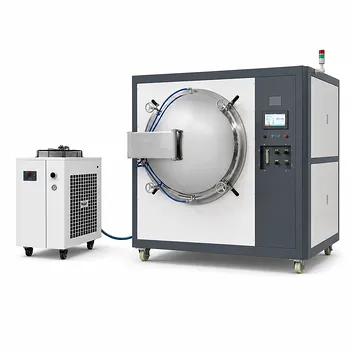
Vacuum hot press sintering drives densification by integrating thermal activation with mechanical force in a contaminant-free environment. This process works by applying unidirectional axial pressure (typically 30 MPa) to the TiC10/Cu-Al2O3 powder mixture while it is heated under high vacuum (around 1.8 x 10^-2 Pa). The pressure forces the copper matrix to flow plastically around the hard ceramic particles, while the vacuum actively extracts trapped gases that would otherwise create internal voids.
Core Takeaway Achieving high density in metal-ceramic composites requires more than just heat; it requires force. The vacuum hot press provides the critical "driving force" of external pressure to mechanically close pores while simultaneously removing the oxide layers and gases that inhibit atomic bonding.
The Mechanics of Densification
The Role of Unidirectional Pressure
In a standard sintering process, particles bond primarily through surface energy reduction. However, for a composite like TiC10/Cu-Al2O3, this is often insufficient due to the rigidity of the ceramic particles.
The vacuum hot press applies a constant axial pressure (e.g., 30 MPa). This external force causes particle rearrangement, physically shifting the powder granules into a tighter packing configuration.
As the temperature rises, the copper matrix softens. The applied pressure then induces plastic flow, forcing the ductile metal to squeeze into the interstitial voids between the hard TiC and Al2O3 particles. This mechanical action eliminates pores that thermal energy alone could not close.
The Function of High Vacuum
The presence of gas is a primary barrier to full densification. If air is trapped between particles during heating, it expands and creates permanent pores.
The furnace maintains a high vacuum environment (1.8 x 10^-2 Pa). This pressure differential actively extracts volatile gases and air from the powder gaps before and during the sintering cycle.
Furthermore, the vacuum is essential for preventing oxidation. Copper and aluminum are susceptible to oxidation at high temperatures. By removing oxygen, the furnace ensures "clean" particle surfaces, which facilitates stronger diffusion bonding between the copper matrix and the ceramic reinforcements.
Thermal Activation and Diffusion
While pressure closes the gaps, heat seals the bond. The high temperature provided by the furnace activates atomic diffusion.
At the grain boundaries where particles touch, atoms migrate across the interface. This creates a metallurgical bond rather than just a mechanical interlock.
The combination of heat and pressure accelerates this process, allowing the material to reach near-full density at temperatures lower than those required for pressureless sintering.
Understanding the Trade-offs
Geometry vs. Density
While vacuum hot pressing offers superior densification, it is geometrically limited. Because the pressure is applied uniaxially (from the top and bottom), the resulting parts are generally restricted to simple shapes like discs, plates, or cylinders. Complex 3D geometries often require post-processing or alternative sintering methods.
Cycle Time and Throughput
This is a batch process. The requirement to pump the chamber down to a high vacuum, heat the mass, apply pressure, and then cool it down under controlled conditions results in longer cycle times compared to continuous sintering methods. It is prioritized for high-performance applications where material quality outweighs production speed.
Making the Right Choice for Your Goal
If your primary focus is Maximum Density and Strength: The vacuum hot press is the ideal solution, as the mechanical pressure ensures near-zero porosity and superior bonding between the Cu matrix and TiC reinforcement.
If your primary focus is Material Purity: The high vacuum environment is non-negotiable, as it is the only reliable way to prevent oxidation and remove volatile impurities during the high-temperature consolidation of copper-based composites.
If your primary focus is Complex Part Geometry: You may need to consider Hot Isostatic Pressing (HIP) or post-sintering machining, as the uniaxial pressure of hot pressing limits the complexity of the "as-sintered" shape.
The vacuum hot press is effectively a forcing function for quality, substituting the uncertainty of natural sintering with the certainty of mechanical pressure.
Summary Table:
| Feature | Vacuum Hot Press Sintering Role | Benefit for TiC10/Cu-Al2O3 |
|---|---|---|
| Unidirectional Pressure | Applies ~30 MPa axial force | Induces plastic flow to eliminate interstitial voids |
| High Vacuum Environment | Maintains ~1.8 x 10^-2 Pa | Extracts trapped gases and prevents oxidation of Cu/Al |
| Thermal Activation | High-temperature heating | Accelerates atomic diffusion and grain boundary bonding |
| Physical Action | Mechanical particle rearrangement | Ensures tighter packing than pressureless sintering |
| Atmosphere Control | Active volatile extraction | Ensures clean surfaces for superior metallurgical bonds |
Elevate Your Material Performance with KINTEK
Achieving near-theoretical density in complex metal-ceramic composites like TiC10/Cu-Al2O3 requires the precision of specialized thermal processing. KINTEK provides industry-leading high-temperature vacuum hot press furnaces and hydraulic systems designed to deliver the exact mechanical force and vacuum purity your research demands.
Beyond sintering, our comprehensive portfolio includes:
- Advanced Furnaces: Muffle, tube, rotary, and specialized CVD/PECVD systems.
- Precision Pressing: Isostatic, hot, and pellet presses for diverse geometries.
- Laboratory Essentials: High-pressure reactors, autoclaves, and high-performance ceramics.
Ready to eliminate porosity and oxidation in your samples? Contact KINTEK today to consult with our experts on the perfect equipment solution for your laboratory.
Related Products
- 600T Vacuum Induction Hot Press Furnace for Heat Treat and Sintering
- Vacuum Heat Treat and Sintering Furnace with 9MPa Air Pressure
- Vacuum Heat Treat and Pressure Sintering Furnace for High Temperature Applications
- Vacuum Hot Press Furnace Heated Vacuum Press Machine Tube Furnace
- Vacuum Hot Press Furnace Machine Heated Vacuum Press
People Also Ask
- What role does an induction vacuum hot pressing furnace play in sintering? Achieve 98% Density in Carbide Blocks
- What advantages does a vacuum hot press furnace provide for LSLBO ceramic electrolytes? Achieve 94% Relative Density
- What role does a Vacuum Hot Press (VHP) furnace play in the densification of austenitic stainless steel 316 composites?
- What are the advantages of a vacuum hot press furnace for W-50%Cu? Achieve 99.6% Density at Lower Temperatures
- What role does mechanical pressure play during the vacuum diffusion bonding of tungsten and copper? Keys to Solid Bonding