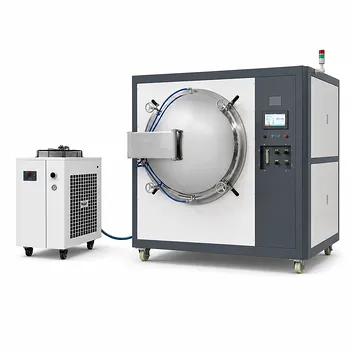
A vacuum hot-press sintering furnace achieves high transmittance in Pr, Y:SrF2 ceramics by creating a simultaneous environment of extreme pressure, heat, and vacuum.
Specifically, it utilizes a high vacuum (better than 1.0×10⁻² Pa), a temperature of 1000 °C, and a mechanical pressure of 30 MPa to systematically eliminate internal defects. This combination drives the removal of residual gases and forces the material to its theoretical density limit, resulting in optical transparency.
The Core Takeaway Optical transparency in ceramics is fundamentally a density problem. The vacuum hot-press furnace solves this by mechanically compressing the material while evacuating trapped gases, thereby removing the microscopic pores that act as light-scattering centers.
The Drivers of Optical Quality
To achieve high transmittance in Pr, Y:SrF2 ceramics, the furnace orchestrates three critical variables. Each plays a distinct role in eliminating porosity, which is the primary enemy of transparency.
The Role of High Vacuum
The furnace maintains a vacuum better than 1.0×10⁻² Pa. This is not merely about keeping the chamber clean; it is an active extraction mechanism.
The vacuum environment effectively removes residual gases trapped in the spaces between the raw powder particles. If these gases were left behind during heating, they would become trapped inside the densifying material, forming permanent bubbles (pores) that scatter light and ruin transparency.
The Impact of Mechanical Pressure
Unlike standard sintering, which relies solely on thermal energy, this process applies a massive uniaxial pressure of 30 MPa.
This mechanical force physically pushes the ceramic grains together. It compensates for the natural resistance of the material, forcing particle rearrangement and closing voids that thermal diffusion alone might not eliminate. This pressure is the key differentiator in achieving near-perfect density.
Thermal Activation and Diffusion
The process operates at 1000 °C. This high temperature provides the activation energy necessary for grain boundary diffusion.
At this temperature, atoms become mobile enough to move across grain boundaries, filling in the microscopic gaps between particles. This diffusion, accelerated by the applied pressure, welds the particles into a solid, continuous mass.
From Powder to Transparent Solid
Understanding the deep need requires looking at why these conditions create transparency.
Eliminating Scattering Centers
In optical ceramics, any internal defect—such as a pore or a grain boundary with a different refractive index—causes light to scatter rather than pass through.
By combining vacuum extraction with mechanical compression, the furnace removes virtually all internal pores. This ensures the light has an unobstructed path through the material.
Reaching the Theoretical Density Limit
The ultimate goal of this process is to reach the material's theoretical density.
Any density below 100% implies the presence of voids. By leveraging the simultaneous application of heat, pressure, and vacuum, the furnace drives the ceramic to a state where it is virtually solid matter with no empty space, rendering the Pr, Y:SrF2 ceramic highly transparent.
Understanding the Trade-offs
While vacuum hot pressing is effective for high-performance optical ceramics, it introduces specific constraints that must be managed.
Scalability vs. Performance
Vacuum hot pressing is inherently a batch process. The requirement to apply uniaxial pressure limits the complexity of shapes that can be formed and generally restricts throughput compared to pressureless sintering methods. You are trading production speed for superior optical quality.
Equipment Complexity
Maintaining a high vacuum (1.0×10⁻² Pa) while simultaneously applying 30 MPa of mechanical force at 1000 °C requires sophisticated, heavy-duty engineering. This increases both the capital cost of the equipment and the operational cost per run compared to standard atmosphere furnaces.
Making the Right Choice for Your Goal
When deciding if this processing route is appropriate for your application, consider your specific performance targets.
- If your primary focus is Maximum Optical Transmittance: Stick rigidly to the vacuum hot-press method; the combination of 30 MPa pressure and high vacuum is non-negotiable for eliminating the final 0.1% of porosity that destroys clarity.
- If your primary focus is Complex Net-Shaping: You may need to evaluate Hot Isostatic Pressing (HIP) as a post-processing step to standard sintering, as uniaxial hot pressing limits geometry options.
Success in optical ceramics depends less on the material itself and more on the rigorous elimination of nothingness—the voids that scatter light.
Summary Table:
| Parameter | Specification | Functional Role in Transparency |
|---|---|---|
| Vacuum Level | < 1.0×10⁻² Pa | Removes residual gases to prevent light-scattering bubbles. |
| Sintering Temp | 1000 °C | Activates grain boundary diffusion for atomic bonding. |
| Mechanical Pressure | 30 MPa | Physically closes voids and drives material to theoretical density. |
| Atmosphere | High Vacuum | Ensures material purity and prevents oxidation defects. |
Maximize Your Material’s Optical Performance with KINTEK
Achieving near-theoretical density requires precision engineering. KINTEK specializes in advanced laboratory solutions designed for high-performance research. From high-vacuum hot-press systems and high-temperature furnaces (muffle, tube, vacuum, CVD) to hydraulic presses (pellet, hot, isostatic) and crushing systems, we provide the tools necessary to eliminate porosity and achieve superior transparency.
Whether you are developing Pr, Y:SrF2 ceramics or next-generation battery materials, our comprehensive portfolio—including high-pressure reactors, electrolytic cells, and cooling solutions—ensures your lab stays at the cutting edge.
Ready to elevate your material synthesis? Contact KINTEK experts today to find the perfect equipment for your specific application.
Related Products
- 600T Vacuum Induction Hot Press Furnace for Heat Treat and Sintering
- Vacuum Heat Treat and Sintering Furnace with 9MPa Air Pressure
- Vacuum Heat Treat and Pressure Sintering Furnace for High Temperature Applications
- Vacuum Hot Press Furnace Heated Vacuum Press Machine Tube Furnace
- Vacuum Hot Press Furnace Machine Heated Vacuum Press
People Also Ask
- What role does an induction vacuum hot pressing furnace play in sintering? Achieve 98% Density in Carbide Blocks
- What advantages does a vacuum hot press furnace provide for LSLBO ceramic electrolytes? Achieve 94% Relative Density
- What role does a Vacuum Hot Press (VHP) furnace play in the densification of austenitic stainless steel 316 composites?
- What are the advantages of a vacuum hot press furnace for W-50%Cu? Achieve 99.6% Density at Lower Temperatures
- What role does mechanical pressure play during the vacuum diffusion bonding of tungsten and copper? Keys to Solid Bonding