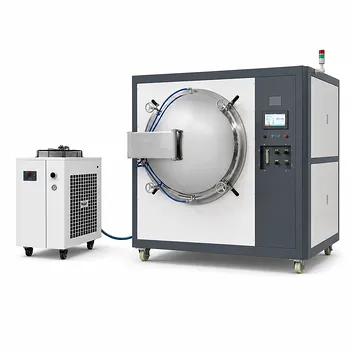
A Vacuum Hot Press Sintering Furnace (VHPS) drives high-density alloy production by simultaneously applying high temperatures and uniaxial mechanical pressure within a controlled vacuum environment. This dual-action mechanism forces powder particles together to promote plastic flow and diffusion, effectively eliminating pores and densifying the material at temperatures well below its melting point.
Core Takeaway The VHPS process replaces the need for extreme heat with mechanical force, significantly reducing the activation energy required for densification. By sintering at lower temperatures, it achieves near-theoretical density while preserving fine-grained microstructures that are often lost during traditional melting processes.
The Mechanics of Densification
Simultaneous Heat and Pressure
The defining characteristic of VHPS is the integration of thermal energy and mechanical force. While traditional sintering relies solely on heat to fuse particles, VHPS applies axial pressure (e.g., 30 MPa) during the heating cycle.
Enhancing Particle Interaction
This applied pressure is critical for overcoming the natural resistance of the material. It forces powder particles into intimate contact, promoting plastic flow and filling voids that would otherwise remain as pores.
Reducing Activation Energy
By mechanically forcing particles together, the furnace lowers the activation energy needed for densification. This allows the alloy to reach high densities (such as 4.08 g/cm³) without requiring the extreme temperatures necessary for full melting.
Preserving Material Integrity
The Vacuum Advantage
High-entropy alloys often contain elements sensitive to oxygen. The vacuum environment is essential for preventing the oxidation of these elements at high temperatures, ensuring the chemical purity and structural integrity of the final bulk material.
Controlling Grain Growth
Because VHPS achieves density at lower temperatures, it effectively inhibits excessive grain growth. This preserves the material's nanocrystalline properties, resulting in a fine-grained, uniform microstructure that offers superior hardness and tensile strength compared to cast materials.
Superior Pore Elimination
Compared to methods like cold pressing followed by sintering, the pressure-assisted mechanism of VHPS is far more effective at closing pores. It utilizes diffusion creep to eliminate internal voids, resulting in a significantly more solid and reliable bulk alloy.
The Critical Role of Tooling
High-Strength Graphite Molds
The success of the process relies on high-strength graphite molds, which serve as the containment vessel. These molds must possess exceptional thermal stability to transmit the hydraulic pressure to the powder while withstanding temperatures as high as 1373 K.
Understanding the Trade-offs
Process Complexity vs. Microstructure
While VHPS offers superior material properties, it introduces complexity compared to traditional arc melting. Arc melting is a direct liquid-to-solid process, but it often results in coarse grains and segregation.
Sintering vs. Melting
VHPS is a solid-state or liquid-phase sintering process, not a casting process. While this allows for fine-grained structures and better mechanical properties, it requires precise control over pressure and temperature curves to avoid under-sintering (porosity) or over-sintering (grain coarsening).
Making the Right Choice for Your Goal
To determine if VHPS is the correct method for your high-entropy alloy application, consider your specific performance requirements:
- If your primary focus is Maximum Density and Purity: VHPS is the superior choice because the vacuum prevents oxidation while the pressure eliminates porosity more effectively than pressureless sintering.
- If your primary focus is Mechanical Strength: VHPS is ideal because the lower processing temperatures restrict grain growth, preserving the fine microstructure necessary for high hardness and tensile strength.
By leveraging the synergy of vacuum protection, thermal diffusion, and mechanical pressure, VHPS transforms loose powder into high-performance structural materials.
Summary Table:
| Feature | Traditional Sintering | Vacuum Hot Press Sintering (VHPS) |
|---|---|---|
| Mechanism | Thermal energy only | Simultaneous heat + uniaxial pressure |
| Environment | Ambient or inert gas | High-vacuum (prevents oxidation) |
| Grain Size | Tendency for grain growth | Fine-grained / Nanocrystalline preservation |
| Densification | Lower (residual porosity) | High (near-theoretical density) |
| Processing Temp | High (near melting point) | Lower (reduced activation energy) |
Elevate Your Material Research with KINTEK Precision
Unlock the full potential of your high-entropy alloys and advanced ceramics with KINTEK’s high-performance Vacuum Hot Press Sintering Furnaces. Our state-of-the-art systems provide the precise control over thermal diffusion and mechanical pressure required to eliminate porosity while preserving superior microstructures.
Why choose KINTEK for your laboratory?
- Comprehensive Range: From high-temperature vacuum and atmosphere furnaces to specialized crushing, milling, and hydraulic presses.
- Advanced Solutions: Expertise in high-pressure reactors, autoclaves, and battery research tools tailored for the most demanding applications.
- Quality Consumables: We provide the high-strength graphite molds, ceramics, and crucibles essential for successful sintering cycles.
Ready to achieve maximum density and purity in your bulk materials? Contact our technical experts today to find the perfect equipment for your research goals!
Related Products
- 600T Vacuum Induction Hot Press Furnace for Heat Treat and Sintering
- Vacuum Heat Treat and Sintering Furnace with 9MPa Air Pressure
- Vacuum Heat Treat and Pressure Sintering Furnace for High Temperature Applications
- 2200 ℃ Tungsten Vacuum Heat Treat and Sintering Furnace
- Vacuum Hot Press Furnace Heated Vacuum Press Machine Tube Furnace
People Also Ask
- What role does an induction vacuum hot pressing furnace play in sintering? Achieve 98% Density in Carbide Blocks
- What advantages does a vacuum hot press furnace provide for LSLBO ceramic electrolytes? Achieve 94% Relative Density
- What role does a Vacuum Hot Press (VHP) furnace play in the densification of austenitic stainless steel 316 composites?
- What are the advantages of a vacuum hot press furnace for W-50%Cu? Achieve 99.6% Density at Lower Temperatures
- What role does mechanical pressure play during the vacuum diffusion bonding of tungsten and copper? Keys to Solid Bonding