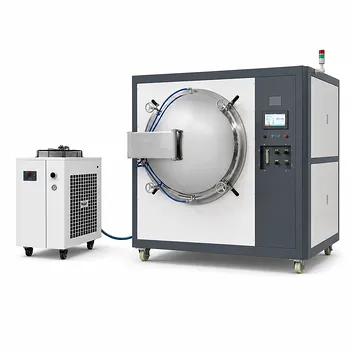
A vacuum hot pressing furnace acts as a synergistic densification tool that solves the specific challenges of combining metal and ceramic phases. It contributes to the densification of Fe-ZTA (Iron-Zirconia Toughened Alumina) cermets by simultaneously applying thermal energy (approximately 1000°C) and mechanical pressure (12 MPa) within a protective vacuum environment. This dual-action process protects the iron binder from oxidation while physically forcing particle rearrangement, resulting in a material with high density and superior interfacial bonding.
Core Takeaway: By introducing mechanical pressure during the sintering phase, vacuum hot pressing overcomes the natural resistance of ZTA particles to consolidate. It allows the iron binder to flow and fill voids at temperatures where it would otherwise oxidize, ensuring a non-porous, structurally sound composite.
The Mechanisms of Densification
Protection of the Metallic Binder
The primary challenge in sintering cermets (ceramic-metal composites) is the reactivity of the metal phase. At high temperatures, the iron (Fe) binder is highly susceptible to oxidation.
The vacuum environment removes oxygen from the chamber. This prevents the formation of iron oxides, which would otherwise weaken the material and inhibit densification. By maintaining the metallic purity of the iron, the furnace ensures the binder can effectively wet the ceramic particles.
Pressure-Assisted Liquid-Phase Sintering
Standard sintering relies solely on thermal diffusion to close pores, which can be slow and incomplete for cermets. Vacuum hot pressing introduces a mechanical driving force—specifically, uniaxial pressure of around 12 MPa.
At 1000°C, the process triggers liquid-phase sintering. The applied pressure actively forces the semi-molten iron binder to flow into the interstitial spaces between the harder ZTA particles. This mechanically induced flow eliminates voids much faster and more completely than thermal energy alone.
Enhanced Particle Rearrangement
The combination of heat and pressure facilitates the rearrangement of the rigid ZTA particles.
As the iron binder becomes compliant, the external pressure overcomes the friction between ceramic grains. This allows the particles to slide into a tighter packing configuration. The result is a significant reduction in porosity and a maximization of the material's theoretical density.
Interfacial Bonding and Diffusion
Densification is not just about removing pores; it is about creating a unified solid. The hot pressing environment promotes atomic diffusion across the boundaries between the metal and ceramic phases.
The mechanical pressure increases the contact area between the Fe and ZTA components. This intimate contact, combined with thermal energy, accelerates the diffusion process, creating strong metallurgical bonds that improve the bulk mechanical properties of the final cermet.
Understanding the Trade-offs
Geometry Limitations
Vacuum hot pressing typically applies force in a single direction (uniaxial).
This makes the process ideal for simple geometries like flat plates, discs, or cylinders. However, it is ill-suited for complex shapes with undercuts or intricate details, as the pressure cannot be distributed hydrostatically (evenly from all sides).
Throughput vs. Quality
This is a batch process, not a continuous one.
While it yields superior density and material properties compared to pressureless sintering, it requires significant cycle time for heating, pressing, and cooling under vacuum. It is a high-cost, low-volume solution best reserved for high-performance applications where material failure is not an option.
Making the Right Choice for Your Goal
To maximize the benefits of vacuum hot pressing for Fe-ZTA, you must align your process parameters with your specific material targets.
- If your primary focus is Maximum Density: Ensure the mechanical pressure (12 MPa) is applied before the peak temperature is reached to trap the fewest gases possible, but maintain vacuum to remove any adsorbed volatiles.
- If your primary focus is Interfacial Strength: Prioritize the hold time at the peak temperature (1000°C) to allow sufficient atomic diffusion between the iron binder and the ZTA matrix.
- If your primary focus is Microstructural Control: Monitor the cooling rate carefully; the vacuum environment lacks convection cooling, so active cooling systems may be needed to prevent grain coarsening after densification.
Precision in balancing the onset of pressure with the rise in temperature is the key to unlocking the full potential of Fe-ZTA cermets.
Summary Table:
| Process Factor | Mechanism | Key Benefit |
|---|---|---|
| Vacuum Environment | Prevents Iron (Fe) oxidation | Maintains purity & ensures wetting |
| Mechanical Pressure | Liquid-phase sintering (12 MPa) | Eliminates voids & closes pores |
| Thermal Energy | Atomic diffusion at 1000°C | Strengthens interfacial bonding |
| Particle Flow | Overcomes grain friction | Maximizes theoretical density |
Elevate Your Material Synthesis with KINTEK
Unlock the full potential of your composite materials with KINTEK’s industry-leading laboratory equipment. We specialize in providing the precision tools necessary for advanced densification, including our high-performance vacuum, atmosphere, and induction melting furnaces, alongside specialized hot and isostatic hydraulic presses.
Whether you are working on Fe-ZTA cermets or specialized battery research, KINTEK offers a comprehensive portfolio to support your entire workflow:
- High-Temperature Systems: Muffle, tube, CVD, PECVD, and MPCVD furnaces.
- Processing & Preparation: Crushing and milling systems, sieving equipment, and homogenizers.
- Reaction & Storage: High-temperature high-pressure reactors, autoclaves, and cooling solutions (ULT freezers, freeze dryers).
- Essential Consumables: High-quality PTFE products, ceramics, and crucibles.
Ready to achieve superior structural integrity and non-porous results? Contact our technical experts today to find the ideal equipment for your high-performance applications.
Related Products
- 600T Vacuum Induction Hot Press Furnace for Heat Treat and Sintering
- Vacuum Hot Press Furnace Heated Vacuum Press Machine Tube Furnace
- Vacuum Hot Press Furnace Machine for Lamination and Heating
- Vacuum Hot Press Furnace Machine Heated Vacuum Press
- Vacuum Heat Treat and Pressure Sintering Furnace for High Temperature Applications
People Also Ask
- What role does an induction vacuum hot pressing furnace play in sintering? Achieve 98% Density in Carbide Blocks
- What advantages does a vacuum hot press furnace provide for LSLBO ceramic electrolytes? Achieve 94% Relative Density
- What role does a Vacuum Hot Press (VHP) furnace play in the densification of austenitic stainless steel 316 composites?
- What role does mechanical pressure play during the vacuum diffusion bonding of tungsten and copper? Keys to Solid Bonding
- What are the advantages of a vacuum hot press furnace for W-50%Cu? Achieve 99.6% Density at Lower Temperatures