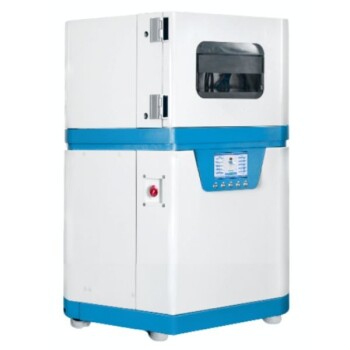
A vacuum hot-pressing furnace facilitates densification by creating a synergistic environment of high heat (1850°C), axial pressure (30 MPa), and vacuum protection. This specific combination triggers the formation of a liquid phase (Al8B4C7) from sintering additives. Under mechanical pressure, this liquid acts as a lubricant, forcing particle rearrangement and accelerating mass transfer to achieve high density in silicon carbide, a material that is notoriously difficult to sinter.
The Core Takeaway Silicon Carbide resists densification due to strong covalent bonds. The vacuum hot-pressing furnace overcomes this not just by heating the material, but by generating a specific liquid phase (Al8B4C7) that acts as a localized lubricant. When compressed, this liquid allows particles to slide into a compact, dense arrangement at temperatures lower than conventional methods would require.
Overcoming the Resistance to Sintering
Silicon Carbide (SiC) is a high-performance ceramic, but its strong covalent bonding makes it naturally resistant to the atomic diffusion required for densification. The vacuum hot-pressing furnace solves this through three coordinated mechanisms.
Formation of the Al8B4C7 Liquid Phase
The most critical mechanism in this specific Al-B-C system is the creation of a liquid phase. When the furnace reaches approximately 1850°C, the sintering additives react to form Al8B4C7.
Instead of relying solely on solid-state diffusion (which is slow and energy-intensive), this liquid phase wets the solid SiC particles. It effectively fills the gaps between grains and acts as a medium for atomic transfer.
Mechanical Lubrication and Rearrangement
While the temperature creates the liquid phase, the axial pressure (30 MPa) utilizes it. The external mechanical force pushes the SiC particles together.
Because the Al8B4C7 liquid is present, it acts as a high-temperature lubricant. The pressure forces the particles to slide past one another and rearrange into a tighter packing configuration. This "plastic flow" eliminates voids and pores much more efficiently than heat alone.
Protection via Vacuum Environment
The furnace maintains a controlled vacuum throughout the process. This is essential to prevent oxidation of both the silicon carbide and the sintering additives.
If oxygen were present at these temperatures, oxide layers would form on particle surfaces, blocking the grain boundaries and inhibiting the sintering process. The vacuum ensures chemically clean surfaces, allowing the liquid phase to interact directly with the SiC grains for maximum adhesion and density.
Understanding the Trade-offs
While vacuum hot-pressing is highly effective for densification, it introduces specific constraints that you must consider during project planning.
Geometric Limitations
The application of uniaxial pressure (pressure from one direction) generally limits the shapes you can produce. This process is ideal for simple geometries like flat plates, disks, or cylinders. Producing complex, net-shape components with intricate 3D features is often impossible without significant post-process machining.
Throughput and Scalability
This is typically a batch process. The requirement to pump down to a vacuum, heat to 1850°C, apply pressure, and slowly cool down limits production speed. Unlike continuous sintering furnaces, vacuum hot-pressing is generally suited for lower-volume, high-value components rather than mass production.
Making the Right Choice for Your Goal
The decision to use a vacuum hot-pressing furnace depends on your specific performance requirements and component design.
- If your primary focus is maximum density and strength: This is the ideal method. The combination of liquid phase sintering and mechanical pressure yields near-theoretical density and superior mechanical properties.
- If your primary focus is complex component geometry: You may need to consider alternative methods like pressureless sintering or hot isostatic pressing (HIP) after an initial forming stage, as uniaxial pressing restricts shape complexity.
- If your primary focus is material purity: The vacuum environment is critical. It ensures that oxygen impurities are removed or prevented, which is vital for maintaining the high thermal and electrical performance of SiC.
Ultimately, vacuum hot-pressing transforms the difficult-to-sinter Al-B-C system into a high-performance ceramic by mechanically forcing densification through a lubricating liquid phase.
Summary Table:
| Feature | Mechanism | Benefit for Al-B-C SiC |
|---|---|---|
| Temperature (1850°C) | Liquid Phase Formation | Creates Al8B4C7 to wet grains and accelerate mass transfer |
| Pressure (30 MPa) | Mechanical Rearrangement | Forces particles to slide and fill voids via plastic flow |
| Vacuum Environment | Oxidation Prevention | Maintains chemically clean surfaces for maximum grain adhesion |
| System Synergy | Enhanced Densification | Overcomes covalent bond resistance to reach near-theoretical density |
Elevate Your Material Performance with KINTEK Precision
Achieving near-theoretical density in difficult-to-sinter ceramics like Silicon Carbide requires more than just heat—it requires precise control over pressure and atmosphere. KINTEK specializes in advanced laboratory equipment, offering high-performance vacuum hot-pressing furnaces and isostatic presses designed to facilitate superior densification for research and production.
Whether you are developing Al-B-C system ceramics or exploring battery research, our comprehensive portfolio—including crushing and milling systems, high-temperature reactors, and ceramic crucibles—provides the reliability your lab demands.
Ready to optimize your sintering process? Contact KINTEK today to consult with our experts and find the perfect high-temperature solution for your target applications.
Related Products
- Vacuum Hot Press Furnace Heated Vacuum Press Machine Tube Furnace
- 600T Vacuum Induction Hot Press Furnace for Heat Treat and Sintering
- Vacuum Hot Press Furnace Machine Heated Vacuum Press
- Vacuum Hot Press Furnace Machine for Lamination and Heating
- Vacuum Heat Treat and Pressure Sintering Furnace for High Temperature Applications
People Also Ask
- What advantages does a vacuum hot press furnace provide for LSLBO ceramic electrolytes? Achieve 94% Relative Density
- What role does a Vacuum Hot Press (VHP) furnace play in the densification of austenitic stainless steel 316 composites?
- What are the advantages of using a vacuum hot pressing furnace? Superior Densification for 2024Al/Gr/SiC Composites
- What are the advantages of a vacuum hot press furnace for LTPO solid electrolytes? Boost Density and Conductivity
- What core processing conditions does a vacuum hot press furnace provide? Achieve High-Density Cu-SiC/Diamond Composites