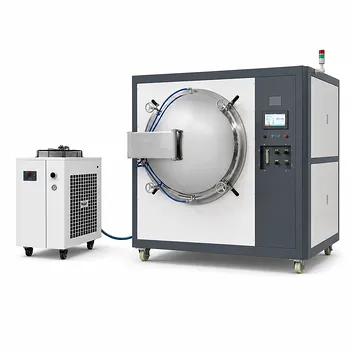
Vacuum hot pressing acts as the critical manufacturing bridge for Continuous Mesophase Pitch-based Carbon Fiber Reinforced Aluminum (MPCF/Al) composites. It overcomes the natural physical resistance of aluminum to infiltrate tight carbon fiber bundles by applying uniaxial pressure alongside high temperatures (620-660°C). This simultaneous application of force and heat breaks down surface oxide films and drives the aluminum matrix into the fiber gaps, ensuring a dense structure that standard heating cannot achieve alone.
The core function of the vacuum hot pressing furnace is to mechanically force plasticized aluminum into fiber bundles while chemically protecting the materials. By eliminating oxygen and applying pressure, it transforms a porous, poorly bonded mixture into a high-density composite with superior interfacial strength.
Overcoming Physical Barriers to Infiltration
The primary challenge in manufacturing MPCF/Al composites is the poor "wettability" of carbon fibers by aluminum.
Forcing Matrix Flow
Molten aluminum does not naturally flow into the microscopic gaps between carbon fibers due to high surface tension. The furnace applies uniaxial pressure to overcome this resistance. This pressure forces the semi-molten or plasticized aluminum to flow physically into the fiber bundles, filling voids that gravity or capillary action alone could not reach.
Breaking Surface Oxide Films
Aluminum powder particles are naturally coated with a thin, stubborn oxide film that inhibits bonding. The combination of heat and mechanical pressure effectively ruptures these oxide layers. Once the film is broken, the underlying pure aluminum can contact the carbon fibers directly, facilitating valid bonding.
Achieving Maximum Densification
Without external pressure, the composite would remain porous and structurally weak. The furnace promotes the densification of the aluminum matrix by compacting the material during its softened state. This results in a composite with high theoretical density and minimal internal defects.
Managing Chemical Integrity via Vacuum
High temperatures are necessary for processing, but they introduce the risk of severe chemical degradation in an open atmosphere.
Preventing Oxidation
The vacuum environment is non-negotiable for preserving the base materials. It prevents the aluminum matrix from oxidizing further and protects the carbon fibers from burning up or degrading. This ensures that the raw materials retain their intrinsic mechanical properties throughout the heating cycle.
Ensuring Interface Purity
A strong bond requires a clean interface between the metal and the reinforcement. By maintaining a vacuum, the furnace removes gases that could become trapped in the composite. This facilitates better flow of the matrix metal and ensures the formation of a strong physical bond at the interface.
Understanding the Trade-offs: Thermal Precision
While heat and pressure are the drivers of success, the process requires a delicate balance. A "more heat is better" approach is a common pitfall that leads to material failure.
Balancing Flowability and Chemistry
The furnace must operate within a precise window, typically between 575°C and 660°C. If the temperature is too low, the aluminum remains too stiff to infiltrate the fibers, leading to voids. If the temperature is too high, the aluminum becomes too reactive.
The Danger of Brittle Reactants
Excessive heat triggers a harmful chemical reaction between the carbon fiber and the aluminum matrix. This creates aluminum carbide (Al4C3), a brittle reactant that severely degrades the material's strength and thermal conductivity. The furnace must maintain temperatures high enough for wetting but low enough to suppress this reaction.
Controlling Matrix Stability
Beyond chemical reactions, thermal control prevents physical manufacturing defects. Overheating can cause metal leakage, where the matrix flows out of the mold entirely. Conversely, insufficient heat prevents the plastic flow required to lock the fibers in place.
Making the Right Choice for Your Goal
To maximize the utility of a vacuum hot pressing furnace for MPCF/Al composites, you must tune your parameters based on the desired outcome.
- If your primary focus is Structural Integrity: Prioritize high uniaxial pressure to maximize density and ensure deep infiltration into the fiber bundles, minimizing porosity.
- If your primary focus is Thermal/Electrical Conductivity: Prioritize strict temperature limits (avoiding the upper 660°C range) to prevent the formation of Al4C3, which acts as a barrier to conductivity.
Success ultimately relies on using the furnace not just as a heater, but as a precision tool to balance mechanical infiltration against chemical degradation.
Summary Table:
| Challenge | Vacuum Hot Pressing Solution | Resulting Benefit |
|---|---|---|
| Poor Infiltration | Uniaxial Pressure & High Heat | High-density structure with no voids |
| Aluminum Oxide Film | Mechanical Rupture via Pressure | Direct bonding of pure Al to fiber |
| Material Degradation | High-Vacuum Environment | Prevention of oxidation and fiber burning |
| Brittle Reactions | Precise Temperature Control | Minimization of Al4C3 to maintain strength |
Elevate Your Material Research with KINTEK
Are you facing challenges with material densification or interfacial bonding? KINTEK specializes in high-performance vacuum hot pressing furnaces and an extensive range of laboratory equipment designed for the most demanding manufacturing processes.
Our solutions for MPCF/Al composite fabrication empower researchers and manufacturers to achieve superior structural integrity and thermal conductivity. From high-temperature furnaces and hydraulic presses to essential ceramics and crucibles, KINTEK provides the precision tools you need to prevent brittle reactants and ensure maximum densification.
Ready to optimize your composite manufacturing? Contact KINTEK today to discuss your specific requirements with our experts.
Related Products
- Vacuum Hot Press Furnace Heated Vacuum Press Machine Tube Furnace
- 600T Vacuum Induction Hot Press Furnace for Heat Treat and Sintering
- Vacuum Hot Press Furnace Machine Heated Vacuum Press
- Vacuum Hot Press Furnace Machine for Lamination and Heating
- Vacuum Heat Treat and Pressure Sintering Furnace for High Temperature Applications
People Also Ask
- What advantages does a vacuum hot press furnace provide for LSLBO ceramic electrolytes? Achieve 94% Relative Density
- What role does a Vacuum Hot Press (VHP) furnace play in the densification of austenitic stainless steel 316 composites?
- What are the advantages of using a vacuum hot pressing furnace? Superior Densification for 2024Al/Gr/SiC Composites
- What are the advantages of a vacuum hot press furnace for LTPO solid electrolytes? Boost Density and Conductivity
- What core processing conditions does a vacuum hot press furnace provide? Achieve High-Density Cu-SiC/Diamond Composites