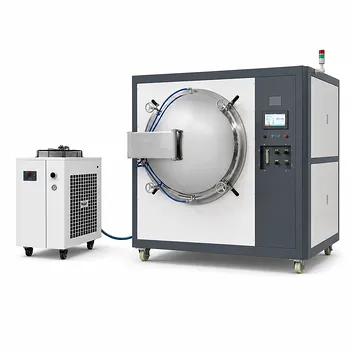
Vacuum hot pressing (VHP) transforms Zinc Sulfide (ZnS) powder into a dense, transparent ceramic by applying simultaneous thermal energy and mechanical force within a protected environment. Specifically, the furnace utilizes temperatures around 1000°C and uniaxial pressures up to 50 MPa in a high vacuum (e.g., 10^-5 mbar) to physically force particles together, eliminating the microscopic voids that block infrared light.
The Core Mechanism: VHP relies on "pressure-assisted sintering." Unlike standard sintering which relies solely on heat, VHP uses mechanical force to overcome the friction between particles. This allows the material to reach near-theoretical density (99.8%) at lower temperatures, preserving the fine microstructure necessary for superior optical clarity.
The Mechanics of Densification
Overcoming Particle Resistance
In a standard sintering process, particles fuse slowly via diffusion. VHP accelerates this by applying significant axial pressure, typically ranging from 20 to 50 MPa.
This mechanical force is critical for overcoming the friction between ZnS powder particles. It forces them into a tight arrangement, promoting plastic flow and grain rearrangement even before the material reaches its melting point.
Eliminating Optical Scattering
For a ceramic to be transparent to infrared light, it must be virtually free of pores. Internal pores act as scattering centers that disrupt light transmission.
The uniaxial pressure of the VHP process actively expels these internal pores. By mechanically collapsing voids during the heating phase, the process ensures the final ceramic achieves a uniform microstructure required for high optical transmittance.
Prevention of Oxidation
The process occurs within a high vacuum environment (often reaching 10^-5 mbar or 10^-3 mtorr). This is essential for chemical purity.
Heating Zinc Sulfide to 1000°C in air would lead to rapid oxidation, ruining the material's optical properties. The vacuum environment protects the material, ensuring that the densification results in pure ZnS rather than opaque oxides.
The Role of the Graphite Assembly
Transmitting Axial Force
The success of VHP depends heavily on the mold, which is almost exclusively made of high-strength graphite.
The graphite mold acts as more than just a container; it serves as the transmission medium. It transfers the massive hydraulic force (axial pressure) directly to the powder, converting external mechanical energy into internal densification.
Thermal Uniformity
Graphite is chosen for its high thermal conductivity. It ensures that the heat (up to 1040°C) is distributed evenly across the ceramic sample.
Uniform heating is vital to prevent internal stress or warping. It allows the liquid phase, if present, to distribute evenly, further aiding in particle rearrangement and bonding.
Understanding the Trade-offs
Carbon Contamination Risks
While graphite molds are essential, they introduce a specific risk: carbon diffusion. At high pressures and temperatures, carbon ions from the mold can migrate into the ZnS ceramic.
This can result in carbonate defects within the material. These defects appear as specific absorption bands in the infrared spectrum, potentially degrading the optical performance at certain wavelengths.
Cost vs. Purity (VHP vs. CVD)
VHP is a rapid, cost-effective alternative to Chemical Vapor Deposition (CVD). CVD produces extremely pure material but is slow and expensive.
VHP allows for faster production cycles and lower costs, making it ideal for industrial scaling. However, the operator must strictly control sintering parameters to balance this speed against the risk of grain boundary impurities mentioned above.
Making the Right Choice for Your Goal
To maximize the performance of Zinc Sulfide ceramics produced via VHP, align your process parameters with your specific end-use requirements:
- If your primary focus is Maximum Optical Transmission: Prioritize high-purity, high-density graphite dies and optimize sintering times to minimize carbon diffusion and absorption bands.
- If your primary focus is Cost-Effective Scaling: Leverage the rapid cycle times of VHP compared to CVD, using the lower end of the pressure spectrum (20 MPa) to extend mold life while maintaining acceptable density.
Summary: VHP achieves transparency by substituting time with mechanical force, crushing porosity to near-zero levels to create a clear optical path through the ceramic.
Summary Table:
| Parameter | VHP Process Requirement | Impact on ZnS Ceramics |
|---|---|---|
| Temperature | Approx. 1000°C | Enables particle bonding below melting point |
| Axial Pressure | 20 - 50 MPa | Collapses internal pores to eliminate light scattering |
| Vacuum Level | 10⁻⁵ mbar | Prevents oxidation and ensures chemical purity |
| Mold Material | High-strength Graphite | Transmits force and ensures uniform heat distribution |
| Density Goal | >99.8% Theoretical | Achieves near-perfect infrared transmittance |
Elevate Your Material Research with KINTEK Precision
Ready to achieve near-theoretical density and superior optical clarity in your advanced ceramics? KINTEK specializes in high-performance laboratory solutions, providing the precision tools needed for the most demanding applications. Whether you require advanced vacuum hot pressing (VHP) systems, high-temperature furnaces (vacuum, tube, or atmosphere), or graphite/ceramic consumables, our expert team is here to support your innovation.
From high-pressure reactors and crushing systems to specialized PTFE and ceramic crucibles, we empower researchers and industrial manufacturers to push the boundaries of material science.
Optimize your sintering process today—Contact KINTEK for a Tailored Solution!
Related Products
- Vacuum Hot Press Furnace Heated Vacuum Press Machine Tube Furnace
- 600T Vacuum Induction Hot Press Furnace for Heat Treat and Sintering
- Vacuum Hot Press Furnace Machine Heated Vacuum Press
- Vacuum Hot Press Furnace Machine for Lamination and Heating
- Vacuum Heat Treat and Pressure Sintering Furnace for High Temperature Applications
People Also Ask
- What advantages does a vacuum hot press furnace provide for LSLBO ceramic electrolytes? Achieve 94% Relative Density
- What role does a Vacuum Hot Press (VHP) furnace play in the densification of austenitic stainless steel 316 composites?
- What are the advantages of using a vacuum hot pressing furnace? Superior Densification for 2024Al/Gr/SiC Composites
- What are the advantages of a vacuum hot press furnace for LTPO solid electrolytes? Boost Density and Conductivity
- What core processing conditions does a vacuum hot press furnace provide? Achieve High-Density Cu-SiC/Diamond Composites