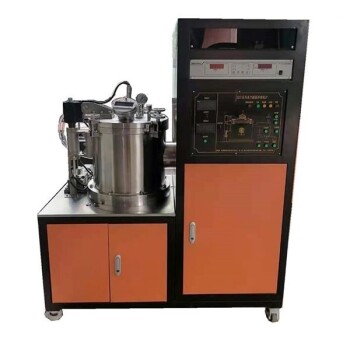
The arc melting furnace facilitates synthesis by generating the extreme, instantaneous heat required to fuse Cerium rods and Antimony particles under a controlled environment. By operating within a protective Argon atmosphere, the system prevents the rapid oxidation of reactive rare earth elements while driving the reaction. The process relies heavily on mechanical repetition—specifically flipping and remelting—to transform separate elements into a unified, chemically homogeneous compound.
The arc melting furnace is not merely a heater; it is a homogenization tool. Its ability to combine high-energy melting with an inert atmosphere allows researchers to stabilize precise stoichiometric phases like Ce4Sb3 and Ce2Sb that would otherwise be difficult to synthesize uniformly.
The Mechanics of Synthesis
Generating Instantaneous Heat
The primary function of the arc melting furnace is to provide extremely high instantaneous temperatures. This rapid thermal energy is necessary to melt the solid precursors—specifically Cerium rods and Antimony particles—starting the reaction almost immediately. Without this intensity, the materials might react incompletely or slowly, leading to impurities.
The Role of Protective Atmosphere
Synthesizing lanthanide compounds presents a chemical challenge: rare earth metals like Cerium oxidize rapidly when exposed to air. To solve this, the furnace operates under an Argon protective atmosphere. This inert environment shields the reactants, ensuring that the final compound is composed strictly of the intended metals without oxide contamination.
Achieving Chemical Homogeneity
The Flipping and Remelting Cycle
Simply melting the materials once is insufficient for creating high-quality intermetallic compounds. To ensure the internal components are thoroughly mixed, the sample must undergo repeated flipping and remelting processes. This mechanical intervention combats gravity-induced separation, where heavier elements might otherwise settle at the bottom of the ingot.
Stabilizing Stoichiometric Phases
The ultimate goal of this rigorous process is to create a chemically uniform material. By forcing the mixture to homogenize through multiple melt cycles, the furnace ensures the material reaches the correct stoichiometric ratios. This precision is essential for isolating and studying specific stable phases, such as Ce4Sb3 or Ce2Sb, rather than a chaotic mixture of different byproducts.
Operational Considerations and Constraints
The Necessity of Iteration
The quality of the final product is directly dependent on the number of melting cycles. A significant trade-off of this method is that it is not a "set and forget" process; it requires active intervention to flip the sample. Failing to repeat the remelting process enough times will result in a heterogeneous sample that does not accurately represent the desired compound.
Input Material Form Factors
The process described specifically utilizes Cerium rods and Antimony particles. The physical form of the raw materials impacts the melting dynamics. If the particle sizes are mismatched or the rods are too large relative to the arc size, it may take longer to achieve the initial melt pool, requiring careful observation by the operator.
Making the Right Choice for Your Goal
When utilizing an arc melting furnace for intermetallic synthesis, your operational priorities should dictate your workflow:
- If your primary focus is phase purity: Prioritize the integrity of the Argon atmosphere to prevent the highly reactive Cerium from oxidizing during the high-heat process.
- If your primary focus is structural homogeneity: Commit to a higher number of flipping and remelting cycles to ensure the Cerium and Antimony are evenly distributed throughout the ingot.
Success in synthesizing Ce4Sb3 and Ce2Sb lies in the disciplined application of heat, atmosphere control, and mechanical repetition.
Summary Table:
| Feature | Synthesis Benefit |
|---|---|
| High Instantaneous Heat | Rapidly fuses Cerium rods and Antimony particles for immediate reaction. |
| Argon Protective Atmosphere | Prevents oxidation of reactive rare earth elements during high-temp processing. |
| Flipping & Remelting | Ensures chemical homogeneity and eliminates gravity-induced separation. |
| Stoichiometric Control | Facilitates the isolation of precise phases like Ce4Sb3 and Ce2Sb. |
Elevate Your Material Research with KINTEK
Precise intermetallic synthesis demands equipment that delivers both extreme thermal power and uncompromising atmosphere control. KINTEK specializes in advanced laboratory solutions, including high-performance arc melting furnaces, vacuum systems, and induction melting tools designed for the rigorous demands of rare earth research.
From crushing and milling systems for precursor preparation to high-temperature furnaces and crucibles for final processing, our comprehensive portfolio ensures your samples achieve perfect homogeneity and phase purity. Partner with KINTEK for reliable results in battery research, metallurgy, and advanced ceramics.
Ready to optimize your synthesis workflow? Contact our technical experts today to find the ideal equipment for your lab!
References
- Yi Xie, Robert D. Mariani. Diffusion behavior of lanthanide-additive compounds (Ce4Sb3, Ce2Sb, and CeTe) against HT9 and Fe. DOI: 10.1016/j.matchar.2019.02.012
This article is also based on technical information from Kintek Solution Knowledge Base .
Related Products
- Non Consumable Vacuum Arc Induction Melting Furnace
- Vacuum Arc Induction Melting Furnace
- Vacuum Heat Treat Furnace and Levitation Induction Melting Furnace
- Lab-Scale Vacuum Induction Melting Furnace
- High Temperature Muffle Oven Furnace for Laboratory Debinding and Pre Sintering
People Also Ask
- What is the use of induction melting furnace? Achieve Fast, Clean, and Precise Metal Melting
- What is the temperature range of the induction melting furnace? Find the Right Heat for Your Metals
- What are the advantages of induction melting furnace? Achieve Purity, Efficiency, and Safety
- How do specialized industrial-grade small melting furnaces address challenges in precision jewelry casting? Expert Guide
- How do vacuum induction or arc melting furnaces facilitate the synthesis of U-Al-C MAX phases? Precision Heat & Purity