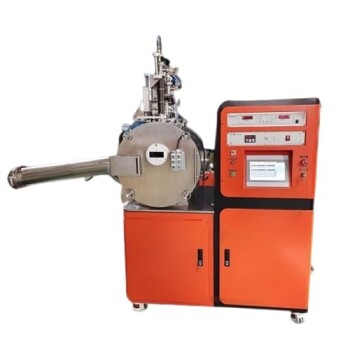
Vacuum arc melting (VAM) facilitates the preparation of Ti-Cr-Al-Nb alloys by utilizing high-temperature electric arcs generated by non-consumable tungsten electrodes to melt refractory metals within a protective environment. This equipment specifically addresses the challenges of high melting points and chemical segregation through a controlled, high-purity argon atmosphere and a rigorous mechanical re-melting process.
The core value of this equipment is its ability to combine extreme thermal energy with a pristine environment, allowing for the complete fusion of heat-resistant elements like Niobium while actively preventing the material segregation common in complex multi-component alloys.
The Mechanics of the Melting Process
Generating Extreme Heat
The VAM equipment relies on non-consumable tungsten electrodes to generate an intense electric arc.
This arc provides the extreme thermal energy necessary to thoroughly melt the raw materials, initiating the fusion process for the alloy components.
Processing Refractory Components
The primary challenge in creating Ti-Cr-Al-Nb alloys is the presence of refractory metals, such as Niobium (Nb), which have exceptionally high melting points.
VAM equipment is specifically designed to reach and sustain the temperatures required to liquefy these refractory components, ensuring they are fully integrated into the liquid matrix rather than remaining as undissolved inclusions.
Ensuring Purity and Homogeneity
The Role of Controlled Atmospheres
To protect the alloy during the melt, the process takes place within a high-purity argon atmosphere.
This controlled environment is critical because Titanium and Aluminum are highly sensitive to oxygen; without this protection, brittle oxide layers would form, severely degrading the material's mechanical performance.
Achieving Chemical Uniformity
A single melt is often insufficient to guarantee a uniform mixture in multi-component alloys, leading to potential composition segregation in the final ingot.
To solve this, the equipment facilitates a procedure of repeated re-melting and flipping of the ingot. This iterative mechanical process ensures that elements like Chromium and Aluminum are evenly distributed throughout the Titanium-Niobium matrix.
Understanding the Trade-offs
The Necessity of Repetition
While VAM is effective, it is not an instantaneous "mix-and-pour" solution. The process relies heavily on the re-melting and flipping procedure to achieve success.
This implies that production time is extended compared to simpler casting methods, as bypassing these repetitive steps risks significant chemical segregation and an unusable final product.
Material Compatibility
The use of non-consumable tungsten electrodes is efficient for generating heat, but it requires precise control.
Unlike vacuum induction melting, which melts via magnetic fields, VAM relies on the arc itself. This makes it ideal for refractory ingots but requires careful management to ensure the electrode does not degrade or contaminate the melt.
Making the Right Choice for Your Goal
When configuring your alloy preparation process, consider which parameter defines your success:
- If your primary focus is Material Purity: Prioritize the integrity of the vacuum and argon atmosphere to prevent the formation of brittle oxides in the Titanium and Aluminum components.
- If your primary focus is Structural Homogeneity: strictly adhere to the protocol of repeated re-melting and flipping to eliminate segregation of the heavy refractory elements.
Success in preparing Ti-Cr-Al-Nb alloys ultimately depends on leveraging the VAM equipment's ability to balance extreme heat with rigorous environmental control.
Summary Table:
| Feature | Benefit for Ti-Cr-Al-Nb Alloys |
|---|---|
| Tungsten Electric Arc | Provides extreme thermal energy to melt high-melting-point Niobium (Nb). |
| Argon Atmosphere | Prevents oxidation of sensitive Titanium (Ti) and Aluminum (Al) components. |
| Water-Cooled Copper Hearth | Minimizes contamination and prevents reaction between the melt and the crucible. |
| Iterative Re-melting | Ensures chemical uniformity and eliminates segregation in multi-component mixtures. |
Elevate Your Material Research with KINTEK Precision Solutions
Precision is non-negotiable when developing complex multi-component alloys like Ti-Cr-Al-Nb. KINTEK specializes in high-performance laboratory equipment designed to meet the rigorous demands of material science. Our comprehensive portfolio includes advanced induction melting systems, high-temperature vacuum furnaces, and crushing and milling systems to streamline your entire alloy preparation workflow.
From high-pressure reactors and dental furnaces to essential consumables like cruibles and ceramics, KINTEK provides the tools you need to achieve structural homogeneity and peak material purity.
Ready to optimize your lab's performance? Contact our technical experts today to find the perfect equipment solution for your research goals.
References
- O.M. Velikodnyi, G.D. Tolstolutska. STRUCTURE AND MECHANICAL PROPERTIES OF Ti-Cr-Al-Nb AND Ti-Cr-Al-Nb-V MULTICOMPONENT ALLOYS. DOI: 10.46813/2023-147-059
This article is also based on technical information from Kintek Solution Knowledge Base .
Related Products
- Vacuum Arc Induction Melting Furnace
- Vacuum Induction Melting Spinning System Arc Melting Furnace
- Non Consumable Vacuum Arc Induction Melting Furnace
- Vacuum Heat Treat Furnace and Levitation Induction Melting Furnace
- Lab-Scale Vacuum Induction Melting Furnace
People Also Ask
- How do vacuum induction or arc melting furnaces facilitate the synthesis of U-Al-C MAX phases? Precision Heat & Purity
- What core role does a Vacuum Induction Melting furnace play in nickel-free steel production? Achieve High-Purity Alloys
- What is the function of vacuum arc melting equipment? Creating High-Purity Ferrochrome (CrFe) Alloys
- What is the primary function of a vacuum arc melting furnace in RHEA preparation? Achieving Extreme Thermal Fusion
- What is the function of a vacuum arc melting furnace? Prepare High-Purity Alx(CrFeNi)1-x High-Entropy Alloys