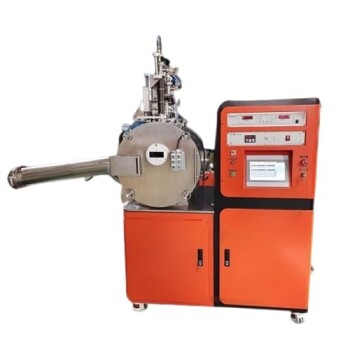
The primary function of vacuum melting equipment is to fuse Titanium (Ti), Zirconium (Zr), and Nickel (Ni) components under extreme vacuum to prevent chemical degradation. By eliminating atmospheric gases, the equipment protects these reactive metals from oxidation and minimizes impurity contamination while they are in a highly vulnerable molten state.
Vacuum melting is more than a heating process; it is a preservation strategy that ensures the precise chemical composition required to form stable quasicrystalline phases in Ti-Zr-Ni alloys.
Preserving Chemical Integrity
Protecting Active Components
Titanium and Zirconium are chemically active metals. When heated to melting points in open air, they react aggressively with oxygen.
Vacuum melting equipment creates an environment devoid of air, effectively halting oxidation. This ensures that the metallic components remain in their pure elemental form rather than converting to brittle oxides.
Minimizing Impurity Contamination
The high-temperature molten state is when alloys are most susceptible to absorbing environmental contaminants.
By operating under ultra-pure conditions, vacuum melting isolates the melt from external impurities. This strict isolation is the only way to guarantee the material foundation remains uncompromised.
The Critical Link to Microstructure
Ensuring Compositional Precision
For complex alloys like Ti41.5Zr41.5Ni17, the ratio of elements must be exact.
If oxidation occurs, the amount of usable metal in the mix decreases, shifting the alloy's final composition. Vacuum melting locks in the specific chemical ratios intended by the formulation.
Facilitating Quasicrystalline Phases
The ultimate goal of preparing this specific alloy is often the formation of quasicrystalline phases.
These phases are highly sensitive to impurities and chemical imbalances. The high-purity foundation established by vacuum melting is a prerequisite for the subsequent stability of these unique microstructures.
Understanding the Trade-offs
Process Complexity and Cost
While vacuum melting ensures purity, it introduces significant operational complexity compared to standard melting.
The equipment requires robust pumping systems to maintain extreme vacuum levels (often distinct from the inert gas purging used in other methods like induction melting). This increases both the energy consumption and the time required per batch.
Volume Limitations
Strict vacuum control can limit the volume of material processed at one time compared to open-air industrial methods.
However, for high-performance materials like Ti-Zr-Ni alloys, this trade-off is accepted to avoid the catastrophic failure caused by oxide inclusions.
Making the Right Choice for Your Goal
To determine if vacuum melting is the critical path for your project, consider the specific requirements of your alloy.
- If your primary focus is Phase Stability: You must use vacuum melting to prevent compositional shifts that would inhibit the formation of quasicrystalline phases.
- If your primary focus is Mechanical Integrity: The elimination of oxide inclusions is non-negotiable to prevent brittleness in active metals like Ti and Zr.
For Ti-Zr-Ni alloys, vacuum melting is not optional; it is the definitive method for translating a chemical formula into a stable, high-performance physical reality.
Summary Table:
| Feature | Vacuum Melting Function | Impact on Ti-Zr-Ni Alloy |
|---|---|---|
| Atmosphere Control | Eliminates oxygen/nitrogen | Prevents oxidation of reactive Ti and Zr |
| Purity Management | Minimizes impurity contamination | Ensures high-purity material foundation |
| Compositional Precision | Maintains exact element ratios | Enables formation of quasicrystalline phases |
| Microstructure Quality | Reduces oxide inclusions | Prevents brittleness and mechanical failure |
Elevate Your Material Research with KINTEK
Precision is non-negotiable when working with reactive metals like Titanium and Zirconium. At KINTEK, we specialize in high-performance laboratory equipment designed to meet the rigorous demands of advanced metallurgy. Our comprehensive range of induction melting systems, vacuum furnaces, and crushing and milling systems provides the ultra-pure environment necessary for synthesizing complex alloys and stable quasicrystalline phases.
Whether you are developing Ti-Zr-Ni alloys or specialized battery materials, our expert solutions—from high-temperature reactors to PTFE consumables and ceramics—ensure your research is backed by consistency and quality.
Ready to achieve superior chemical integrity in your samples? Contact KINTEK today to discover how our tailored equipment solutions can empower your lab's innovation.
References
- S.V. Malykhin, D. Terentyev. STRUCTURAL-PHASE CHANGES IN THIN FILMS AND SURFACE LAYERS OF Ti41.5Zr41.5Ni17 ALLOY, STIMULATED BY RADIATION-THERMAL IMPACT OF HYDROGEN PLASMA. DOI: 10.46813/2019-119-083
This article is also based on technical information from Kintek Solution Knowledge Base .
Related Products
- Vacuum Induction Melting Spinning System Arc Melting Furnace
- Lab-Scale Vacuum Induction Melting Furnace
- Vacuum Heat Treat Furnace and Levitation Induction Melting Furnace
- Vacuum Arc Induction Melting Furnace
- Non Consumable Vacuum Arc Induction Melting Furnace
People Also Ask
- What are the advantages of a vacuum induction melting furnace? Achieve High-Purity Alloys with Precision VIM
- Why use VIM for rare earth steel? Essential Precision for Melting Reactive Lanthanum and Cerium
- What is the primary function of a vacuum induction melting furnace in Ni-Mo-Cr-Fe master alloy prep? Ensure High Purity
- What is the function of a vacuum induction melting furnace? Essential Guide for High-Purity FeCrAl Alloy Production
- What types of metals are typically processed in a vacuum induction melting furnace? High-Purity Alloys for Critical Applications