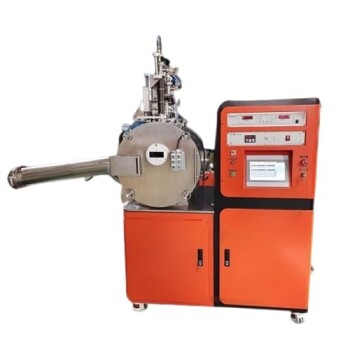
The primary role of a laboratory vacuum arc remelting furnace is to ensure the precise synthesis and chemical homogeneity of complex materials like high-entropy alloys.
This equipment generates a high-temperature electric arc using a tungsten electrode within a water-cooled copper crucible to rapidly melt combined metal elements. By operating under a vacuum or a high-purity argon shield, the furnace prevents the oxidation of active elements while facilitating the atomic-level mixing required for experimental and welding applications.
Core Takeaway The vacuum arc remelting furnace addresses the two biggest risks in preparing alloys like Al0.8CoCrFeNi: it eliminates oxygen to prevent the degradation of reactive metals (like Aluminum) and utilizes repeated melting cycles to force elements with different melting points into a single, uniform solid solution.
Creating the Ideal Melting Environment
Generating Extreme Heat via Electric Arc
The furnace utilizes a high-energy electric arc to create the intense heat necessary to melt refractory and standard metals alike.
This allows for the rapid melting of elements with vastly different melting points—such as iron, chromium, nickel, and aluminum—ensuring they transition to a liquid state simultaneously for proper mixing.
Preventing Oxidation of Active Elements
High-entropy alloys often contain active elements, such as the Aluminum in Al0.8CoCrFeNi, which oxidize instantly at high temperatures if exposed to air.
The furnace mitigates this by evacuating the chamber to a vacuum and backfilling it with high-purity argon. This protective atmosphere ensures the final alloy remains pure and free of brittle oxide inclusions.
Contamination Control
The melting process takes place inside a water-cooled copper crucible.
Because the copper is actively cooled, it does not melt or react with the molten alloy, effectively preventing cross-contamination that could skew the chemical composition of the sample.
Ensuring Homogeneity and Structure
Achieving Atomic-Level Mixing
Simply melting the metals once is rarely sufficient to create a true high-entropy alloy structure (such as a single-phase FCC or BCC lattice).
The furnace is designed to facilitate flip-remelting cycles. After the first melt, the alloy "button" is flipped over and remelted multiple times to ensure the elements are mixed uniformly at the atomic level.
Eliminating Porosity
The combination of high heat and a controlled vacuum environment helps drive out trapped gases from the raw materials.
This results in a dense, non-porous ingot that serves as a reliable base material for characterization or further processing, such as welding or mechanical testing.
Understanding the Trade-offs
Batch Process Limitations
While this method offers superior purity, laboratory VAR furnaces are typically batch-process machines designed for small quantities. They are ideal for material discovery and research but are not suited for continuous, large-scale production without significant industrial scaling.
The Necessity of Repetition
Homogeneity is not automatic; it relies on the operator's protocol. If the flip-remelting cycles are insufficient (e.g., melting only once or twice), the alloy may suffer from macro-segregation, where heavier elements sink and lighter elements float, ruining the high-entropy properties.
Making the Right Choice for Your Goal
To maximize the utility of a vacuum arc remelting furnace for your specific alloy project, consider the following:
- If your primary focus is Chemical Homogeneity: You must mandate a minimum number of flip-remelting cycles (typically 4-5) to guarantee the uniform distribution of elements like Cobalt and Chromium.
- If your primary focus is Purity: You must prioritize the quality of the vacuum pull and the purity grade of the argon gas to prevent the oxidation of Aluminum.
Ultimately, the vacuum arc remelting furnace is the gatekeeper of quality, transforming loose metal powders into the dense, uniform crystalline structures required for high-performance alloy research.
Summary Table:
| Feature | Function in HEA Preparation | Benefit for Al0.8CoCrFeNi |
|---|---|---|
| Electric Arc Heating | Rapidly melts elements with diverse melting points | Ensures simultaneous melting of Cr, Fe, Ni, and Al |
| Vacuum/Argon Shield | Eliminates oxygen and nitrogen exposure | Prevents oxidation of active Aluminum (Al) elements |
| Water-Cooled Crucible | Provides a non-reactive melting environment | Eliminates cross-contamination for high-purity ingots |
| Flip-Remelting Cycles | Facilitates repeated atomic-level mixing | Achieves a uniform, single-phase solid solution structure |
| Vacuum Degassing | Drives out trapped gases during melting | Produces dense, non-porous samples for mechanical testing |
Elevate Your Material Research with KINTEK Precision
Achieving perfect chemical homogeneity in high-entropy alloys requires more than just heat; it requires a controlled, high-purity environment. KINTEK specializes in advanced laboratory equipment designed for the most demanding material science applications.
Whether you are synthesizing complex HEAs or conducting critical welding research, our comprehensive range of vacuum arc remelting furnaces, high-temperature furnaces (CVD, PECVD, Induction), and crushing/milling systems provides the reliability your data deserves. From high-purity ceramic crucibles to precision hydraulic presses, we supply the tools necessary to transform raw elements into high-performance innovations.
Ready to optimize your alloy synthesis process?
Contact KINTEK today to discuss your laboratory requirements
References
- Ionelia Voiculescu, Elena Scutelnicu. Effect of Diffusion on Dissimilar Welded Joint between Al0.8CoCrFeNi High-Entropy Alloy and S235JR Structural Steel. DOI: 10.3390/met12040548
This article is also based on technical information from Kintek Solution Knowledge Base .
Related Products
- Vacuum Arc Induction Melting Furnace
- Vacuum Induction Melting Spinning System Arc Melting Furnace
- Non Consumable Vacuum Arc Induction Melting Furnace
- Vacuum Heat Treat Furnace and Levitation Induction Melting Furnace
- Lab-Scale Vacuum Induction Melting Furnace
People Also Ask
- How do vacuum induction or arc melting furnaces facilitate the synthesis of U-Al-C MAX phases? Precision Heat & Purity
- What core role does a Vacuum Induction Melting furnace play in nickel-free steel production? Achieve High-Purity Alloys
- What is the function of a vacuum arc melting furnace? Master Homogeneity for Amorphous Alloy Ribbons
- What is the function of vacuum arc melting equipment? Creating High-Purity Ferrochrome (CrFe) Alloys
- What is the function of a vacuum arc melting furnace? Prepare High-Purity Alx(CrFeNi)1-x High-Entropy Alloys