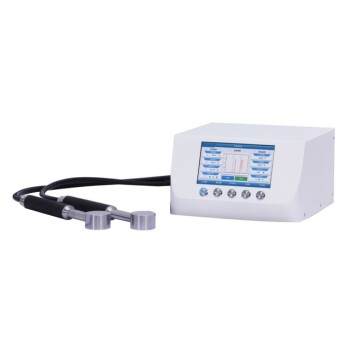
An automatic PID temperature controller secures data accuracy by actively stabilizing the reactor's thermal environment against external variables. By utilizing a K-type thermocouple to constantly monitor feedback, the controller adjusts power output to maintain the microreactor temperature within a strict tolerance of $\pm 1^\circ\text{C}$.
Core Takeaway The PID controller acts as a variable isolator, ensuring that temperature volatility does not skew chemical reaction rates. This guarantees that measured catalytic conversion rates are a result of the chemistry itself, rather than thermal instability, rendering the data highly comparable and reproducible.
The Mechanism of Precision Control
To understand how accuracy is achieved, one must look at the continuous "closed-loop" cycle the controller performs.
The Feedback Loop
The PID controller does not simply turn a heater on or off; it calculates the deviation between your target temperature (setpoint) and the actual temperature.
It uses this data to modulate power output dynamically. This prevents the sharp spikes and drops associated with standard on/off thermostats.
Integration with K-Type Thermocouples
The system relies on a K-type thermocouple to provide real-time thermal data.
This sensor acts as the "eyes" of the system, detecting minute changes in the microreactor's environment. The controller reacts to this feedback instantly to correct errors before they grow larger than the $\pm 1^\circ\text{C}$ limit.
Dynamic Power Adjustment
If the reaction generates its own heat (exothermic) or requires more energy, the PID algorithm adjusts the energy input proportionally.
This ensures the system adheres strictly to the programmed path, eliminating thermal noise that could otherwise be mistaken for reaction data.
Why Stability Dictates Data Accuracy
In propane oxidation experiments, temperature is the critical variable governing reaction rates.
Eliminating Thermal Instability
Chemical reaction rates are exponentially sensitive to temperature changes.
By clamping fluctuations to within $\pm 1^\circ\text{C}$, the controller removes thermal instability as a confounding factor. This allows you to attribute changes in oxidation rates directly to the catalyst's performance, rather than environmental error.
Ensuring Comparability
For data to be valid, measurements taken at different setpoints (e.g., $300^\circ\text{C}$ vs. $350^\circ\text{C}$) must be distinct and stable.
The PID controller ensures that a setpoint of $300^\circ\text{C}$ is effectively maintained, allowing for valid comparisons between different temperature tiers in your experiment.
Reproducibility of Conversion Rates
Reproducibility is the gold standard of experimental data.
Because the PID controller enforces a strict thermal environment, identical experimental conditions will yield identical catalytic conversion rates in subsequent runs. This consistency is impossible without active deviation management.
Understanding the Trade-offs
While PID controllers are essential for accuracy, they rely heavily on correct setup and tuning.
Sensor Limitations
The controller is only as accurate as the feedback it receives.
If the K-type thermocouple is poorly calibrated or positioned incorrectly within the microreactor, the controller will stabilize the temperature at the wrong value. This creates "precise" but inaccurate data.
Tuning Complexity
A PID controller must be tuned to the specific thermal mass of your reactor.
If the Proportional, Integral, and Derivative values are not optimized, the system may oscillate around the setpoint or react too slowly to changes. This can reintroduce the very fluctuations you are trying to eliminate.
Making the Right Choice for Your Goal
To maximize the quality of your propane oxidation data, apply the following principles:
- If your primary focus is kinetic accuracy: Ensure your PID controller is tuned to limit fluctuations strictly to $\pm 1^\circ\text{C}$ to prevent thermal noise from skewing reaction rate calculations.
- If your primary focus is experimental reproducibility: Verify the placement and calibration of the K-type thermocouple to guarantee that "feedback" temperature matches the actual internal reactor temperature.
Ultimately, the value of your data depends not just on the reaction itself, but on the rigorous thermal stability that surrounds it.
Summary Table:
| Feature | Function in Experiments | Impact on Data Accuracy |
|---|---|---|
| PID Algorithm | Dynamic power modulation | Prevents thermal spikes and noise |
| K-Type Thermocouple | Real-time feedback monitoring | Detects minute deviations instantly |
| $\pm 1^\circ\text{C}$ Tolerance | Strict temperature clamping | Ensures conversion rates are chemically driven |
| Closed-Loop Control | Continuous error correction | Guarantees high experimental reproducibility |
Elevate Your Research Precision with KINTEK
Precise thermal control is the backbone of reliable chemical analysis. At KINTEK, we specialize in high-performance laboratory solutions designed to eliminate variables and secure your data integrity. Whether you are conducting propane oxidation in our advanced high-temperature reactors and autoclaves or performing material synthesis in our CVD/PECVD furnaces, our equipment delivers the $\pm 1^\circ\text{C}$ stability your research demands.
From crushing and milling systems to precision hydraulic presses and specialized electrolytic cells, KINTEK provides the comprehensive tools and consumables—including PTFE and ceramic crucibles—needed for world-class laboratory workflows.
Ready to eliminate thermal instability? Contact our technical experts today to find the perfect high-temperature solution for your lab!
References
- Sunday Odiba, Paul A. Russell. Micro-Reactor System for Complete Oxidation of Volatile Organic Compounds. DOI: 10.3390/catal10080846
This article is also based on technical information from Kintek Solution Knowledge Base .
Related Products
- Infrared Heating Quantitative Flat Plate Press Mold
- Automatic High Temperature Heated Hydraulic Press Machine with Heated Plates for Lab
- Manual High Temperature Heated Hydraulic Press Machine with Heated Plates for Lab
- Laboratory Small Constant Temperature Heated Magnetic Stirrer Heater and Stirrer
People Also Ask
- Can a heat press be used as a laminator? Why It's a Risky Choice for Your Projects
- What is the difference between manual and air compressed heat press? Choose the Right Tool for Your Production Needs
- Can you use a heat press for transfers? The Definitive Tool for Professional Results
- What is the standard temperature for heat press? Master the Perfect Settings for Durable Transfers
- What is the process of hot press molding? A Guide to High-Density Material Manufacturing