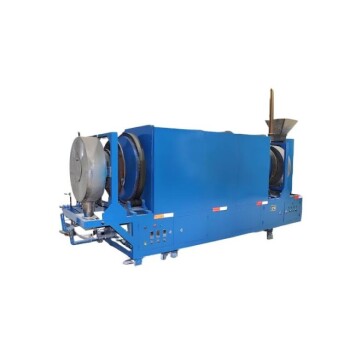
An industrial high-temperature electric heating furnace functions as a precision thermal cycling chamber designed to stress-test materials. To simulate engine conditions for valve steel, it utilizes programmable controls to rapidly elevate samples to operational temperatures, specifically 973 K or 1173 K, and maintains these levels for a set duration, such as two hours. This heating phase is paired with a subsequent cooling phase to induce thermal shock, replicating the fluctuating extreme environment an engine valve experiences during operation.
The primary purpose of this simulation is to evaluate cyclic thermal shock resistance. By alternating between intense heat and cooling, the furnace tests the valve steel's ability to withstand oxidation and structural degradation under the dynamic loads of a real-world engine.
The Mechanics of Thermal Simulation
Programmable Heat Management
The furnace does not simply apply heat; it executes a specific thermal recipe. Operators program the system to ramp up temperature rapidly, mimicking engine startup and peak load conditions. For valve steel, these targets are typically set to distinct plateaus like 973 K (700°C) or 1173 K (900°C).
The "Soak" Phase
Once the target temperature is reached, the furnace enters a holding pattern. It maintains the heat level for a specified duration, such as 2 hours. This ensures the thermal energy fully penetrates the core of the sample, not just the surface.
Inducing Thermal Shock
The simulation is incomplete without the cooling phase. After the holding period, the furnace facilitates a transition to a lower temperature. This rapid change creates thermal shock, forcing the material to contract after expansion, which is where most mechanical failures occur in engine components.
Why Cyclic Testing is Critical
Evaluating Oxidation Resistance
Engine valves are highly susceptible to oxidation at high temperatures. The furnace environment accelerates the chemical reaction between the steel and oxygen. This allows engineers to measure how quickly the material degrades or forms oxide layers under stress.
Testing Surface Integrity
As the material expands and contracts, the surface is tested for stability. The process verifies if the protective oxide scale (or applied coating) remains adherent to the substrate. If the material cannot handle the cycle, the surface scale will crack or flake off (spallation), leading to rapid failure.
Understanding the Trade-offs
Thermal vs. Mechanical Stress
While this furnace excels at simulating thermal loads, it isolates heat from other engine factors. It does not simulate mechanical vibration, physical impact of valve closure, or chemical corrosion from fuel combustion byproducts. It is a specialized test for thermal endurance, not a total engine simulation.
Accelerated Aging Risks
To get results quickly, these tests often use conditions slightly more severe or condensed than typical daily driving. There is a risk that the accelerated nature of the test might induce failure modes that wouldn't necessarily occur under normal, slower operational cycles. Data interpretation requires distinguishing between realistic fatigue and test-induced anomalies.
Making the Right Choice for Your Goal
When interpreting data from these furnace simulations, focus on the specific metric that aligns with your engineering objectives.
- If your primary focus is material longevity: Look for data regarding weight change over cycles, which indicates how much material is being lost to oxidation or spallation.
- If your primary focus is coating adhesion: Examine the samples for micro-cracking or peeling after the cooling phase, as this indicates the bond cannot survive thermal expansion mismatches.
Ultimately, this furnace serves as a critical quality gate, ensuring that only valve steels capable of surviving the repetitive trauma of thermal shock are approved for engine production.
Summary Table:
| Feature | Specification/Action | Purpose in Simulation |
|---|---|---|
| Target Temperatures | 973 K (700°C) / 1173 K (900°C) | Mimics engine startup and peak load conditions |
| Soak Duration | 2 Hours (typical) | Ensures uniform thermal penetration to the sample core |
| Heating Method | Programmable Ramp-up | Replicates rapid engine temperature fluctuations |
| Failure Testing | Thermal Shock Cycles | Evaluates oxidation resistance and surface scale adhesion |
| Key Metric | Weight Change & Spallation | Measures material loss and coating integrity |
Elevate Your Material Testing with KINTEK Precision Solutions
Ensure your components can withstand the most rigorous thermal cycles with KINTEK’s industry-leading laboratory equipment. Whether you are testing engine valve steel or developing next-generation alloys, our high-temperature furnaces (muffle, tube, and atmosphere) and high-pressure reactors provide the precise control needed for accurate thermal shock and oxidation simulation.
Why partner with KINTEK?
- Comprehensive Range: From advanced vacuum and CVD furnaces to specialized crushing, milling, and hydraulic presses.
- Reliability: Engineered for high-temperature endurance and uniform heat distribution.
- Expertise: Supporting battery research, metallurgy, and material science with premium consumables like ceramics, crucibles, and PTFE products.
Don't leave your material integrity to chance. Contact KINTEK today to find the perfect thermal processing solution for your lab!
References
- K. Adamaszek, Mariusz WISŁA. Valve steel oxidation rate in the exhaust gases of diesel engines fueled with 5% biocomponent diesel oil. DOI: 10.19206/ce-117037
This article is also based on technical information from Kintek Solution Knowledge Base .
Related Products
- 1700℃ Laboratory High Temperature Tube Furnace with Alumina Tube
- 1400℃ Controlled Atmosphere Furnace with Nitrogen and Inert Atmosphere
- 1700℃ Controlled Atmosphere Furnace Nitrogen Inert Atmosphere Furnace
- High Temperature Muffle Oven Furnace for Laboratory Debinding and Pre Sintering
- 1700℃ Muffle Oven Furnace for Laboratory
People Also Ask
- What functions does a laboratory high-temperature tube furnace perform? Master Catalyst Synthesis & Carbonization
- What roles does a high-temperature tube furnace play in the synthesis of N/O co-doped carbon? Master Precise Doping
- How does a laboratory tube furnace facilitate methane catalyst evaluation & regeneration? Optimize Thermal Performance
- What are the primary applications of muffle and tube furnaces in photocatalysts? Optimize Metal Loading & Support Synthesis
- How does a high-temperature tube furnace influence 253MA steel? Master Microstructure & High-Temp Creep Resistance