Knowledge dental furnace How does firing temperature affect ceramics? Master the Key to Perfect Strength and Aesthetics
Author avatar

Tech Team · Kintek Solution

Updated 2 months ago

How does firing temperature affect ceramics? Master the Key to Perfect Strength and Aesthetics


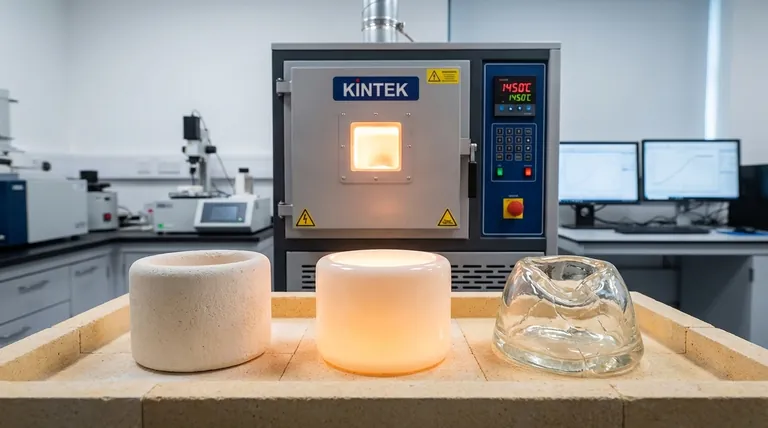
Firing temperature is the single most critical variable in creating ceramics, directly governing their final aesthetic and functional properties. The heat applied during this process dictates the material's density, strength, and optical characteristics, such as translucency. Getting the temperature wrong results in a fundamentally flawed product, while precision yields a successful, reliable outcome.

Firing temperature isn't just about making ceramics hard; it's a precise balancing act. Too high a temperature creates excessive glassiness and structural weakness, while too low a temperature results in a porous, opaque, and brittle product. The correct temperature achieves the optimal fusion of particles for both strength and appearance.
How does firing temperature affect ceramics? Master the Key to Perfect Strength and Aesthetics

The Core Process: Sintering and Vitrification

What Happens During Firing?

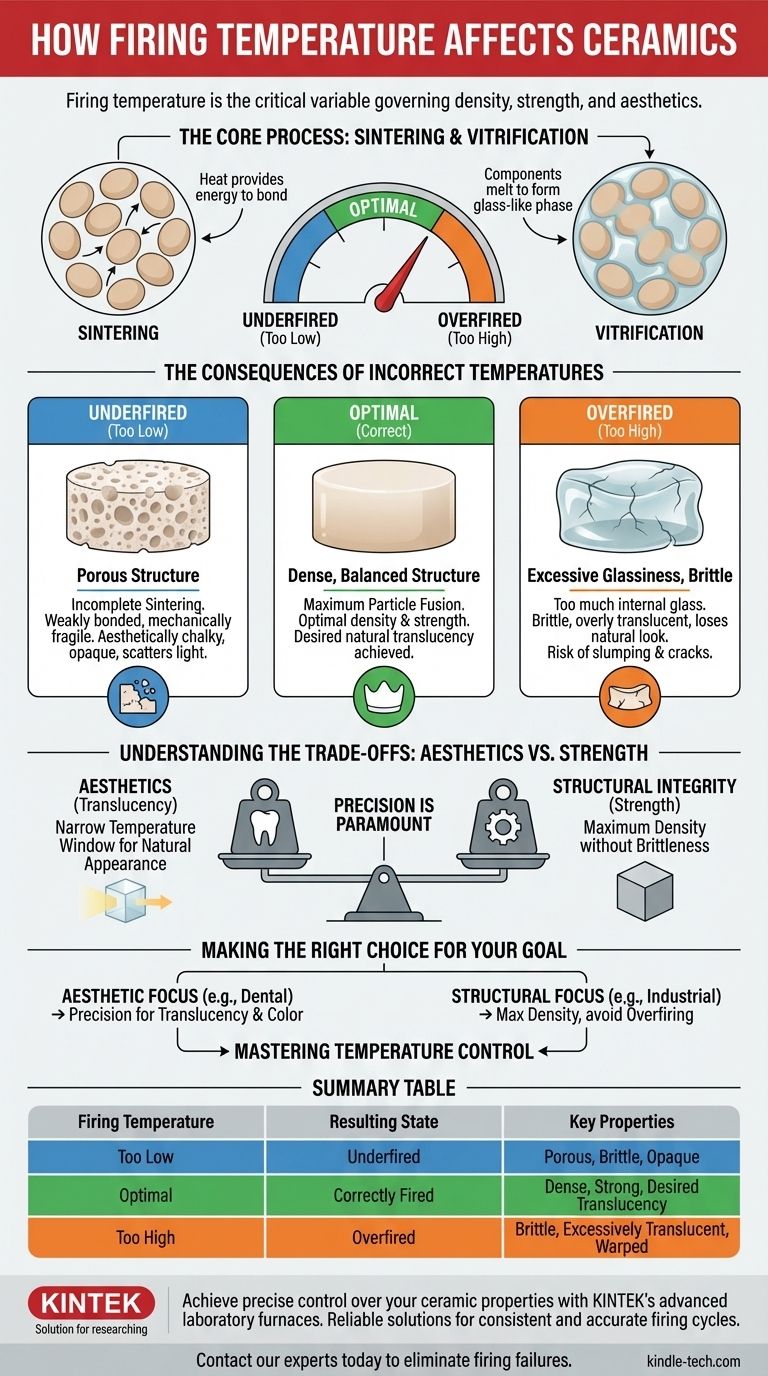
During firing, ceramic particles undergo a process called sintering. Heat provides the energy for individual grains to bond and fuse, eliminating the pores between them.

This densification process is often accompanied by vitrification, where some components melt to form a glass-like phase. This glassy matrix fills the remaining voids, binding the crystalline particles into a strong, coherent mass.

Why Temperature Governs This Process

Temperature is the catalyst for this transformation. It directly controls the rate and extent of atomic diffusion, which allows the ceramic particles to join.

The final ratio of crystalline particles to the glassy phase is determined by the peak temperature and the duration of the firing cycle. This balance is what defines the ceramic's final properties.

The Consequences of Incorrect Temperatures

The Problem of Underfiring

If the firing temperature is too low, the ceramic is underfired. There isn't enough thermal energy to complete the sintering process.

This results in a porous, weakly bonded structure that is mechanically fragile. Aesthetically, underfired ceramics often appear chalky, opaque, and overly reflective because the voids and un-fused particles scatter light instead of transmitting it.

The Dangers of Overfiring

Conversely, if the temperature is too high, the ceramic becomes overfired. This causes excessive vitrification, creating too much internal glass.

While this may increase density, it can also make the material brittle. Visually, an overfired ceramic becomes too translucent, losing its aesthetic appeal and natural appearance. In extreme cases, the material can slump, warp, or develop internal stresses that lead to crack propagation and failure.

Understanding the Trade-offs: Aesthetics vs. Strength

The Quest for Translucency

Achieving the desired level of translucency is a primary goal, especially in applications like dental ceramics. This optical property is dictated by a very narrow temperature window.

A slight deviation can dramatically alter how light passes through the material, shifting it from a natural appearance to either opaque or glassy. Accurate furnace temperature is therefore essential for aesthetic success.

Ensuring Structural Integrity

The functional properties of strength and fracture resistance are just as sensitive to temperature. The objective is to create a dense, non-porous body without introducing the stresses or brittleness associated with overfiring.

The optimal temperature achieves maximum particle fusion and minimal porosity, creating a material that can withstand functional stress without failing.

Making the Right Choice for Your Goal

Calibrating your approach to the specific material and desired outcome is essential. The "correct" temperature is not a single number but a precise target based on your objective.

  • If your primary focus is aesthetics (e.g., dental restorations): Precision is paramount, as even minor temperature deviations will visibly alter translucency and color.
  • If your primary focus is structural performance (e.g., industrial components): Your goal is maximum density and strength, which requires reaching the full sintering temperature without overshooting into a phase that introduces brittleness.
  • If you are experiencing failures like cracking or poor appearance: The first variable to investigate and calibrate is your furnace's firing temperature and cycle.

Ultimately, mastering temperature control is mastering the final properties of your ceramic.

Summary Table:

Firing Temperature Resulting State Key Properties
Too Low Underfired Porous, Brittle, Opaque
Optimal Correctly Fired Dense, Strong, Desired Translucency
Too High Overfired Brittle, Excessively Translucent, Warped

Achieve precise control over your ceramic properties with KINTEK's advanced laboratory furnaces.

Whether you are developing dental restorations that demand perfect aesthetics or industrial components that require maximum strength, the right furnace is critical. KINTEK specializes in high-precision lab equipment, offering reliable solutions for consistent and accurate firing cycles.

Contact our experts today to discuss your specific ceramic application and discover how our equipment can help you eliminate firing failures and achieve superior results.

Visual Guide
How does firing temperature affect ceramics? Master the Key to Perfect Strength and Aesthetics Visual Guide

Related Products

People Also Ask

Related Products

Vacuum Heat Treat Furnace with Ceramic Fiber Liner

Vacuum Heat Treat Furnace with Ceramic Fiber Liner

Vacuum furnace with polycrystalline ceramic fiber insulation liner for excellent heat insulation and uniform temperature field. Choose from 1200℃ or 1700℃ max. working temperature with high vacuum performance and precise temperature control.

Dental Porcelain Zirconia Sintering Ceramic Furnace Chairside with Transformer

Dental Porcelain Zirconia Sintering Ceramic Furnace Chairside with Transformer

Experience top-notch sintering with Chairside Sintering Furnace with Transformer. Easy to operate, noise-free pallet, and automatic temperature calibration. Order now!

Dental Porcelain Zirconia Sintering Ceramic Vacuum Press Furnace

Dental Porcelain Zirconia Sintering Ceramic Vacuum Press Furnace

Get precise dental results with Dental Vacuum Press Furnace. Automatic temperature calibration, low noise tray, and touch screen operation. Order now!

2200 ℃ Graphite Vacuum Heat Treat Furnace

2200 ℃ Graphite Vacuum Heat Treat Furnace

Discover the power of the KT-VG Graphite Vacuum Furnace - with a maximum working temperature of 2200℃, it's perfect for vacuum sintering of various materials. Learn more now.

High Temperature Muffle Oven Furnace for Laboratory Debinding and Pre Sintering

High Temperature Muffle Oven Furnace for Laboratory Debinding and Pre Sintering

KT-MD High temperature debinding and pre-sintering furnace for ceramic materials with various molding processes. Ideal for electronic components such as MLCC and NFC.

1200℃ Muffle Furnace Oven for Laboratory

1200℃ Muffle Furnace Oven for Laboratory

Upgrade your lab with our 1200℃ Muffle Furnace. Achieve fast, precise heating with Japan alumina fibers and Molybdenum coils. Features TFT touch screen controller for easy programming and data analysis. Order now!

Ultra-High Temperature Graphite Vacuum Graphitization Furnace

Ultra-High Temperature Graphite Vacuum Graphitization Furnace

The ultra-high temperature graphitization furnace utilizes medium frequency induction heating in a vacuum or inert gas environment. The induction coil generates an alternating magnetic field, inducing eddy currents in the graphite crucible, which heats up and radiates heat to the workpiece, bringing it to the desired temperature. This furnace is primarily used for graphitization and sintering of carbon materials, carbon fiber materials, and other composite materials.

Large Vertical Graphite Vacuum Graphitization Furnace

Large Vertical Graphite Vacuum Graphitization Furnace

A large vertical high-temperature graphitization furnace is a type of industrial furnace used for the graphitization of carbon materials, such as carbon fiber and carbon black. It is a high-temperature furnace that can reach temperatures of up to 3100°C.

Vertical High Temperature Graphite Vacuum Graphitization Furnace

Vertical High Temperature Graphite Vacuum Graphitization Furnace

Vertical high temperature graphitization furnace for carbonization and graphitization of carbon materials up to 3100℃.Suitable for shaped graphitization of carbon fiber filaments and other materials sintered in a carbon environment.Applications in metallurgy, electronics, and aerospace for producing high-quality graphite products like electrodes and crucibles.

1700℃ Muffle Oven Furnace for Laboratory

1700℃ Muffle Oven Furnace for Laboratory

Get superior heat control with our 1700℃ Muffle Furnace. Equipped with intelligent temperature microprocessor, TFT touch screen controller & advanced insulation materials for precise heating up to 1700C. Order now!

Graphite Vacuum Continuous Graphitization Furnace

Graphite Vacuum Continuous Graphitization Furnace

High-temperature graphitization furnace is a professional equipment for graphitization treatment of carbon materials. It is a key equipment for the production of high-quality graphite products. It has high temperature, high efficiency and uniform heating. It is suitable for various high-temperature treatments and graphitization treatments. It is widely used in metallurgy, electronics, aerospace, etc. industry.

1400℃ Controlled Atmosphere Furnace with Nitrogen and Inert Atmosphere

1400℃ Controlled Atmosphere Furnace with Nitrogen and Inert Atmosphere

Achieve precise heat treatment with KT-14A controlled atmosphere furnace. Vacuum sealed with a smart controller, it's ideal for lab and industrial use up to 1400℃.

1200℃ Controlled Atmosphere Furnace Nitrogen Inert Atmosphere Furnace

1200℃ Controlled Atmosphere Furnace Nitrogen Inert Atmosphere Furnace

Discover our KT-12A Pro Controlled atmosphere furnace - high precision, heavy duty vacuum chamber, versatile smart touch screen controller, and excellent temperature uniformity up to 1200C. Ideal for both laboratory and industrial application.

1700℃ Controlled Atmosphere Furnace Nitrogen Inert Atmosphere Furnace

1700℃ Controlled Atmosphere Furnace Nitrogen Inert Atmosphere Furnace

KT-17A Controlled atmosphere furnace: 1700℃ heating, vacuum sealing technology, PID temperature control, and versatile TFT smart touch screen controller for laboratory and industrial use.

Laboratory Muffle Oven Furnace Bottom Lifting Muffle Furnace

Laboratory Muffle Oven Furnace Bottom Lifting Muffle Furnace

Efficiently produce batches with excellent temperature uniformity using our Bottom Lifting Furnace. Features two electric lifting stages and advanced temperature control up to 1600℃.

1200℃ Split Tube Furnace with Quartz Tube Laboratory Tubular Furnace

1200℃ Split Tube Furnace with Quartz Tube Laboratory Tubular Furnace

KT-TF12 split tube furnace: high-purity insulation, embedded heating wire coils, and max. 1200C. Widely used for new materials and chemical vapour deposition.

600T Vacuum Induction Hot Press Furnace for Heat Treat and Sintering

600T Vacuum Induction Hot Press Furnace for Heat Treat and Sintering

Discover the 600T Vacuum Induction Hot Press Furnace, designed for high-temperature sintering experiments in vacuum or protected atmospheres. Its precise temperature and pressure control, adjustable working pressure, and advanced safety features make it ideal for nonmetal materials, carbon composites, ceramics, and metal powders.

Laboratory Rapid Thermal Processing (RTP) Quartz Tube Furnace

Laboratory Rapid Thermal Processing (RTP) Quartz Tube Furnace

Get lightning-fast heating with our RTP Rapid Heating Tube Furnace. Designed for precise, high-speed heating and cooling with convenient sliding rail and TFT touch screen controller. Order now for ideal thermal processing!

Non Consumable Vacuum Arc Induction Melting Furnace

Non Consumable Vacuum Arc Induction Melting Furnace

Explore the benefits of Non-Consumable Vacuum Arc Furnace with high melting point electrodes. Small, easy to operate & eco-friendly. Ideal for laboratory research on refractory metals & carbides.

Horizontal High Temperature Graphite Vacuum Graphitization Furnace

Horizontal High Temperature Graphite Vacuum Graphitization Furnace

Horizontal Graphitization Furnace: This type of furnace is designed with the heating elements placed horizontally, allowing for uniform heating of the sample. It's well-suited for graphitizing large or bulky samples that require precise temperature control and uniformity.


Leave Your Message



















