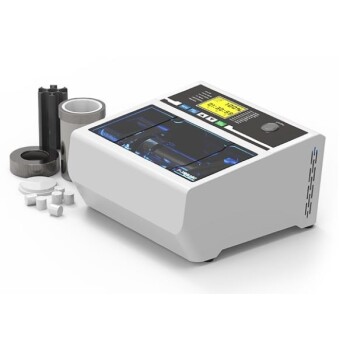
Jet milling operates by harnessing high-velocity gas streams, such as compressed air or nitrogen, to accelerate biomass particles inside a specialized chamber. Instead of crushing the material against a surface, the equipment forces the particles to collide with one another at high speeds, fracturing them into ultrafine powders.
Core Takeaway Jet milling achieves size reduction through particle-to-particle collisions rather than mechanical grinding media, eliminating the risk of metal contamination. This method is uniquely capable of producing high-purity biomass powders at the micron level (approximately 20 μm) without using moving parts in the grinding zone.
The Mechanics of Fluid Energy Grinding
The Role of High-Velocity Gas
The core driver of a jet mill is not an electric motor turning a blade, but the kinetic energy of a gas. Compressed air or nitrogen is injected into the grinding chamber at extremely high velocities.
This gas stream creates a turbulent vortex that entrains the biomass feed. The use of nitrogen is particularly noted, which can be beneficial for inert processing.
Particle-to-Particle Collisions
Once the biomass is airborne, the turbulence causes the particles to impact each other with significant force. This is the defining characteristic of jet milling: the material grinds itself.
Because the reduction occurs in mid-air through mutual impact, the biomass does not suffer from the friction and wear associated with traditional mechanical mills.
Achieving Ultrafine Particle Sizes
The collision intensity is sufficient to pulverize biomass down to the micron scale. The process consistently produces ultrafine powders with an average particle size of approximately 20 μm.
This level of fineness is often required for high-value downstream applications where surface area and reactivity are critical.
Advantages for Biomass Processing
Elimination of Contamination
Traditional mills use grinding media like steel balls or ceramic beads. Over time, these media wear down, leaving microscopic impurities in the final product.
Jet mills operate with no grinding media, ensuring that the produced powder remains pure. This is essential when the biomass is intended for pharmaceutical, food, or high-purity chemical applications.
Simplified Mechanical Design
As noted in laboratory setups, these mills often have no moving parts within the grinding chamber itself.
This lack of mechanical components reduces the complexity of the machine and eliminates distinct failure points common in high-wear mechanical grinders.
Understanding the Trade-offs
Energy Requirements
While jet mills offer superior purity, generating the necessary high-velocity gas streams requires significant energy input. The cost of compressing air or nitrogen can be higher than the electricity required to run a standard mechanical rotor.
Specificity of Application
This technology is specialized for creating ultrafine powders.
If your project only requires coarse grinding or simple shredding, the precision of a jet mill may be excessive for the application, representing an unnecessary operational cost.
Making the Right Choice for Your Goal
When deciding if jet milling is the correct solution for your biomass processing needs, consider your specific constraints:
- If your primary focus is product purity: Jet milling is the superior choice because it eliminates grinding media, preventing metal impurity contamination.
- If your primary focus is particle size: Choose this method to reliably achieve ultrafine powders in the 20 μm range.
- If your primary focus is equipment longevity: The absence of moving parts in the grinding chamber reduces mechanical wear and maintenance needs.
Jet milling represents the optimal balance of purity and precision for projects demanding high-quality, ultrafine biomass powders.
Summary Table:
| Feature | Jet Milling Mechanism | Benefit for Biomass |
|---|---|---|
| Energy Source | High-velocity compressed gas (Air/N2) | No heat generation or mechanical wear |
| Reduction Method | Particle-to-particle collisions | Eliminates metal/media contamination |
| Particle Size | Consistent ~20 μm output | Ideal for high-reactivity applications |
| Moving Parts | None in the grinding chamber | Lower maintenance and higher durability |
| Atmosphere | Inert gas options (e.g., Nitrogen) | Safe processing for sensitive materials |
Elevate Your Biomass Processing with KINTEK
Precision is non-negotiable when your research or production demands high-purity, ultrafine powders. KINTEK specializes in advanced laboratory equipment and consumables, offering specialized crushing and milling systems designed to deliver superior particle size control without contamination.
Whether you are refining biomass, developing battery materials, or requiring high-pressure reactors and hydraulic presses, our comprehensive portfolio—including high-temperature furnaces, ceramics, and PTFE consumables—is engineered to meet the rigorous standards of modern labs.
Ready to optimize your milling efficiency? Contact our technical experts today to find the perfect equipment for your specific application.
References
- Martin J. Taylor, Vasiliki Skoulou. Choosing Physical, Physicochemical and Chemical Methods of Pre-Treating Lignocellulosic Wastes to Repurpose into Solid Fuels. DOI: 10.3390/su11133604
This article is also based on technical information from Kintek Solution Knowledge Base .
Related Products
- High Energy Vibratory Laboratory Ball Mill Double Tank Type
- High Energy Planetary Ball Mill Machine for Laboratory Horizontal Tank Type
- High Energy Planetary Ball Mill Milling Machine for Laboratory
- Hybrid High Energy Vibratory Ball Mill for Lab Use
- Laboratory Horizontal Planetary Ball Mill Milling Machine
People Also Ask
- What is the function of a laboratory ball mill in the preparation of AMMCs? Optimize Dispersion & Grain Refinement
- What is the primary function of a laboratory ball mill in the modification of sulfide-based solid electrolytes with LiPO2F2?
- What is the function of a laboratory ball mill in the pretreatment of waste tire char (WTC)? Optimize Material Reactivity
- How do laboratory ball mills facilitate the mechanochemical synthesis of ZIF-8? Solvent-Free Synthesis Explained
- What is the primary function of a laboratory ball mill in Rice Husk Ash (RHA) modification? Achieve Peak Densification