Knowledge atmosphere furnace How does the chemical reduction of silica during hydrogen sintering affect the furnace's refractory materials? Ensure Longevity with the Right Lining
Author avatar

Tech Team · Kintek Solution

Updated 2 months ago

How does the chemical reduction of silica during hydrogen sintering affect the furnace's refractory materials? Ensure Longevity with the Right Lining


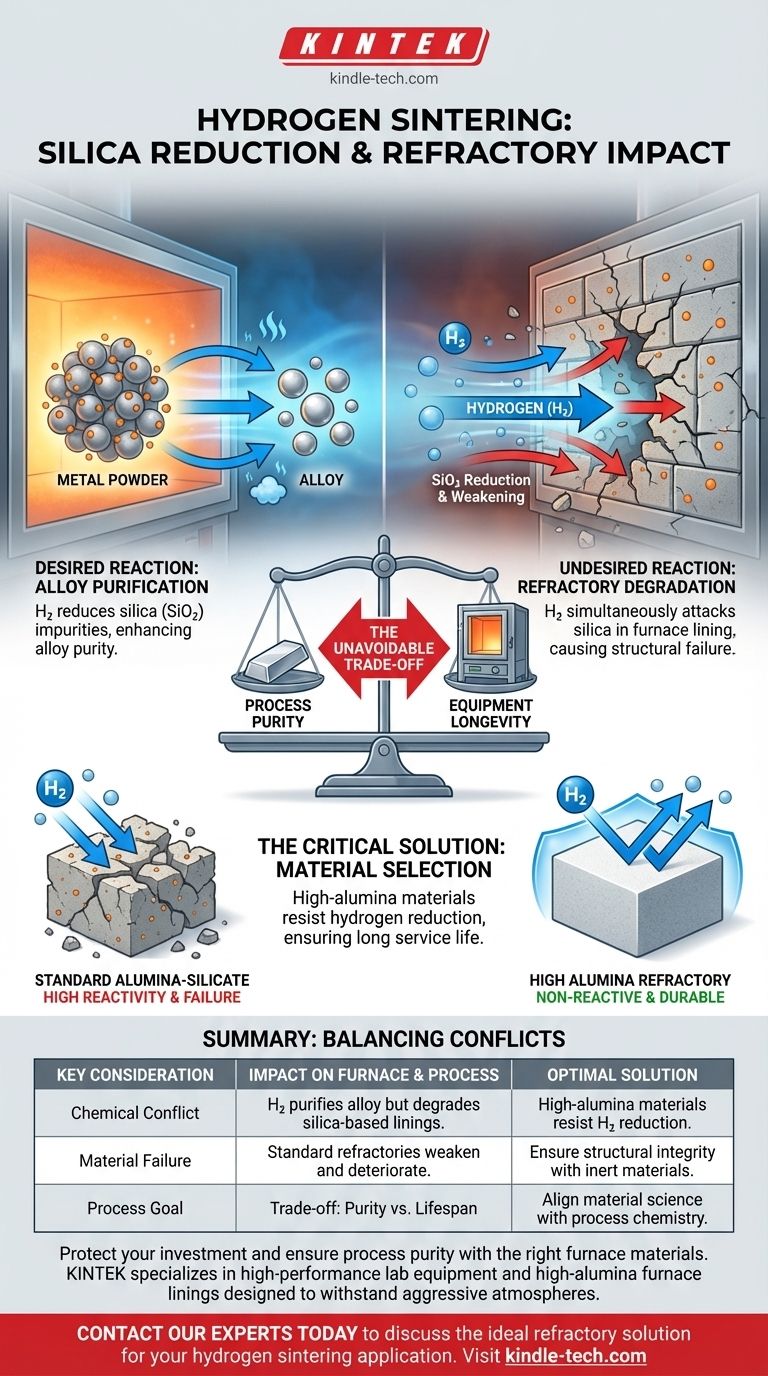
The chemical reduction of silica during hydrogen sintering directly causes the degradation of a furnace's refractory materials. While this chemical reaction is intentionally used to purify the sintered alloy by removing silica impurities, it unintentionally attacks and weakens the furnace lining if it also contains silica-based compounds.

The core issue is a chemical conflict: the same hydrogen atmosphere that purifies the product can simultaneously consume the furnace itself. This makes the selection of a non-reactive refractory material the most critical factor for ensuring furnace longevity and operational stability.
How does the chemical reduction of silica during hydrogen sintering affect the furnace's refractory materials? Ensure Longevity with the Right Lining

The Underlying Chemical Conflict

To operate a hydrogen sintering furnace effectively, it's essential to understand the two competing reactions happening at high temperatures. One is beneficial for your product, while the other is detrimental to your equipment.

The Desired Reaction: Purifying the Alloy

The primary goal of using a hydrogen atmosphere is often purification. Hydrogen acts as a reducing agent, reacting with oxides like silica (silicon dioxide) present in the metal powder. This reaction removes the oxygen, leaving behind a purer final alloy.

The Undesired Reaction: Degrading the Refractory

The problem arises because the hydrogen atmosphere cannot distinguish between the silica in your product and the silica compounds that may be part of the furnace's refractory lining. The same chemical reduction process that purifies the alloy will attack the structural integrity of the furnace walls, causing them to degrade over time.

Understanding the Trade-offs

This dynamic creates an unavoidable trade-off between process optimization and equipment lifespan. The key is to manage this balance through intelligent material selection.

Process Purity vs. Equipment Longevity

Aggressive sintering conditions, such as higher temperatures or specific hydrogen concentrations designed to maximize silica reduction in the alloy, will inevitably accelerate the degradation of an unsuitable refractory. You gain product purity at the direct cost of your furnace's structural health.

The Critical Role of Material Selection

This conflict makes the choice of refractory material a critical design element, not an afterthought. The material must be fundamentally non-reactive to the hydrogen atmosphere under operational conditions to avoid this degradation cycle entirely.

Selecting the Right Refractory Material

The solution lies in choosing a refractory composition that is inherently stable in a high-temperature hydrogen environment.

Why Common Refractories Can Fail

Many conventional refractory bricks and linings are alumina-silicates, which, as the name implies, contain silica. These materials are highly susceptible to chemical attack and degradation during hydrogen sintering.

The Primary Requirement: Non-Reactivity

The single most important quality for a refractory in this application is its chemical inertness. It must resist reduction by pure or mixed hydrogen atmospheres at the intended sintering temperatures to provide a long service life.

Recommended Materials: High Alumina

For this reason, high alumina or specialized alumina-silicate formulations with very high alumina content are the industry standard. Alumina (aluminum oxide) is significantly more stable and less reactive in hydrogen atmospheres than silica, making it the ideal choice for furnace construction.

Making the Right Choice for Your Furnace

Your operational goals directly inform your material requirements.

  • If your primary focus is maximizing product purity: You must invest in high-alumina refractory materials, as standard silica-bearing options will fail quickly under the aggressive conditions required.
  • If your primary focus is extending furnace lifespan: The selection of a high-grade, non-reactive refractory is paramount. This ensures the furnace structure remains stable and inert regardless of the sintering process.

Ultimately, aligning your furnace's material science with your process chemistry is the key to achieving both product quality and operational reliability.

Summary Table:

Key Consideration Impact on Furnace & Process
Chemical Conflict Hydrogen purifies the alloy but degrades silica-based refractory linings.
Material Failure Standard alumina-silicate refractories weaken and deteriorate over time.
Optimal Solution High-alumina refractory materials resist hydrogen reduction, ensuring longevity.

Protect your investment and ensure process purity with the right furnace materials.

The chemical conflict in hydrogen sintering demands a refractory solution engineered for stability. KINTEK specializes in high-performance lab equipment and consumables, including furnace linings designed to withstand aggressive atmospheres. Our expertise in high-alumina materials ensures your furnace maintains structural integrity, allowing you to focus on achieving superior product quality without compromising equipment lifespan.

Contact our experts today to discuss the ideal refractory solution for your hydrogen sintering application.

Visual Guide
How does the chemical reduction of silica during hydrogen sintering affect the furnace's refractory materials? Ensure Longevity with the Right Lining Visual Guide

Related Products

People Also Ask

Related Products

Controlled Nitrogen Inert Hydrogen Atmosphere Furnace

Controlled Nitrogen Inert Hydrogen Atmosphere Furnace

KT-AH Hydrogen atmosphere furnace - induction gas furnace for sintering/annealing with built-in safety features, dual housing design, and energy-saving efficiency. Ideal for lab and industrial use.

High Temperature Muffle Oven Furnace for Laboratory Debinding and Pre Sintering

High Temperature Muffle Oven Furnace for Laboratory Debinding and Pre Sintering

KT-MD High temperature debinding and pre-sintering furnace for ceramic materials with various molding processes. Ideal for electronic components such as MLCC and NFC.

600T Vacuum Induction Hot Press Furnace for Heat Treat and Sintering

600T Vacuum Induction Hot Press Furnace for Heat Treat and Sintering

Discover the 600T Vacuum Induction Hot Press Furnace, designed for high-temperature sintering experiments in vacuum or protected atmospheres. Its precise temperature and pressure control, adjustable working pressure, and advanced safety features make it ideal for nonmetal materials, carbon composites, ceramics, and metal powders.

Vacuum Heat Treat and Molybdenum Wire Sintering Furnace for Vacuum Sintering

Vacuum Heat Treat and Molybdenum Wire Sintering Furnace for Vacuum Sintering

A vacuum molybdenum wire sintering furnace is a vertical or bedroom structure, which is suitable for withdrawal, brazing, sintering and degassing of metal materials under high vacuum and high temperature conditions. It is also suitable for dehydroxylation treatment of quartz materials.

Ultra-High Temperature Graphite Vacuum Graphitization Furnace

Ultra-High Temperature Graphite Vacuum Graphitization Furnace

The ultra-high temperature graphitization furnace utilizes medium frequency induction heating in a vacuum or inert gas environment. The induction coil generates an alternating magnetic field, inducing eddy currents in the graphite crucible, which heats up and radiates heat to the workpiece, bringing it to the desired temperature. This furnace is primarily used for graphitization and sintering of carbon materials, carbon fiber materials, and other composite materials.

Spark Plasma Sintering Furnace SPS Furnace

Spark Plasma Sintering Furnace SPS Furnace

Discover the benefits of Spark Plasma Sintering Furnaces for rapid, low-temperature material preparation. Uniform heating, low cost & eco-friendly.

Vacuum Heat Treat and Sintering Furnace with 9MPa Air Pressure

Vacuum Heat Treat and Sintering Furnace with 9MPa Air Pressure

The air pressure sintering furnace is a high-tech equipment commonly used for the sintering of advanced ceramic materials. It combines vacuum sintering and pressure sintering techniques to achieve high-density and high-strength ceramics.

Vacuum Heat Treat and Pressure Sintering Furnace for High Temperature Applications

Vacuum Heat Treat and Pressure Sintering Furnace for High Temperature Applications

Vacuum pressure sintering furnaces are designed for high temperature hot pressing applications in metal and ceramic sintering. Its advanced features ensure precise temperature control, reliable pressure maintenance, and a robust design for seamless operation.

Vacuum Dental Porcelain Sintering Furnace

Vacuum Dental Porcelain Sintering Furnace

Get precise and reliable results with KinTek's Vacuum Porcelain Furnace. Suitable for all porcelain powders, it features hyperbolic ceramic furnace function, voice prompt, and automatic temperature calibration.

Small Vacuum Heat Treat and Tungsten Wire Sintering Furnace

Small Vacuum Heat Treat and Tungsten Wire Sintering Furnace

The small vacuum tungsten wire sintering furnace is a compact experimental vacuum furnace specially designed for universities and scientific research institutes. The furnace features a CNC welded shell and vacuum piping to ensure leak-free operation. Quick-connect electrical connections facilitate relocation and debugging, and the standard electrical control cabinet is safe and convenient to operate.

Mesh belt controlled atmosphere furnace

Mesh belt controlled atmosphere furnace

Discover our KT-MB mesh belt sintering furnace - perfect for high-temperature sintering of electronic components & glass insulators. Available for open air or controlled atmosphere environments.

2200 ℃ Tungsten Vacuum Heat Treat and Sintering Furnace

2200 ℃ Tungsten Vacuum Heat Treat and Sintering Furnace

Experience the ultimate refractory metal furnace with our Tungsten vacuum furnace. Capable of reaching 2200℃, perfect for sintering advanced ceramics and refractory metals. Order now for high-quality results.

Dental Porcelain Zirconia Sintering Ceramic Furnace Chairside with Transformer

Dental Porcelain Zirconia Sintering Ceramic Furnace Chairside with Transformer

Experience top-notch sintering with Chairside Sintering Furnace with Transformer. Easy to operate, noise-free pallet, and automatic temperature calibration. Order now!

Dental Porcelain Zirconia Sintering Ceramic Vacuum Press Furnace

Dental Porcelain Zirconia Sintering Ceramic Vacuum Press Furnace

Get precise dental results with Dental Vacuum Press Furnace. Automatic temperature calibration, low noise tray, and touch screen operation. Order now!

2200 ℃ Graphite Vacuum Heat Treat Furnace

2200 ℃ Graphite Vacuum Heat Treat Furnace

Discover the power of the KT-VG Graphite Vacuum Furnace - with a maximum working temperature of 2200℃, it's perfect for vacuum sintering of various materials. Learn more now.

Vacuum Heat Treat Furnace with Ceramic Fiber Liner

Vacuum Heat Treat Furnace with Ceramic Fiber Liner

Vacuum furnace with polycrystalline ceramic fiber insulation liner for excellent heat insulation and uniform temperature field. Choose from 1200℃ or 1700℃ max. working temperature with high vacuum performance and precise temperature control.

Vertical High Temperature Graphite Vacuum Graphitization Furnace

Vertical High Temperature Graphite Vacuum Graphitization Furnace

Vertical high temperature graphitization furnace for carbonization and graphitization of carbon materials up to 3100℃.Suitable for shaped graphitization of carbon fiber filaments and other materials sintered in a carbon environment.Applications in metallurgy, electronics, and aerospace for producing high-quality graphite products like electrodes and crucibles.

Graphite Vacuum Furnace High Thermal Conductivity Film Graphitization Furnace

Graphite Vacuum Furnace High Thermal Conductivity Film Graphitization Furnace

The high thermal conductivity film graphitization furnace has uniform temperature, low energy consumption and can operate continuously.

Horizontal High Temperature Graphite Vacuum Graphitization Furnace

Horizontal High Temperature Graphite Vacuum Graphitization Furnace

Horizontal Graphitization Furnace: This type of furnace is designed with the heating elements placed horizontally, allowing for uniform heating of the sample. It's well-suited for graphitizing large or bulky samples that require precise temperature control and uniformity.

Graphite Vacuum Furnace Bottom Discharge Graphitization Furnace for Carbon Materials

Graphite Vacuum Furnace Bottom Discharge Graphitization Furnace for Carbon Materials

Bottom-out graphitization furnace for carbon materials, ultra-high temperature furnace up to 3100°C, suitable for graphitization and sintering of carbon rods and carbon blocks. Vertical design, bottom discharging, convenient feeding and discharging, high temperature uniformity, low energy consumption, good stability, hydraulic lifting system, convenient loading and unloading.


Leave Your Message