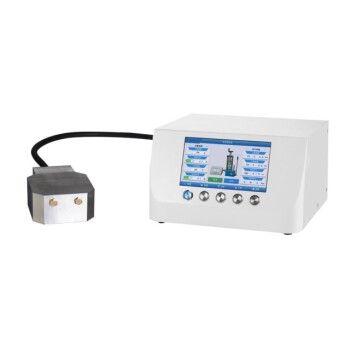
The dual electric heater design in laboratory-scale batch reactors utilizes independent heating elements positioned on both the external cylindrical wall and the bottom of the vessel. This configuration allows for independent current adjustment at different locations, creating the precise zonal control necessary to establish a uniform temperature field throughout the reactor.
By effectively managing heat distribution, this design eliminates thermal gradients to simulate the thermodynamic environment of industrial-scale generators and ensures exact control over the final pyrolysis temperature.
Achieving Thermal Homogeneity
Independent Zonal Control
The core innovation of this design is the ability to decouple the heating of the reactor's sides from its bottom.
By adjusting the electrical current independently for the cylindrical wall and the base, operators can fine-tune heat input based on the specific geometry and thermal needs of the feedstock.
Creating a Uniform Field
In single-source heating systems, temperature gradients often form, leading to uneven reaction rates within the batch.
The dual-heater configuration counteracts this by supplying heat from multiple vectors. This ensures that the entire reactor volume maintains a uniform temperature field, which is critical for consistent experimental data.
Simulating Real-World Conditions
Bridging the Scale Gap
Laboratory experiments are often criticized for failing to represent the complexities of large-scale operations.
This dual-heater setup is specifically engineered to effectively simulate the thermodynamic environment of industrial-scale generators. It allows researchers to observe heat transfer behaviors that are relevant to commercial applications.
Precise Process Control
Pyrolysis is highly sensitive to the maximum temperature reached during the reaction.
The independent control loops allow for the exact control of the final pyrolysis temperature. This precision ensures that the resulting bio-oils, chars, or gases are produced under strictly defined thermal conditions.
Understanding the Constraints
Operational Complexity
While dual heaters offer superior control, they introduce higher complexity compared to single-element systems.
Operators must manage two distinct control loops. This requires careful monitoring to ensure the "independent adjustment" mentioned in the reference does not accidentally create the very thermal gradients you are trying to avoid.
Calibration Dependencies
To achieve the promised uniform temperature field, both heaters must be perfectly calibrated relative to one another.
If the bottom heater is aggressive while the wall heater lags, the system fails to simulate the industrial environment accurately. The efficacy of the design relies entirely on the synchronization of these two independent variables.
Optimizing Your Experimental Setup
To maximize the utility of a dual-heater batch reactor, align your operation strategy with your specific research goals:
- If your primary focus is Industrial Upscaling: Focus on programming the heaters to mimic the specific heat transfer rates expected in your target commercial generator.
- If your primary focus is Reaction Kinetics: Prioritize the uniformity of the temperature field to ensure every particle of feedstock undergoes pyrolysis at the exact same temperature.
By mastering the independent control of these heating zones, you transform your reactor from a simple heating vessel into a high-fidelity simulator of complex thermodynamic processes.
Summary Table:
| Feature | Single Heater Design | Dual Heater Design |
|---|---|---|
| Heat Distribution | Single vector, prone to gradients | Multiple vectors (wall & bottom) |
| Temperature Control | Uniform adjustment only | Independent zonal control |
| Thermal Field | Potential cold spots | High homogeneity |
| Industrial Simulation | Limited scaling accuracy | High-fidelity thermodynamic simulation |
| Process Precision | Approximate final temperature | Exact control of pyrolysis temperature |
Enhance Your Pyrolysis Research with KINTEK Precision
Achieving consistent results in pyrolysis requires absolute thermal control. KINTEK specializes in advanced laboratory equipment, including high-performance high-temperature high-pressure reactors and autoclaves designed to simulate complex industrial environments with precision.
Whether you are focusing on industrial upscaling or reaction kinetics, our comprehensive range of heating solutions—from muffle and vacuum furnaces to specialized reactors—ensures your lab is equipped for success.
Ready to optimize your experimental setup? Contact us today to find the perfect reactor for your research and experience the KINTEK advantage in laboratory excellence.
References
- J. Chojnacki, Václav Peer. Batch Pyrolysis and Co-Pyrolysis of Beet Pulp and Wheat Straw. DOI: 10.3390/ma15031230
This article is also based on technical information from Kintek Solution Knowledge Base .
Related Products
- Mini SS High Pressure Autoclave Reactor for Laboratory Use
- Customizable Laboratory High Temperature High Pressure Reactors for Diverse Scientific Applications
- High Pressure Laboratory Autoclave Reactor for Hydrothermal Synthesis
- Stainless High Pressure Autoclave Reactor Laboratory Pressure Reactor
- Customizable High Pressure Reactors for Advanced Scientific and Industrial Applications
People Also Ask
- Why use high-pressure reactors for molecular sieve synthesis? Unlock Superior Crystallinity and Framework Control
- Why are high-pressure reactors or autoclaves necessary for the synthesis of new functional materials? Unlock Precision.
- What are the advantages of using a high-pressure reactor like an autoclave? Maximize Liquefaction Speed & Yield
- What is the function of a high-pressure reactor autoclave? Enhancing Cu/N Co-Doped Carbon Catalyst Synthesis
- How are high-pressure reactors used to prepare metaphosphate electrocatalysts? Master In-Situ Precursor Growth