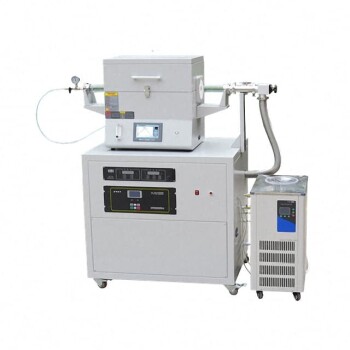
The heating system performs a vital chemical preparation function by raising the reaction environment to 300 °C prior to the actual growth of graphene. This precise thermal pretreatment is necessary to thoroughly decompose nitrate compounds on the stainless steel mesh, effectively converting precursors into the active metallic catalytic centers required for synthesis.
The success of graphene synthesis relies on the purity of the catalyst surface. The heating system prevents structural defects by thermally stripping impurities and activating the metal substrate before the high-temperature growth phase begins.
The Chemistry of Thermal Pretreatment
The primary function of the heating system during the pretreatment phase is not merely to increase temperature, but to facilitate a specific chemical transformation.
Nitrate Decomposition
The system targets a stable temperature of 300 °C.
At this specific thermal threshold, nitrate compounds loaded on the stainless steel mesh become unstable. The heat forces these compounds to decompose, effectively removing them from the substrate.
Creation of Active Centers
Once the nitrates are removed, the remaining precursors transform into active metallic catalytic centers.
These pure metal surfaces are the essential foundation for the process. They allow carbon atoms to successfully nucleate (attach and grow) during the subsequent high-temperature phase, which occurs between 950 °C and 1050 °C.
Achieving Thermal Uniformity
To ensure the catalyst is activated evenly across the entire substrate, the heating system relies on specific design mechanics.
Efficient Combustion
The furnace utilizes a pilot burner fueled by propane gas.
Selected for its economic efficiency and availability, this burner is ignited via a push-button mechanism. It is noted for higher efficiency compared to standard burner configurations.
Strategic Positioning
The burner is positioned at the bottom of the combustion chamber.
This placement is critical for the pretreatment process. It ensures uniform heating of the metal inside the crucible, preventing cold spots where nitrate compounds might fail to decompose.
Safety and Monitoring
A dedicated temperature sensor continuously monitors the thermal environment.
If the heat exceeds specific safety limits, the system automatically cuts off the gas input. This protects both the equipment and the integrity of the catalyst during the sensitive pretreatment phase.
Understanding the Trade-offs
While the heating system is effective, it is important to recognize potential operational risks associated with thermal pretreatment.
Incomplete Activation
If the system fails to maintain the 300 °C threshold uniformly, nitrate decomposition may be incomplete.
Residual nitrates act as contaminants. This blocks the active metallic centers, preventing proper carbon nucleation and leading to patchy or low-quality graphene coverage.
Thermal Lag and Overshoot
Combustion-based systems (using propane) can sometimes exhibit less precise temperature control than electric systems.
Reliance on a pilot burner requires careful monitoring of the temperature sensor. Significant overshooting of the temperature could prematurely age the catalyst or alter the stainless steel microstructure before growth begins.
Making the Right Choice for Your Goal
The heating system is the gatekeeper of catalyst quality. Your operational approach should depend on your specific synthesis priorities.
- If your primary focus is Graphene Quality: Verify that the system holds at 300 °C long enough to ensure 100% nitrate decomposition before ramping up to growth temperatures.
- If your primary focus is Process Consistency: Regularly calibrate the temperature sensor and inspect the pilot burner positioning to guarantee the uniform heating required for repeatable results.
By strictly controlling the 300 °C pretreatment phase, you turn a standard stainless steel mesh into a highly receptive platform for carbon synthesis.
Summary Table:
| Process Phase | Temperature Goal | Primary Function | Key Outcome |
|---|---|---|---|
| Thermal Pretreatment | 300 °C | Nitrate Decomposition | Formation of active metallic catalytic centers |
| Synthesis Phase | 950 °C – 1050 °C | Carbon Nucleation | Growth of graphene layers on substrate |
| Uniform Heating | Continuous | Bottom-positioned Pilot Burner | Prevention of cold spots and incomplete activation |
| Safety Monitoring | Real-time | Sensor-controlled Gas Cut-off | Protection of catalyst integrity and equipment |
Elevate Your Material Research with KINTEK Precision
High-quality graphene synthesis demands absolute thermal control. KINTEK specializes in advanced laboratory solutions designed to master the complexities of chemical vapor deposition. Our high-performance CVD and PECVD furnaces provide the precise temperature uniformity required for critical nitrate decomposition and catalyst activation.
Beyond synthesis, we offer a comprehensive portfolio including:
- High-temperature furnaces (tube, muffle, vacuum, and atmosphere).
- Crushing, milling, and sieving equipment for precursor preparation.
- Hydraulic presses (pellet, hot, isostatic) and high-pressure reactors.
- Battery research tools, electrolytic cells, and essential consumables like PTFE and ceramics.
Don't let thermal instability compromise your results. Contact our technical experts today to find the perfect equipment for your stainless steel substrate applications.
Contact KINTEK for a Consultation
References
- Ferial Ghaemi, Robiah Yunus. Synthesis of Different Layers of Graphene on Stainless Steel Using the CVD Method. DOI: 10.1186/s11671-016-1709-x
This article is also based on technical information from Kintek Solution Knowledge Base .
Related Products
- Customer Made Versatile CVD Tube Furnace Chemical Vapor Deposition Chamber System Equipment
- Multi Heating Zones CVD Tube Furnace Machine Chemical Vapor Deposition Chamber System Equipment
- Split Chamber CVD Tube Furnace with Vacuum Station Chemical Vapor Deposition System Equipment Machine
- Horizontal High Temperature Graphite Vacuum Graphitization Furnace
- Vertical High Temperature Graphite Vacuum Graphitization Furnace
People Also Ask
- What is a CVD tube furnace? A Complete Guide to Thin-Film Deposition
- What is the function of a high-temperature CVD tube furnace in 3D graphene foam prep? Master 3D Nanomaterial Growth
- What are the technical advantages of using a CVD tube furnace? Optimize Silicon-Carbon Battery Anodes
- How does a CVD tube furnace inhibit the sintering of silver supports? Boost Membrane Durability and Performance
- What is the function of a tube furnace in CVD SiC synthesis? Achieving Ultra-Pure Silicon Carbide Powders