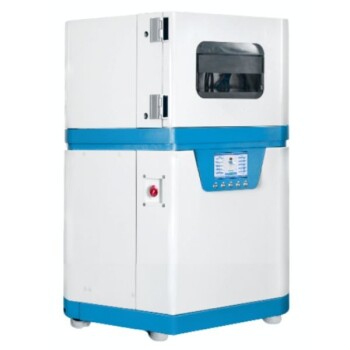
Precise heating rate control acts as the governor of microstructural evolution in copper/graphene composites. By adhering to a specific ramp rate, such as 10 °C/min, you ensure the material heats steadily before reaching the final sintering temperature (typically 600°C to 800°C). This regulated approach prevents thermal shock, inhibits abnormal grain coarsening, and protects the delicate graphene structure from degradation, directly optimizing the composite's electrical conductivity.
Core Takeaway The stability provided by precise heating rate control is the deciding factor between a uniform, high-conductivity composite and a defective one. It balances densification kinetics against grain growth, ensuring the graphene reinforcement remains intact and evenly distributed within the copper matrix.
The Mechanics of Microstructural Control
Regulating Grain Growth and Densification
The heating rate is the primary variable controlling the kinetics of the sintering process. A controlled rate, rather than rapid or erratic heating, dictates how copper grains grow and how the material densifies.
Precise control prevents abnormal grain coarsening. If the temperature spikes or rises too quickly, copper grains can grow disproportionately large, which isolates the graphene and weakens the material's properties. Steady heating ensures uniform grain size distribution.
Preserving Graphene Structural Integrity
Graphene is thermally stable but sensitive to processing conditions when embedded in a metal matrix. Excessive heating speeds or temperature fluctuations can physically damage or structurally alter the graphene lattice.
Maintaining the graphene structure is essential for conductivity. If the heating rate is too aggressive, the graphene may degrade or agglomerate. Precise thermal control preserves the graphene network, allowing it to function effectively as a conductive reinforcement.
Initiating Atomic Diffusion
During the early stages of sintering, the programmed heat input drives atomic thermal vibrations and surface diffusion. This is a thermodynamic prerequisite for densification.
This controlled energy input transitions particles from point contact to area contact. It induces the generation of Shockley partial dislocations and forms the initial "necks" between copper particles, setting the stage for a fully dense material.
The Role of Environment and Stability
Preventing Thermal Stress
Rapid temperature changes introduce significant thermal gradients within the composite. Because copper and graphene have different coefficients of thermal expansion, these gradients cause internal stress.
Steady heating minimizes thermal stress. By raising the temperature gradually and precisely, the furnace ensures the entire composite expands uniformly, preventing micro-cracking or delamination at the copper-graphene interface.
Synergy with Vacuum Protection
While the heating rate controls the kinetics, the vacuum environment is critical for chemical stability. At high sintering temperatures, both the copper matrix and the graphene filler are susceptible to oxidation.
The vacuum atmosphere prevents oxidation. This ensures that the precise heating profile acts on pure materials, promoting metallic bonding rather than the formation of insulating oxide layers that would ruin the composite's performance.
Understanding the Trade-offs
The Risk of Excessive Speed
Pushing for a faster cycle time by increasing the heating rate is a common temptation. However, this often leads to uncontrolled grain growth and thermal shock.
Rapid heating provides insufficient time for particle rearrangement and diffusion mechanisms to operate smoothly. This results in a microstructure with trapped pores and a degraded graphene network, ultimately lowering both mechanical strength and electrical conductivity.
The Necessity of "Soak" Stability
Reaching the target temperature is only half the battle; maintaining it without fluctuation is equally vital.
Fluctuations at the peak temperature can disrupt the equilibrium of interfacial reactions. Precise control ensures the energy provided promotes metallurgical bonding without triggering the formation of brittle phases or causing the decomposition of the reinforcement phase.
Making the Right Choice for Your Goal
To achieve specific material properties, tailor your furnace parameters based on your primary objective:
- If your primary focus is Electrical Conductivity: Prioritize a moderate, steady heating rate (e.g., 10 °C/min) to strictly prevent graphene degradation and abnormal grain growth.
- If your primary focus is Mechanical Density: Ensure the heating profile supports the formation of initial particle necks and includes a stable vacuum to prevent oxidation-induced brittleness.
Ultimate success lies in synchronizing the heating rate with the material's diffusion limits to achieve full densification without compromising the graphene reinforcement.
Summary Table:
| Parameter | Impact on Microstructure | Influence on Composite Performance |
|---|---|---|
| Controlled Heating (10°C/min) | Prevents abnormal grain coarsening | Ensures uniform grain size & high conductivity |
| Steady Thermal Ramp | Minimizes internal thermal stress | Prevents micro-cracking & interface delamination |
| Atomic Diffusion | Facilitates neck formation between particles | Promotes full densification & metallic bonding |
| Vacuum Environment | Eliminates oxidation of copper/graphene | Maintains purity & structural integrity of materials |
Elevate Your Material Research with KINTEK Precision
Achieving the perfect balance between densification and microstructural integrity requires world-class thermal control. KINTEK specializes in advanced laboratory equipment, including high-performance vacuum hot pressing furnaces, muffle furnaces, and CVD systems designed for sensitive material synthesis like copper/graphene composites.
From high-temperature high-pressure reactors to precision hydraulic presses and milling systems, our comprehensive portfolio empowers researchers to optimize every variable of their process. Let our expertise in cooling solutions, ceramics, and high-temperature furnaces drive your innovation.
Ready to achieve superior composite properties? Contact KINTEK today for a consultation!
Related Products
- Vacuum Hot Press Furnace Heated Vacuum Press Machine Tube Furnace
- 600T Vacuum Induction Hot Press Furnace for Heat Treat and Sintering
- Vacuum Hot Press Furnace Machine Heated Vacuum Press
- Vacuum Hot Press Furnace Machine for Lamination and Heating
- Vacuum Heat Treat and Pressure Sintering Furnace for High Temperature Applications
People Also Ask
- What advantages does a vacuum hot press furnace provide for LSLBO ceramic electrolytes? Achieve 94% Relative Density
- What role does a Vacuum Hot Press (VHP) furnace play in the densification of austenitic stainless steel 316 composites?
- What are the advantages of using a vacuum hot pressing furnace? Superior Densification for 2024Al/Gr/SiC Composites
- What are the advantages of a vacuum hot press furnace for LTPO solid electrolytes? Boost Density and Conductivity
- What core processing conditions does a vacuum hot press furnace provide? Achieve High-Density Cu-SiC/Diamond Composites