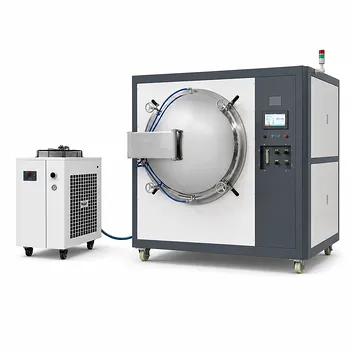
Precise temperature control acts as the critical governor determines the mechanical integrity of Ti-Al laminated composites. By maintaining a stable processing temperature, such as 550°C, the furnace provides sufficient energy to activate atomic diffusion for strong metallurgical bonding while simultaneously restricting the reaction rate. This prevents the formation of excessively thick, brittle intermetallic compounds like Al3Ti, ensuring the final composite retains ductility alongside high bonding strength.
Core Takeaway Temperature in vacuum hot pressing is not just a switch for bonding; it is a throttle for chemical reactivity. The primary goal of precise control is to maintain a "diffusion window" where atomic migration creates a dense bond, but the growth kinetics of brittle phases (like Al3Ti) are strictly arrested to prevent structural failure.
The Mechanism of Interfacial Control
Activation of Atomic Diffusion
The fundamental requirement for joining titanium and aluminum foils is bringing their atoms into close interaction.
High-precision temperature control ensures the system reaches the specific energy threshold required to mobilize atoms. This thermal energy drives solid-solid diffusion across the interface.
Without this sustained and stable heat, the atoms cannot overcome the activation energy barrier, leading to weak adhesion and potential delamination.
Throttling Intermetallic Growth
While diffusion is necessary, the chemical reaction between Titanium and Aluminum can be aggressive.
If the temperature fluctuates or spikes, the reaction rate accelerates, leading to the rapid growth of Al3Ti, a hard but extremely brittle intermetallic compound.
Precise control at a set point (e.g., 550°C) allows you to grow a thin reaction layer sufficient for bonding, but stops the process before this layer becomes thick enough to compromise the material's overall ductility.
Densification and Void Elimination
Temperature works in tandem with mechanical pressure to densify the material.
Steady heat softens the metal matrices, allowing the applied pressure to collapse microscopic voids and overcome surface roughness.
If the temperature drops below the target window, the material may remain too rigid to flow into these gaps, resulting in a porous, low-density interface.
Beyond the Hold Temperature: Thermal Cycling
Managing Heating Rates
The precision of the furnace applies to the ramp-up phase, not just the hold time.
Controlled heating rates (e.g., 10°C/min) prevent thermal shock and abnormal grain coarsening before the sintering temperature is even reached.
Stable heating ensures the microstructure evolves uniformly, preventing the buildup of internal stresses that could distort the delicate foil layers.
Controlled Cooling and Phase Transformation
The cooling phase is as critical as the heating phase for microstructural definition.
Programmable, slow furnace cooling allows for controlled phase transformations, such as the evolution of alpha phases into laminar structures.
This gradual reduction in temperature is essential for releasing residual thermal stresses generated during the pressing cycle, which prevents the composite from warping or cracking post-production.
Understanding the Trade-offs
The Risk of Overheating (Overshoot)
If temperature control fails and overshoots the target, the diffusion kinetics become exponential.
This results in a thick, continuous layer of Al3Ti. While the bond strength might appear high initially, this layer acts as a "glass" weak point that will shatter under stress, drastically reducing impact resistance and ductility.
The Risk of Underheating
Conversely, operating too cautiously below the target temperature preserves ductility but sacrifices integrity.
Insufficient heat results in incomplete diffusion. The interface remains distinct rather than integrated, leading to poor load transfer between layers and eventual separation (delamination) during use.
Making the Right Choice for Your Goal
To optimize your Ti-Al composite, you must tune your thermal profile to your specific performance requirements.
- If your primary focus is Maximum Ductility: Prioritize the lowest possible temperature that still achieves bonding to minimize the thickness of the brittle Al3Ti layer.
- If your primary focus is Bond Strength: Ensure the soak time and temperature are sufficient to fully eliminate interfacial voids, even if it results in a slightly thicker intermetallic zone.
- If your primary focus is Dimensional Stability: Utilize strict heating and cooling ramp rates to minimize residual stress and prevent warping of the laminated layers.
Success lies in finding the exact thermal equilibrium where the layers merge atomically without chemically consuming one another.
Summary Table:
| Parameter Control | Impact on Microstructure | Resulting Material Property |
|---|---|---|
| Stable Heating (550°C) | Activates atomic diffusion | Strong metallurgical bonding |
| Throttling Growth | Limits Al3Ti intermetallic thickness | Preserves ductility & prevents brittleness |
| Densification | Collapses microscopic voids | High-density, integrated interface |
| Controlled Cooling | Relieves residual thermal stress | Prevents warping and cracking |
| Ramp Rate (10°C/min) | Uniform grain evolution | Minimal internal stress & grain coarsening |
Elevate Your Advanced Material Research with KINTEK
Precise thermal management is the difference between a high-performance composite and a structural failure. KINTEK specializes in high-precision laboratory equipment, offering a comprehensive range of vacuum hot pressing furnaces, high-temperature furnaces, and isostatic presses designed to give you absolute control over your material's microstructure.
Whether you are developing Ti-Al laminates, battery components, or advanced ceramics, our solutions provide the thermal stability and mechanical precision your research demands.
Ready to optimize your sintering and bonding processes? Contact us today to find the perfect furnace for your lab!
Related Products
- Vacuum Hot Press Furnace Heated Vacuum Press Machine Tube Furnace
- 600T Vacuum Induction Hot Press Furnace for Heat Treat and Sintering
- Vacuum Hot Press Furnace Machine Heated Vacuum Press
- Vacuum Hot Press Furnace Machine for Lamination and Heating
- Vacuum Heat Treat and Pressure Sintering Furnace for High Temperature Applications
People Also Ask
- What advantages does a vacuum hot press furnace provide for LSLBO ceramic electrolytes? Achieve 94% Relative Density
- What role does a Vacuum Hot Press (VHP) furnace play in the densification of austenitic stainless steel 316 composites?
- What are the advantages of using a vacuum hot pressing furnace? Superior Densification for 2024Al/Gr/SiC Composites
- What are the advantages of a vacuum hot press furnace for LTPO solid electrolytes? Boost Density and Conductivity
- What core processing conditions does a vacuum hot press furnace provide? Achieve High-Density Cu-SiC/Diamond Composites