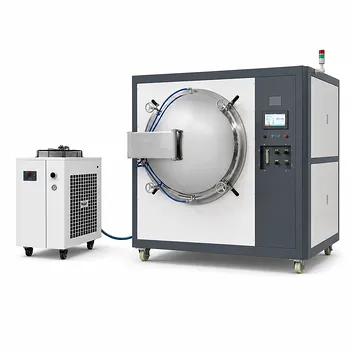
Pressure-assisted sintering in a vacuum hot press furnace significantly enhances the performance of Yttrium Aluminum Garnet (YAG) ceramics by applying axial mechanical pressure directly to the powder during heating. This external force drives particle rearrangement and plastic flow, allowing the material to reach near-perfect density at lower temperatures, which is critical for achieving optical transparency.
By applying mechanical pressure alongside heat, this process decouples densification from thermal growth. It allows the ceramic to achieve high density without the excessive grain enlargement that typically degrades optical quality, resulting in a superior, transparent material.
The Mechanism of Densification
Axial Mechanical Pressure
The vacuum hot press applies a specific axial force, such as 40 MPa, via a press head directly onto the powder inside a mold. This mechanical intervention acts as a catalyst for compaction that thermal energy alone cannot achieve efficiently.
Promoting Plastic Flow
Simultaneously heating the material to temperatures around 1500°C softens the particles. The applied pressure then forces these particles to undergo plastic flow, physically moving them to fill voids and eliminate porosity.
Particle Rearrangement
The combination of heat and pressure causes the powder particles to rearrange themselves tightly. This physical reorganization is much faster and more effective than the slow diffusion processes relied upon in pressureless sintering.
Impact on Optical and Microstructural Quality
Lowering Sintering Temperatures
Because mechanical pressure assists in closing pores, the process requires significantly less thermal energy to achieve full density. This effectively lowers the sintering temperature required for the ceramic to become solid.
Inhibiting Grain Growth
High temperatures and long dwell times typically cause grains to grow excessively large, which scatters light and reduces transparency. By sintering at lower temperatures, the vacuum hot press inhibits this unwanted grain growth.
Achieving Fine Grain Sizes
The result of this controlled process is a ceramic with fine grain sizes. A fine, uniform microstructure is essential for high-performance transparent ceramics as it minimizes optical defects.
Understanding the Trade-offs
Geometric Limitations
The reliance on a mold and a uniaxial press head generally restricts production to simple shapes. Complex, net-shape components are difficult to manufacture using this method compared to pressureless techniques.
Equipment Constraints
This process requires specialized vacuum environments and robust mechanical presses capable of withstanding high heat. This adds a layer of operational complexity compared to standard atmospheric furnaces.
Making the Right Choice for Your Goal
To maximize the benefits of vacuum hot pressing for YAG ceramics, consider your specific performance targets:
- If your primary focus is maximum transparency: Leverage the high pressure to eliminate residual pores, as achieving near-theoretical density is the single most important factor for light transmission.
- If your primary focus is microstructural control: Utilize the lower sintering temperatures to maintain fine grain sizes, ensuring the material retains both optical clarity and mechanical strength.
This method is the definitive choice when optical quality and high density cannot be compromised.
Summary Table:
| Feature | Pressureless Sintering | Vacuum Hot Press Sintering |
|---|---|---|
| Driving Force | Thermal energy only | Thermal energy + Axial mechanical pressure |
| Sintering Temp | Higher (promotes grain growth) | Lower (inhibits grain growth) |
| Densification | Slower diffusion process | Rapid particle rearrangement & plastic flow |
| Microstructure | Coarse grains, potential pores | Fine, uniform grain size; near-zero porosity |
| Optical Quality | Variable transparency | High optical transparency & density |
Elevate Your Advanced Material Research with KINTEK
Precision is non-negotiable when developing high-performance YAG transparent ceramics. KINTEK specializes in cutting-edge laboratory equipment, providing the high-temperature vacuum hot press furnaces and hydraulic presses essential for achieving near-theoretical density and superior optical quality.
Whether you are focusing on fine-grain microstructural control or maximum transparency, our comprehensive range—from crushing and milling systems to high-temperature furnaces and PTFE consumables—is designed to support every stage of your material science workflow.
Ready to optimize your sintering process? Contact our technical experts today to discover how KINTEK's precision tools can transform your research outcomes.
Related Products
- Vacuum Hot Press Furnace Heated Vacuum Press Machine Tube Furnace
- 600T Vacuum Induction Hot Press Furnace for Heat Treat and Sintering
- Vacuum Hot Press Furnace Machine Heated Vacuum Press
- Vacuum Hot Press Furnace Machine for Lamination and Heating
- Vacuum Heat Treat and Pressure Sintering Furnace for High Temperature Applications
People Also Ask
- What advantages does a vacuum hot press furnace provide for LSLBO ceramic electrolytes? Achieve 94% Relative Density
- What role does a Vacuum Hot Press (VHP) furnace play in the densification of austenitic stainless steel 316 composites?
- What are the advantages of using a vacuum hot pressing furnace? Superior Densification for 2024Al/Gr/SiC Composites
- What are the advantages of a vacuum hot press furnace for LTPO solid electrolytes? Boost Density and Conductivity
- What core processing conditions does a vacuum hot press furnace provide? Achieve High-Density Cu-SiC/Diamond Composites