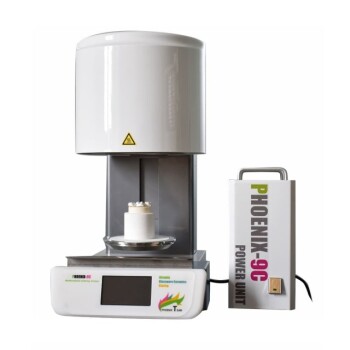
The sintering furnace serves as the critical structural hardening stage in the manufacturing of granular titanium dioxide photocatalysts. It is responsible for transforming fragile "green bodies"—compressed mixtures of powder and organic binders—into robust, distinct granules through a high-temperature treatment typically ranging from 600°C to 800°C.
Core Takeaway While the initial shaping process defines the form of the catalyst, the sintering furnace defines its durability and lifespan. By inducing diffusion bonding and binder reactions, the furnace creates a mechanically stable granule capable of withstanding the physical rigors of wastewater treatment without disintegrating.
Transforming Powder into Durable Granules
The primary function of the sintering furnace is to alter the physical state of the material, shifting it from a loose aggregate to a cohesive solid.
The Transition from Green Body to Solid State
Before entering the furnace, the material exists as a "green body." This is a formed but uncured shape made of titanium dioxide powder held together by organic binders.
At this stage, the structure is mechanically weak. It relies entirely on the temporary adhesion provided by the binders and lacks the structural integrity required for industrial application.
The Mechanism of Diffusion Bonding
Inside the furnace, the high thermal energy (600°C–800°C) activates a process called diffusion bonding.
Heat causes the atoms at the interface of adjacent titanium dioxide particles to vibrate and move. This movement allows the particles to fuse together at the atomic level, effectively welding them into a singular, cohesive granular unit.
Chemical Reactions in Organic Binders
Simultaneously, the heat triggers essential chemical reactions within the organic binders used to shape the green bodies.
Depending on the specific binder chemistry, these additives are either cured to reinforce the structure or burned off in a controlled manner, leaving behind a rigid ceramic skeleton.
Optimizing for Performance and Reuse
The sintering process is not just about making the particles stick together; it is about engineering a product that can survive harsh operating environments.
Achieving High Mechanical Strength
The diffusion bonding process results in granules with exceptional mechanical strength.
Unlike raw powder, which would disperse and wash away, or weak agglomerates that would crumble, sintered granules are resistant to breakage. This hardness is essential for preventing attrition (wear and tear) during handling and operation.
Enabling Repeated Wastewater Treatment
The ultimate goal of this mechanical reinforcement is to facilitate reuse.
In wastewater treatment applications, the photocatalyst must survive turbulent water flow, circulation, and rinsing. Sintered granules maintain their shape and integrity, allowing them to be recovered and reused over multiple cycles without significant mass loss.
Stabilization of Crystalline Phases
Beyond mechanical strength, the thermal treatment stabilizes the photoactive crystalline phase of the titanium dioxide.
While the primary focus of granular production is structural, maintaining the correct temperature profile ensures the material retains the anatase phase (highly active) rather than converting entirely to the less active rutile phase, which can happen if temperatures act uncontrolled.
Understanding the Trade-offs
While sintering is necessary for durability, it requires precise control to avoid compromising the catalyst's efficiency.
Balancing Strength vs. Surface Area
There is an inherent tension between mechanical strength and photocatalytic activity.
Higher sintering temperatures generally lead to stronger, denser granules (better durability). However, excessive heat can reduce the specific surface area and porosity of the material. Since photocatalysis occurs on the surface, a loss of surface area can reduce the chemical efficiency of the granule.
The Phase Transformation Risk
Operating at the higher end of the temperature spectrum increases the risk of unwanted phase transformation.
If the furnace exceeds the optimal range (pushing well beyond 600°C–700°C towards higher extremes), the titanium dioxide may transition from the desirable anatase phase to the rutile phase. While rutile is stable, it often exhibits lower photocatalytic activity for certain degradation tasks.
Making the Right Choice for Your Goal
When configuring the sintering process for granular titanium dioxide, the temperature profile must be dictated by your specific end-use requirements.
- If your primary focus is Durability and Reuse: Prioritize the higher end of the sintering range (near 800°C) to maximize diffusion bonding and impact resistance, ensuring the granules survive long-term mechanical stress in fixed-bed reactors.
- If your primary focus is Peak Chemical Activity: Target the lower to mid-range temperatures (approx. 600°C) to preserve the anatase crystalline phase and porosity, accepting slightly lower mechanical strength for faster reaction rates.
The sintering furnace acts as the bridge between a raw chemical powder and a viable industrial tool, turning potential activity into usable, durable performance.
Summary Table:
| Stage/Feature | Sintering Process Detail | Impact on Photocatalyst |
|---|---|---|
| Temperature Range | 600°C – 800°C | Determines balance between strength & activity |
| Material State | Green Body to Solid | Transforms fragile powder into robust granules |
| Core Mechanism | Diffusion Bonding | Fuses particles at atomic level for durability |
| Binder Action | Thermal Curing/Burn-off | Creates a rigid, stable ceramic skeleton |
| Key Outcome | Mechanical Strength | Enables reuse in turbulent wastewater cycles |
| Phase Control | Anatase Preservation | Ensures high photocatalytic chemical efficiency |
Optimize Your Photocatalyst Production with KINTEK
Precision temperature control is the difference between a high-performance catalyst and a failed batch. KINTEK specializes in advanced laboratory and industrial equipment, providing the high-temperature muffle, tube, and atmosphere furnaces essential for the precise sintering of titanium dioxide and other advanced ceramics.
Whether you are focusing on maximizing surface area for peak chemical activity or ensuring mechanical durability for wastewater reuse, our equipment offers the thermal stability and uniform heating required for repeatable results. Beyond thermal processing, we support your entire workflow with crushing and milling systems, pellet presses, and high-quality crucibles.
Ready to elevate your material research? Contact our technical experts today to find the perfect sintering solution for your laboratory or production line.
References
- Şahin Giray Atalı, Bilgehan Cem Turan. Granular titanium dioxide and silicon‐doped titanium dioxide as reusable photocatalysts for dye removal. DOI: 10.1111/ijac.14603
This article is also based on technical information from Kintek Solution Knowledge Base .
Related Products
- Spark Plasma Sintering Furnace SPS Furnace
- 600T Vacuum Induction Hot Press Furnace for Heat Treat and Sintering
- 2200 ℃ Tungsten Vacuum Heat Treat and Sintering Furnace
- High Temperature Muffle Oven Furnace for Laboratory Debinding and Pre Sintering
- Mesh belt controlled atmosphere furnace
People Also Ask
- What is SPS sintering method? A Guide to High-Speed, High-Performance Material Fabrication
- Why are Spark Plasma Sintering (SPS) furnaces or hot presses utilized in the preparation of Li3PS4 solid electrolytes?
- What is the difference between spark plasma sintering and flash sintering? A Guide to Advanced Sintering Methods
- What technical advantages does a Spark Plasma Sintering (SPS) furnace offer for LZP ceramics? Enhance Ionic Conductivity
- What is the theory of spark plasma sintering? A Guide to Rapid, Low-Temperature Densification