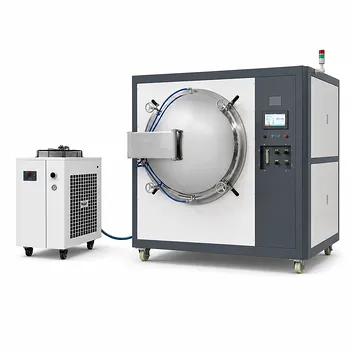
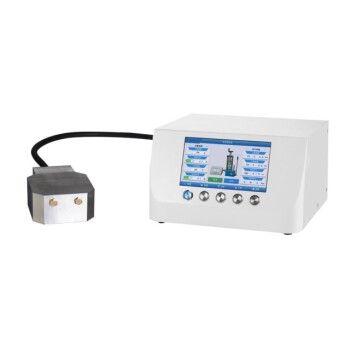
The precision of temperature control in a hot press furnace is the deciding factor in determining the final phase composition of iron-based amorphous alloy composites. It specifically regulates whether the matrix remains fully amorphous or transitions into a nanocrystalline state, while simultaneously dictating the thickness of the interfacial reaction layer to tune mechanical performance.
Precise thermal management acts as a toggle switch for the material's microstructure, enabling the selective precipitation of alpha-Fe and the controlled growth of intermetallic compounds to balance hardness with toughness.
Regulating the Matrix Phase
The Amorphous-Nanocrystalline Switch
The primary function of temperature precision is to distinguish between maintaining the amorphous state and inducing nanocrystallization.
Small deviations in temperature can drastically alter the material's atomic structure. For example, holding the temperature at 485°C keeps the matrix in its original amorphous condition.
Controlling Alpha-Fe Precipitation
By increasing the temperature slightly to 530°C, the precise control allows the material to cross a specific thermal threshold.
At this temperature, alpha-Fe (α-Fe) precipitates begin to form within the matrix. This capability allows engineers to introduce a nanocrystalline phase intentionally rather than accidentally.
Managing the Interfacial Layer
Formation of Intermetallic Compounds
Temperature precision governs the extent of diffusion bonding between particles. This heat drives the formation of the FeAl3 intermetallic compound layer at the interface.
This layer is critical for bonding the composite materials together. Without sufficient heat, the diffusion bonding is weak; with too much heat, the reaction accelerates uncontrollably.
Tuning Layer Thickness
The thickness of the FeAl3 layer is directly proportional to the thermal input.
Accurate temperature regulation ensures this layer does not become excessive. By controlling the thickness, you directly adjust the material's mechanical response, specifically the balance between hardness and toughness.
The Role of Heating Consistency
Ensuring Uniform Thermal History
Resistance heating elements provide the stability required to maintain a consistent heating rate (e.g., 10°C/min).
This uniformity prevents thermal shock and ensures that every part of the composite experiences the exact same thermal history. This is vital for achieving reliable properties across different production batches.
Avoiding Unintended Transitions
Because amorphous alloys have specific glass transition and crystallization temperatures, uneven heating can lead to mixed microstructures.
precise control eliminates excessive temperature gradients. This ensures the entire sample transitions (or resists transitioning) simultaneously.
Understanding the Trade-offs
The Hardness-Toughness Conflict
There is an inherent trade-off when adjusting temperature to alter microstructure.
Higher temperatures that promote nanocrystallization and thicker FeAl3 layers typically increase hardness. However, this often comes at the cost of reduced fracture toughness, making the material more brittle.
The Risk of Overheating
Exceeding the optimal temperature window leads to excessive growth of the brittle intermetallic layer.
While the bond might be strong, a thick FeAl3 layer can act as a stress concentrator. This compromises the overall integrity of the composite by introducing points of failure under stress.
Making the Right Choice for Your Goal
To optimize your iron-based amorphous alloy composites, you must align your furnace settings with your specific mechanical requirements.
- If your primary focus is Maximum Toughness: Target lower processing temperatures (around 485°C) to preserve the amorphous matrix and minimize the thickness of the brittle FeAl3 layer.
- If your primary focus is High Hardness: target higher processing temperatures (around 530°C) to induce the precipitation of alpha-Fe nanocrystals and promote a robust intermetallic interface.
Mastering temperature precision allows you to treat the furnace not just as a heater, but as a precision instrument for microstructural engineering.
Summary Table:
| Temperature Feature | Process Impact | Microstructural Result |
|---|---|---|
| 485°C (Precise) | Matrix Preservation | Fully amorphous structure; maximum toughness |
| 530°C (Precise) | Controlled Precipitation | Formation of alpha-Fe nanocrystals; high hardness |
| Interfacial Control | Diffusion Regulation | Optimized FeAl3 layer thickness for bond strength |
| Heating Consistency | Thermal Uniformity | Prevents brittle gradients and unintended phase shifts |
Precision is the difference between a brittle failure and a high-performance composite. KINTEK provides state-of-the-art laboratory equipment including hot presses, vacuum furnaces, and crushing systems designed for the rigorous demands of material science. Whether you are engineering iron-based amorphous alloys or advanced ceramics, our solutions offer the thermal stability required for exact microstructural regulation. Contact KINTEK today to equip your lab with the precision tools needed to master material performance.
Related Products
- 600T Vacuum Induction Hot Press Furnace for Heat Treat and Sintering
- Vacuum Hot Press Furnace Heated Vacuum Press Machine Tube Furnace
- Vacuum Hot Press Furnace Machine Heated Vacuum Press
- Vacuum Heat Treat and Pressure Sintering Furnace for High Temperature Applications
- Laboratory High Pressure Vacuum Tube Furnace
People Also Ask
- What role does an induction vacuum hot pressing furnace play in sintering? Achieve 98% Density in Carbide Blocks
- What advantages does a vacuum hot press furnace provide for LSLBO ceramic electrolytes? Achieve 94% Relative Density
- What role does a Vacuum Hot Press (VHP) furnace play in the densification of austenitic stainless steel 316 composites?
- What role does mechanical pressure play during the vacuum diffusion bonding of tungsten and copper? Keys to Solid Bonding
- What are the advantages of a vacuum hot press furnace for W-50%Cu? Achieve 99.6% Density at Lower Temperatures